Commercial cleaning is one of the most accessible businesses anyone can start in the service industry. Startup costs are low compared to most businesses, the demand is consistent and growing, and once you land recurring monthly contracts, the revenue becomes predictable. There’s a reason thousands of people launch cleaning companies every year.
But starting right makes all the difference. The cleaning businesses that grow quickly and stay profitable are the ones that put the right foundation in place from day one — the right legal structure, insurance, pricing model, and a clear plan for getting their first clients. The ones that struggle are usually the ones that skip steps and figure it out as problems arise.
This guide walks you through every step required to start a commercial cleaning business in 2026 — from making your first decisions before you spend a dollar, all the way to landing your first contract and building toward growth.
Why Commercial Cleaning — And Why 2026 Is a Good Time to Start
The U.S. commercial cleaning market generated over $91 billion in 2024 and is projected to keep growing steadily through the next decade. The demand isn’t seasonal and it isn’t slowing down — businesses, healthcare facilities, schools, and retail spaces all need consistent, professional cleaning regardless of what’s happening in the broader economy.
Commercial cleaning also offers something most service businesses don’t: recurring revenue. When you sign a monthly janitorial contract, that same client pays you every month without you having to resell them. That predictability is what makes this industry so attractive as a business model.
| Factor | Commercial Cleaning | Residential Cleaning | Franchise |
|---|---|---|---|
| Startup cost | $2,000–$10,000 | $500–$5,000 | $17,000–$225,000+ |
| Revenue model | Recurring monthly contracts | One-time or weekly | Royalty-based |
| Avg contract value | $800–$5,000+/month | $100–$300/visit | Varies |
| Profit margin | 40–60% (no royalties) | 30–50% | Net 20–30% after fees |
| Growth potential | High | Moderate | Limited by territory |
12 Steps to Start a Commercial Cleaning Business the Right Way
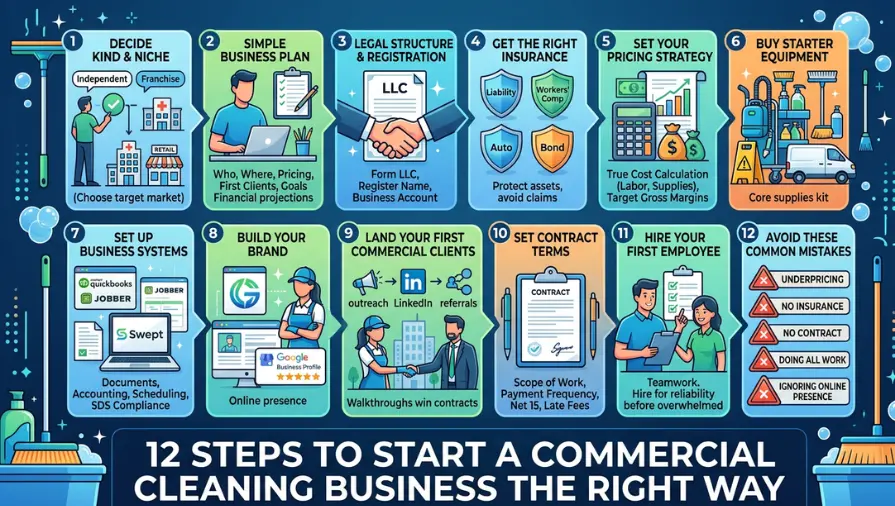
Starting a commercial cleaning business doesn’t have to be complicated — but it does have to be done in the right order. Skip a step early on and it tends to cost you time, money, or clients down the road. Here’s the exact sequence that works.
Step 1 — Decide What Kind of Cleaning Business You’re Starting
Before registering anything or buying a single supply, get clear on what you’re actually building. This decision shapes your insurance needs, equipment list, pricing, and which clients you’ll target.
Independent Operator vs. Franchise
A commercial cleaning franchise gives you a brand name, training program, and some built-in systems — but you pay for it through royalty fees that typically run between 5-12% of your gross revenue. An independent cleaning business keeps 100% of what it earns and has no territory restrictions.
Most commercial cleaning entrepreneurs in mid-sized markets are better served going independent.
Choose Your Niche Early
Generalists struggle. Specialists grow faster. Picking a niche — even loosely — sharpens your marketing message and helps you win clients who are looking for someone who understands their specific environment.
- Office buildings — the most common starting point; predictable scope, consistent hours
- Medical and dental offices — higher billing rates, compliance requirements (more on that below)
- Retail spaces — often after-hours, high-traffic floor care emphasis
- Post-construction cleanup — project-based, high per-job value
- Schools and educational facilities — require background checks, strong recurring demand
Not sure which niche fits your market? Browse the commercial industries we serve to see where demand is highest in your area.
Expert tip: Don’t try to serve every facility type from day one. Pick one or two niches, get very good at serving them, then expand. Specialized cleaning companies close contracts at higher rates than generalists.
Step 2 — Write a Simple Business Plan
You don’t need a 40-page document. You need a clear, honest plan that answers five questions before you spend any money:
- Who are you cleaning for — what types of commercial facilities?
- What geographic area will you serve?
- What will you charge, and does that cover your actual costs?
- How will you find your first clients?
- What does the business look like at 6 months and 12 months?
Financial Projections to Include
Estimate your startup costs, your monthly operating expenses (supplies, insurance, transportation, software), and the minimum number of contracts needed to break even. This exercise alone prevents the pricing mistakes that sink most new cleaning businesses in their first year.
Step 3 — Choose Your Legal Structure and Register
Most new cleaning business owners register as either a sole proprietor or an LLC. The difference matters more than most people realize.
LLC Is the Right Choice for Most Cleaners
A Limited Liability Company (LLC) protects your personal assets — your savings, your car, your home — from business liability claims. In a service business where employees work in clients’ buildings and handle chemicals, that protection matters. An LLC also signals professionalism when you’re approaching commercial property managers for contracts.
Forming an LLC is straightforward in most states — typically involves filing Articles of Organization with your state’s Secretary of State office and paying a filing fee. The process can usually be completed online in a single afternoon.
Register Your Business Name
Your business name should be clean, professional, and available as a domain name. Check your state’s business name database, search the U.S. Patent and Trademark Office database for trademark conflicts, and secure the .com domain before you commit to the name.
Open a Dedicated Business Checking Account
Keep business and personal finances completely separate from day one. This makes bookkeeping cleaner, simplifies taxes, and is required by most banks if you want a business credit card or line of credit later.
Step 4 — Get the Right Insurance
This is not optional. If an employee damages a client’s property, slips on a wet floor, or a chemical causes surface damage, the right insurance is the only thing standing between you and a claim that could end the business. Most commercial facility managers will also ask for your insurance certificates before signing any contract.
Essential Coverage for Commercial Cleaning
- General Liability Insurance — covers property damage and third-party injury claims (industry standard minimum: $1 million per occurrence)
- Workers’ Compensation — legally required in most states the moment you hire your first employee
- Commercial Auto Insurance — covers vehicles used for business purposes; personal auto policies typically exclude business use
- Janitorial Bonds (Surety Bond) — protects clients against theft by your employees; many facility managers require this
Expert tip: Get certificates of insurance issued in the client’s name before every new contract. Having them ready in advance is a small detail that signals professionalism — and it removes one of the most common last-minute objections before signing.
Step 5 — Set Your Pricing Strategy
Pricing is where most new cleaning businesses make their biggest early mistake. They price to win the bid rather than to cover their costs and generate profit — and end up running busy schedules that barely break even.
Know Your True Cost Before You Quote
Every estimate needs to account for:
- Labor — your time or your employee’s time, including drive time
- Cleaning supplies and chemicals per job
- Equipment wear and replacement
- Insurance and bonding allocated per job
- Overhead — software, phone, vehicle costs, etc.
Common Pricing Models
| Model | How It Works | Best For | Typical Range |
|---|---|---|---|
| Square footage | Price per sq ft cleaned | Office buildings | $0.05–$0.25/sq ft |
| Hourly rate | Charge per hour of labor | Variable scope jobs | $35–$75/hour |
| Flat monthly rate | Fixed recurring fee | Standard recurring contracts | $500–$5,000+/month |
| Per service | Price per visit | Infrequent cleaning clients | $150–$800/visit |
Target a gross margin of at least 40-50% on every contract. If the numbers don’t work at that margin, the pricing needs to go up — not the hours.
Step 6 — Buy Your Starter Equipment
You don’t need to spend a fortune on equipment to start. A focused starter kit gets you into your first contracts, and you add specialized equipment as the client base grows.
Core Equipment List
- Commercial upright vacuum cleaner (not residential grade)
- Microfiber mop system with multiple heads
- Commercial bucket and wringer
- Backpack sprayer for disinfectant application
- Microfiber cloths — color-coded by area (restrooms, surfaces, glass)
- Cleaning chemical kit: multi-surface cleaner, restroom disinfectant, glass cleaner, floor stripper
- Wet floor signs and safety equipment
- Rolling cart or supply caddy
- Reliable vehicle — cargo van or truck preferred for supply storage
Budget Expectation
A solid starter equipment kit for a solo commercial operator typically runs between $1,500 and $3,500. Add vehicle costs and initial insurance premiums and a realistic launch budget for most new cleaning businesses falls between $3,000 and $8,000 total.
Step 7 — Set Up Your Business Systems
The systems you build early will either support your growth or create chaos later. Setting these up before you land your first client is worth the time.
Accounting and Invoicing
QuickBooks Online or FreshBooks are the most practical starting points for a new cleaning business. Recurring invoicing for monthly contracts, expense tracking, and simple financial reports are all you need at this stage. Wave is a free alternative if budget is tight.
Scheduling and Job Management
As soon as you have more than two or three accounts, a scheduling tool like Jobber or Swept helps you track jobs, manage crews, and keep client communication organized — without relying on your memory or a stack of notes.
Safety Data Sheets and Compliance Records
Keep a current Safety Data Sheet (SDS) for every chemical you use. OSHA requires this for all cleaning operations with employees. Facility managers — particularly in medical settings — will ask for your SDS records as part of their vendor approval process.
Step 8 — Build Your Brand
Your brand is the first impression a facility manager gets before they ever meet you. A professional appearance at this stage costs very little but creates outsized credibility.
What You Actually Need at the Start
- A clean, professional business name and logo
- A simple website with your services, service area, and a contact form
- Branded uniforms — even a simple polo shirt with your company name signals professionalism
- A Google Business Profile with your accurate address, service area, and category
- Business cards to leave after walkthroughs
Expert tip: Your Google Business Profile is one of the most valuable free tools available to a new cleaning business. Set it up completely, include photos, and start collecting reviews from your very first clients. Reviews from real clients convert skeptical facility managers faster than any sales pitch.
Step 9 — Land Your First Commercial Cleaning Clients
This is the step most guides gloss over — and the one that actually determines whether the business survives its first year. Getting good at client acquisition early is the difference between a business that grows and one that struggles to get off the ground.
Where to Find Commercial Cleaning Clients
- Direct outreach to local office buildings, medical offices, and retail centers
- LinkedIn — search for facility managers and property managers in your city
- Google Business Profile — optimized profiles show up when people search for cleaning near them
- Referral partnerships with commercial real estate agents and general contractors
- Verified janitorial lead providers — who deliver appointment-ready prospects to your calendar
The Walkthrough Is Your Most Powerful Sales Tool
Never quote a commercial job remotely. Getting into the building, measuring the space, asking questions about their current pain points, and leaving a detailed, professional proposal behind is what separates cleaning companies that close contracts from ones that keep sending emails that go unanswered.
Walk the space. Dress professionally. Ask about their last cleaner. Then address exactly what they complained about in your proposal. This one-step approach wins more contracts than any marketing campaign.
“The first commercial contract is always the hardest. The second one is where you realize this business actually works.”
Step 10 — Set Your Contract Terms
Never start work without a signed service agreement. Your contract should clearly state the scope of work, service frequency, payment terms, notice period for cancellation, and liability limitations.
Keep it simple and readable — a one or two-page agreement is enough at this stage.
Payment Terms That Protect Your Cash Flow
- Invoice at the beginning of each month for that month’s service
- Net 15 payment terms — not Net 30 — to keep cash flow healthy
- Late payment clause — a clear penalty for invoices paid after the due date
- Auto-pay option — clients who pay automatically rarely miss a payment
Step 11 — Hire Your First Employee
Most cleaning businesses start with the owner doing the cleaning. That’s the right approach — you learn the work, understand the scope, and build your first client relationships personally. But at some point, usually around three to five accounts, you need to make your first hire.
What to Look for in Your First Hire
Reliability matters more than cleaning experience at this stage. Someone who shows up on time every day, follows instructions, and communicates problems can learn your cleaning process through your checklists.
Someone with perfect technique who calls in sick regularly is a liability.
Don’t Wait Until You’re Overwhelmed
Hire before you’re desperate. Training a new employee while you’re already stretched across five accounts running every job yourself is how quality slips and clients start complaining.
Bring someone on when you have three solid contracts — not when you have six and no time to breathe.
Step 12 — Avoid These 5 Common Mistakes
These are the mistakes that consistently hold back new commercial cleaning businesses — and they’re all avoidable.
Mistake 1 — Underpricing to Win the Bid
Winning a contract at a price that doesn’t cover your labor and supplies isn’t growth — it’s a slow drain on your energy and cash flow. Price for profit from the start, even if it means losing some early bids.
Mistake 2 — Starting Without Insurance
One damaged piece of equipment, one slip-and-fall in a client’s building, and an uninsured cleaning business is looking at a claim that can wipe out everything built so far. Get covered before you clean your first commercial building.
Mistake 3 — No Written Contract
A handshake agreement works fine until scope creep sets in, a client disputes an invoice, or someone wants to cancel without notice. A simple written service agreement prevents all of those problems.
Mistake 4 — Doing Everything Yourself Too Long
Staying in the cleaning role too long prevents the business from growing. At some point, every hour spent mopping floors is an hour not spent on sales, operations, and client relationships — the work that actually scales a cleaning business.
Mistake 5 — Ignoring Your Online Presence
A facility manager who can’t find you online assumes you’re not legitimate. Even a basic Google Business Profile with a few reviews is enough to establish credibility with local prospects who’ve never heard of you.
Conclusion
Starting a commercial cleaning business in 2026 comes down to making the right foundational decisions early — the right legal structure, the right insurance, the right pricing model, and a clear plan for finding clients before you need them urgently.
The steps in this guide aren’t complicated. They’re sequential. Work through them in order, don’t skip the ones that feel like paperwork, and focus the bulk of your energy on client acquisition from the very first week.
The businesses that succeed in commercial cleaning aren’t the ones with the fanciest equipment or the lowest prices. They’re the ones that show up professionally, deliver consistent work, and never stop filling their pipeline with new opportunities.