Hiring the wrong person in a commercial cleaning business doesn’t just mean a bad hire — it means a client’s building gets serviced poorly, a complaint arrives, and a recurring contract is at risk. The cleaning industry has one of the highest employee turnover rates of any service sector, with some estimates putting annual turnover above 70%. Most of that turnover is preventable.
The cleaning businesses that grow consistently and hold onto their best people do so because they have a real hiring process — not just a job post and a gut-feeling interview. They know what they’re looking for, how to screen for it, and how to onboard new hires in a way that sets them up to succeed rather than disappear after two weeks.
This guide covers how to hire employees for a janitorial business step by step — from writing the job post to building a training system that reduces turnover and protects your client relationships.
The most reliable cleaning employees are found through referrals from current staff and targeted Indeed or ZipRecruiter postings. The interview should test reliability indicators more than cleaning skill — technique can be taught, reliability cannot.
5 Steps to Hire Employees for a Janitorial Business
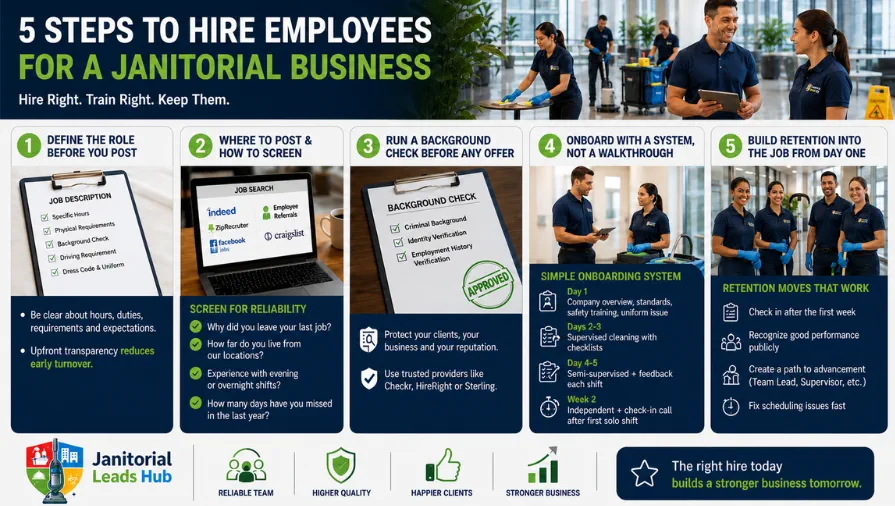
Step 1 — Define the Role Before You Post
Before writing a job post, be clear about exactly what the role requires. A vague posting produces vague applicants. A precise posting attracts people who know what they’re agreeing to — which reduces the early dropout rate significantly.
Key Details to Include
- Specific hours — whether evening or overnight shifts are required, and on what days
- Physical requirements — lifting, standing for extended periods, chemical handling
- Background check requirement — non-negotiable for any commercial cleaning role
- Driving requirement — if travel between sites is expected, state clearly
- Dress code and uniform expectations
Expert tip: Be honest about the hours in your posting. Cleaners who discover that shifts are 10pm-2am after accepting an offer almost always leave within the first month. Upfront transparency reduces churn dramatically.
Step 2 — Where to Post and How to Screen
Best Platforms for Hiring Cleaning Staff
- Indeed — the highest volume platform for service industry hiring; pay-per-apply option worth testing
- ZipRecruiter — strong automatic matching that surfaces relevant candidates faster
- Facebook Jobs — effective for local community-based hiring, especially in suburban markets
- Current employee referrals — consistently produce the highest-quality, highest-retention hires
- Craigslist — still relevant in many markets for entry-level positions with no experience required
Screen for Reliability Before Everything Else
Cleaning skill can be taught in a day through a good checklist. Reliability cannot be trained.
During your initial screening call — before any in-person interview — ask questions that reveal reliability:
- ‘Tell me about your most recent job and why you left.’ — Listen for how they describe leaving, not just that they left.
- ‘How far are you from our main work locations?’ — Distance is one of the top predictors of no-shows.
- ‘Have you ever had a job that required overnight or evening hours? How did that work for you?’
- ‘What does consistent look like for you — how many days have you missed in your last job in the past year?’
Step 3 — Run a Background Check Before Any Offer
Background checks are non-negotiable in commercial cleaning. Your crew has unsupervised access to clients’ buildings, their equipment, their documents, and sometimes sensitive areas. A background check protects your clients, protects your bonding coverage, and protects your business from liability.
What to Check
- Criminal background — particularly theft, fraud, and violent offenses
- Identity verification — confirm the person is who they say they are
- Employment history verification — particularly for candidates with gaps or vague job histories
Use a reputable background check service like Checkr, HireRight, or Sterling. Most results come back within 24-48 hours. Inform candidates upfront that a background check is part of your hiring process — legitimate applicants expect it and won’t object.
Step 4 — Onboard With a System, Not a Walkthrough
The Difference Between Training and Onboarding
Training is showing someone how to clean a restroom. Onboarding is making sure they understand the company’s standards, the specific requirements of each account they’ll service, the communication system they’ll use, the uniform expectations, and what happens if they can’t make a shift.
New hires who go through a structured onboarding process stay longer and perform better than those who shadow a current employee for two days and are then sent out alone. The investment in onboarding pays back in reduced turnover.
A Simple Onboarding System
- Day 1: Company overview, cleaning standards, chemical safety (OSHA SDS review), uniform issue
- Days 2-3: Supervised cleaning on a lower-stakes account with checklists to follow
- Day 4-5: Semi-supervised on their primary assigned account with feedback session at the end of each shift
- Week 2: Independent with check-in call at end of first solo shift
Step 5 — Build Retention Into the Job From Day One
Why Cleaning Industry Turnover Is So High
Turnover in janitorial businesses is rarely about pay. Most experienced cleaners know what the work pays before they apply.
The most common reasons people leave are inconsistent scheduling, feeling invisible to management, no clear path to advancement, and poor communication when problems arise.
Simple Retention Moves That Cost Almost Nothing
- Check in after the first week — a 5-minute call asking how the first shifts went creates trust immediately
- Recognize good performance publicly — a team group chat mention goes further than most owners expect
- Create a team lead role to promote into — the most reliable cleaners will stay longer if there’s somewhere to go
- Fix scheduling problems fast — erratic hours are the fastest way to lose reliable staff
Expert tip: The single highest-impact retention move is a check-in call at the end of a new hire’s first solo shift. ‘How did it go? Was everything clear? Any questions?’ — three questions that take 3 minutes and dramatically reduce early-stage turnover.
Contractor vs Employee — What to Know Before You Hire
Some cleaning business owners try to classify all cleaning staff as 1099 contractors to avoid payroll tax and workers’ compensation obligations. This approach carries significant legal risk — misclassification can result in back taxes, retroactive workers’ comp premiums, and state-level fines.
The IRS and most state labor boards have clear criteria for who qualifies as an independent contractor, and most cleaning staff don’t meet them.
When in doubt, classify as W-2. The additional cost is real but manageable — and the alternative is far more expensive if an audit or a workers’ comp claim surfaces a misclassification.
Conclusion
Hiring for a janitorial business works best when the process is clear, the expectations are set upfront, background checks are non-negotiable, and onboarding is structured enough that a new hire knows exactly what success looks like in their first two weeks.
The cleaning businesses that hold onto their best people and keep clients satisfied are almost always the ones that treat hiring as a repeatable system — not a reactive scramble every time someone quits.
Build the system once. Refine it with every hire. And measure turnover quarterly — it’s the single best indicator of how healthy your hiring and onboarding process actually is.
Hiring a reliable crew is one part of growing a janitorial business. Filling their schedule with verified commercial cleaning walkthroughs is the other. Janitorial Leads Hub delivers exclusive, appointment-ready janitorial leads matched to your service area