The janitorial industry remains one of the most resilient sectors in commercial services, with demand driven by a simple reality: every office, clinic, and retail space needs consistent, professional cleaning to operate. For business owners who have built a foundation of three or four loyal clients, the next stage of growth often presents a different challenge altogether — one that has less to do with cleaning quality and more to do with how the business itself is structured.
Many janitorial business owners reach a plateau not because demand is lacking, but because their operations were never built to handle scale. The systems, staffing, and sales processes that worked well at a small size start to strain under added volume, and without intervention, growth stalls before it truly begins.
This guide breaks down exactly how to grow a janitorial business fast — covering the contract types worth pursuing, the operational systems that protect quality, the staffing structure that allows an owner to step back from daily cleaning, and the local lead generation tactics that keep new opportunities arriving consistently.
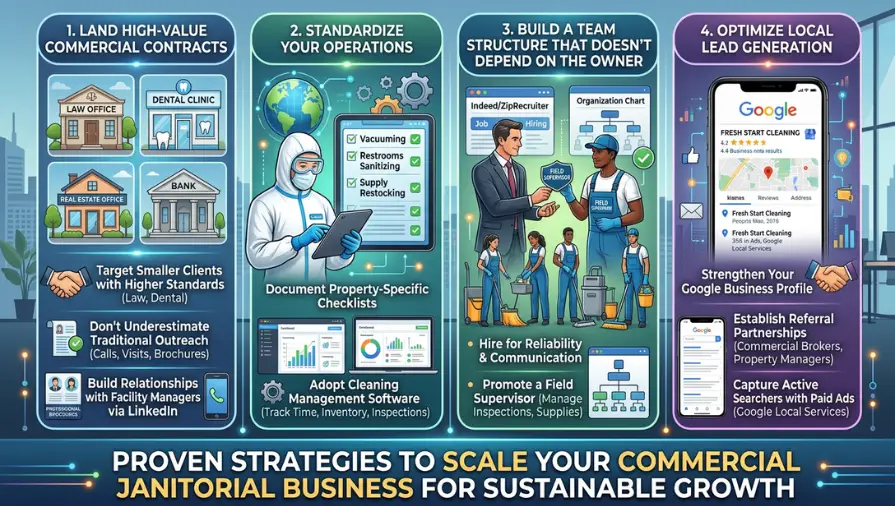
1. Land High-Value Commercial Contracts
Commercial janitorial work offers something residential cleaning rarely does: predictable, recurring revenue. The challenge is identifying which commercial clients are worth pursuing — and approaching them the right way.
Target Smaller Clients With Higher Standards
Retail centers, warehouses, and other facility types all have different needs. Browse the industries we serve to find the highest-value targets in your market. These businesses tend to have smaller physical footprints but stricter cleanliness expectations, which creates room for premium, specialized pricing.
Don’t Underestimate Traditional Outreach
Cold calling and in-person visits remain effective in this industry. Visiting a business, requesting to speak with the office manager, and leaving a professional brochure behind still opens doors — particularly when followed up with a phone call or a personalized email within the week.
Build Relationships With Facility Managers
LinkedIn has become a practical tool for connecting directly with property and facility managers in a local area. A short, genuine introduction message often leads to conversations that cold outreach alone cannot.
“The janitorial businesses that grow fastest aren’t chasing more leads — they’re chasing the right ones, consistently.”
2. Standardize Your Operations
Growth without operational structure tends to create more problems than it solves. Standard operating procedures ensure that service quality remains consistent across every property, regardless of which employee is assigned to the job.
Document Property-Specific Checklists
Each building should have its own detailed task list — covering vacuuming schedules, restroom sanitizing procedures, and supply restocking requirements. This documentation forms the backbone of a scalable janitorial business growth strategy and significantly reduces training time for new hires.
Adopt Cleaning Management Software
Platforms such as Swept or Jobber allow owners to track employee clock-ins, manage supply inventory, and handle client inspections from a single system. As contract volume increases, this kind of software replaces the spreadsheets and informal tracking methods that quickly become unmanageable.
3. Build a Team Structure That Doesn’t Depend on the Owner
A janitorial business cannot scale while its owner remains the primary person performing the cleaning. At some point, the physical labor must transition fully to a trained team.
Hire for Reliability
Job boards such as Indeed and ZipRecruiter make sourcing cleaning staff straightforward. Reliability and communication should be prioritized in the hiring process, since cleaning technique can be taught effectively through standardized checklists.
Promote a Field Supervisor
Once multiple contracts are in place, promoting a trusted employee to a Field Supervisor role becomes essential. This person can manage random quality inspections, handle supply deliveries, and address minor client concerns directly — freeing the owner to focus on sales and overall business strategy.
4. Optimize Local Lead Generation
Sustainable growth depends on a steady stream of new business opportunities, which requires maintaining visibility wherever potential clients are actively searching.
Strengthen Your Google Business Profile
A fully completed Google Business Profile, supported by genuine client reviews, improves visibility in local search results — often the first place a facility manager looks when evaluating cleaning providers in their area.
Establish Referral Partnerships
Commercial real estate brokers, property managers, and office interior designers regularly work with businesses that require cleaning services. Offering a referral commission for every successful introduction transforms their existing professional network into a consistent source of new contracts.
Capture Active Searchers With Paid Ads
Google Local Services Ads place a business directly in front of decision-makers who are actively searching for commercial cleaning services. While organic strategies build momentum over time, this approach can generate qualified leads more immediately.
Conclusion
Growing a janitorial business fast is rarely the result of working harder — it is the outcome of building systems that allow growth to happen without the owner personally managing every detail. Identifying the right commercial clients, standardizing daily operations, developing a capable team structure, and maintaining consistent local lead generation are the four pillars that support sustainable expansion.
When these elements work together, fast growth stops being an aspiration and becomes a predictable outcome of well-structured operations.