You convert janitorial sales leads by qualifying them fast, running a sharp on-site walkthrough that exposes what your competitor is missing, sending a custom itemized proposal instead of a flat-rate quote, and following up consistently until the timing is right.
That’s the whole process in one sentence. But most cleaning companies lose contracts at every single one of those four steps — usually without realizing it.
B2B cleaning contracts are high-value, low-frequency decisions. A facility manager doesn’t switch cleaners on a whim — they switch when trust breaks down with their current provider and a better option is sitting right in front of them at exactly the right moment.
The companies that land the best opportunities are not always the cheapest. They are the ones that appear professional, stay visible, follow up quickly, and build trust before the decision is made.
“A janitorial lead isn’t won in the first phone call. It’s won in the follow-up nobody else bothered to send.”
Here’s exactly how to convert janitorial sales leads the right way.
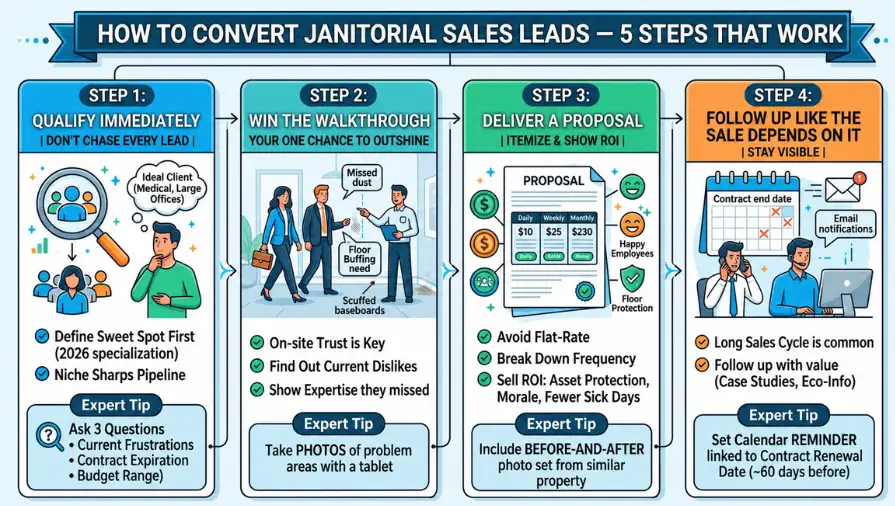
Step 1 — Qualify Immediately, Before You Waste a Single Hour
Don’t Chase Every Lead — Chase the Right Ones
This is the step almost every cleaning company skips, and it’s the most expensive mistake in the entire sales process.
Define Your Ideal Client First
Decide your sweet spot before you ever pick up the phone — square footage range, target industry, contract type. In 2026, specialization wins.
Instead of saying “we provide commercial cleaning services,” say “we specialize in medical office cleaning with OSHA-compliant protocols,” or “we focus on large office buildings over 20,000 square feet.”
A defined niche doesn’t shrink your pipeline — it sharpens it. Specialization reduces price competition and increases average contract size, because you’re no longer competing against every generic cleaner in the city.
Ask the Three Questions That Actually Matter
During initial contact, find out:
- What specifically frustrates them about their current cleaner
- When their existing contract actually expires
- What budget range they’re realistically working with
Expert Tip: If a lead can’t answer when their current contract ends, that’s your cue to ask if you can follow up closer to that date instead of pushing for an immediate decision.
Step 2 — Win the Walkthrough, Win the Contract
This Is Your One Real Chance to Outshine the Competition
The on-site walkthrough is where deals are actually won or lost — not the phone call, not the proposal. Trust is everything in the cleaning industry. Facility managers and property management companies prefer reliable partners, not one-time cleaners.
Find Out What’s Actually Wrong With Their Current Cleaner
Ask directly: what do you dislike about your current service? This single question often reveals exactly what to emphasize in your proposal — and what your competitor is failing to deliver.
Show Expertise They Didn’t Expect
Point out specific issues most cleaners miss on a casual walkthrough — high dusting that’s been neglected, floor buffing that’s overdue, scuffed baseboards nobody’s addressed in months. Then explain exactly how your team handles each one.
This single move does more to differentiate you than any pricing discussion ever will. It demonstrates expertise the prospect can see with their own eyes, not just hear in a sales pitch.
Expert Tip: Bring a tablet and take photos of problem areas during the walkthrough — referencing those specific photos in your follow-up proposal proves you actually looked, not just toured.
Step 3 — Deliver a Proposal That Sells Itself
Generic Pricing Sheets Lose to Itemized Value Breakdowns Every Time
Never send a flat-rate quote. It’s the fastest way to get compared purely on price — and price-only comparisons almost always go to the cheapest bidder, not the best one.
Break Down Pricing by Frequency and Scope
Itemize daily, weekly, and monthly service tiers separately rather than bundling everything into one number. This shows the prospect exactly what they’re paying for at each frequency — and makes it easy to see where they might add or reduce scope later.
Sell the ROI, Not Just the Clean
A strong commercial cleaning lead generation service prioritizes quality over quantity, ensuring your sales team speaks only with serious decision makers. When you do get in front of a serious decision-maker, make the proposal demonstrate return — not just cleanliness.
Show how consistent professional cleaning protects flooring, carpets, and fixtures from premature wear, and how a cleaner environment measurably improves employee morale and reduces sick days. Facility managers care about asset protection and budget justification — not just shiny floors.
Expert Tip: Include a simple before-and-after photo set from a comparable property in every proposal — visual proof outperforms written claims in every commercial cleaning pitch.
Step 4 — Follow Up Like the Sale Depends On It (Because It Does)
The Long Sales Cycle Is Where Most Cleaning Companies Give Up Too Early
Commercial cleaning contracts rarely close on the first conversation. A lot of janitorial businesses deliver excellent service but still struggle to grow. The pipeline stays inconsistent because of weak follow-up, not weak service.
Stay Visible Without Being Annoying
Follow up every few weeks with something genuinely useful — a relevant case study, a fresh set of before-and-after photos, information about eco-friendly products if that matters to their brand. Every touchpoint should add value, not just ask “are you ready yet?”
Time Your Follow-Up to Their Actual Contract Calendar
If a prospect is currently locked into a competitor’s contract, ask permission to add them to a mailing list and reach back out roughly 60 days before that contract ends. This is precisely when facility managers start evaluating alternatives — and being in their inbox at that exact moment beats cold outreach every time.
Expert Tip: Set a calendar reminder tied to their contract renewal date the moment you learn it — most lost opportunities aren’t lost to a competitor, they’re lost to bad timing.
What Separates Companies That Convert From Companies That Don’t
| Weak Approach | Strong Approach |
| Pitches every lead the same way | Qualifies by size, industry, and budget fit first |
| Phone or email quote only | Always conducts an in-person walkthrough |
| Generic flat-rate pricing sheet | Itemized, frequency-based custom proposal |
| One follow-up, then gives up | Multi-touch nurture sequence over months |
| Talks only about cleaning tasks | Sells ROI — asset protection, morale, reliability |
| Cold-calls regardless of contract status | Times outreach to competitor contract expir |
Conclusion
Converting janitorial sales leads isn’t about working harder on more leads — it’s about working smarter on the right ones.
Qualify fast so you’re not wasting time on poor-fit prospects. Win the walkthrough by showing expertise your competitor never demonstrated.
Send a proposal that sells value, not just a price. And follow up consistently, timed to when the prospect is actually ready to switch.
In commercial cleaning, great service helps you keep clients. Smart lead generation and conversion is what helps you win them in the first place.
Do these four steps consistently, and your close rate stops depending on luck — it starts depending on process.