Most cleaning business owners spend their week chasing leads that never turn into a contract. The problem usually isn’t the pitch — it’s that nobody ever booked a real appointment in the first place.
Commercial cleaning appointment setting is the process of securing face-to-face or virtual walkthroughs with the actual decision-maker at a facility — not a receptionist, not an assistant, the person who signs the contract.
Get this right, and your pipeline fills itself. Get it wrong, and you’ll spend months dialing numbers that go nowhere.
What Appointment Setting Actually Requires
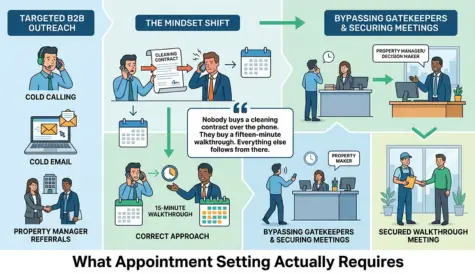
Commercial cleaning appointment setting relies on highly targeted B2B outreach — cold calling, cold email, and property manager referrals — designed specifically to bypass gatekeepers and lock in time with qualified decision-makers.
It’s not about selling the cleaning service on the call. It’s about selling the meeting. That single mindset shift is what separates cleaning businesses with full calendars from the ones still cold calling the same dead leads three months later.
“Nobody buys a cleaning contract over the phone. They buy a fifteen-minute walkthrough. Everything else follows from there.”
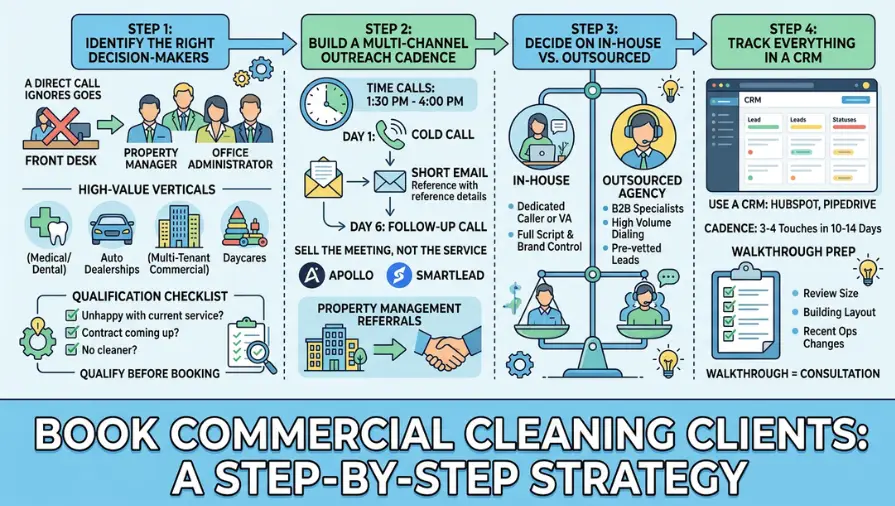
Step 1 Identify the Right Decision-Makers First
Who You Should Actually Be Calling
Calling the front desk rarely leads anywhere. Your outreach should be aimed directly at Property Managers, Facility Managers, Office Administrators, or HR Directors — the people with the authority to actually approve a new cleaning vendor.
The Verticals Worth Your Time
Not every business is worth the call. Focus your energy on medical and dental offices, auto dealerships, multi-tenant commercial buildings, and daycares — these facilities need specialised, consistent cleaning and tend to have steady budgets allocated for it.
Qualify Before You Book
Only push for a meeting if one of these is true:
- The prospect is unhappy with their current janitorial service
- Their contract is coming up for renewal
- They don’t currently have a cleaner at all
Booking appointments with unqualified leads wastes time on both ends. A qualified lead books faster and closes faster.
Step 2 Build a Multi-Channel Outreach Cadence
Time Your Cold Calls Properly
Call between 1:30 PM and 4:00 PM. Most facility and office managers are buried in their morning rush, but the early afternoon window is when they’re far more likely to actually pick up and talk.
What to Say — and What Not to Say
Don’t sell the cleaning service on the call. Sell the meeting.
A simple, low-pressure approach works best: introduce yourself, mention you work with similar buildings in the area, and ask for fifteen minutes for a complimentary walkthrough and estimate. The goal of every cold call is one outcome only — get the appointment on the calendar.
Use Cold Email to Reinforce the Call
Short, hyper-personalised emails outperform long pitches every time. Reference a specific detail about their building or industry, mention other local properties you service, and close with a simple ask for a short call or walkthrough.
Platforms like Apollo for B2B contact data and Smartlead for automated email sequencing make this process far more scalable than manual outreach alone.
Don’t Overlook Property Management Referrals
Local commercial real estate professionals are often the first to know when a new business signs a lease or a building changes management. Build a running relationship with two or three property management firms, and you’ll hear about new opportunities before your competitors do.
Step 3 Decide Between In-House and Outsourced Calling
Running It In-House
Hiring a dedicated remote cold caller or virtual assistant gives you full control over the script, the target list, and how your brand sounds on every call.
Outsourcing to a Specialist Agency
Agencies that specialise in B2B appointment setting for cleaning businesses handle the volume dialing and pre-vetting for you, freeing up your time to focus on walkthroughs and closing.
Neither option is automatically better — it depends on whether you’d rather control the process or scale the volume.
Step 4 Track Everything in a CRM
A CRM like HubSpot or Pipedrive keeps every touchpoint visible, so no lead falls through the cracks.
A standard, effective cadence runs three to four touchpoints across a ten-to-fourteen day window before archiving a cold lead. Beyond that point, most leads simply aren’t going to convert without a new angle.
Prepare Before Every Walkthrough
Before you ever step on-site, review the company size, the building layout, and any recent changes in their operations. Showing up with that knowledge already in hand is what makes a walkthrough feel like a consultation instead of a sales pitch.
Conclusion
Appointment setting for cleaning businesses isn’t about dialing more numbers — it’s about dialing the right numbers, at the right time, with one clear goal.
Sell the meeting, not the service. Qualify before you book. Track every touchpoint. Do that consistently, and your calendar stays full of walkthroughs that actually turn into signed contracts.