Hiring the wrong person in a commercial cleaning business doesn’t just mean a bad hire — it means a client’s building gets serviced poorly, a complaint arrives, and a recurring contract is at risk. The cleaning industry has one of the highest employee turnover rates of any service sector, with some estimates putting annual turnover above 70%. Most of that turnover is preventable.
The cleaning businesses that grow consistently and hold onto their best people do so because they have a real hiring process — not just a job post and a gut-feeling interview. They know what they’re looking for, how to screen for it, and how to onboard new hires in a way that sets them up to succeed rather than disappear after two weeks.
This guide covers how to hire employees for a janitorial business step by step — from writing the job post to building a training system that reduces turnover and protects your client relationships.
The most reliable cleaning employees are found through referrals from current staff and targeted Indeed or ZipRecruiter postings. The interview should test reliability indicators more than cleaning skill — technique can be taught, reliability cannot.
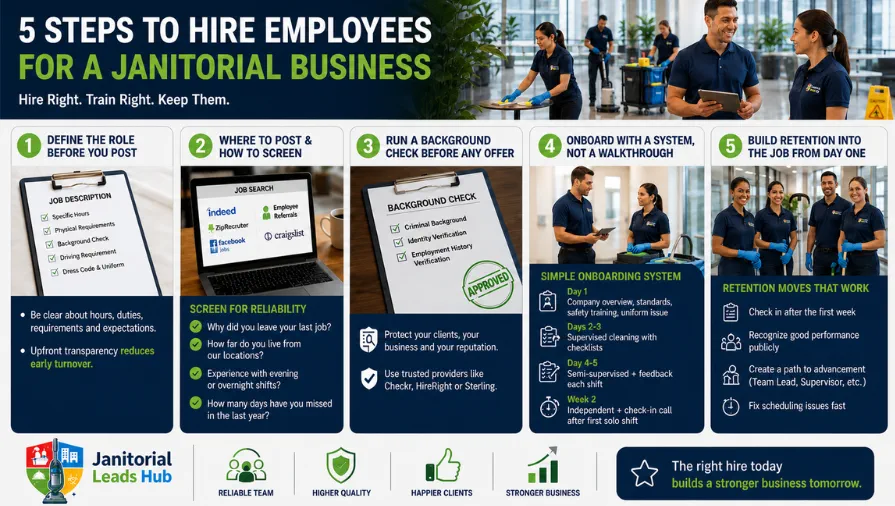
5 Steps to Hire Employees for a Janitorial Business
Step 1 — Define the Role Before You Post
Before writing a job post, be clear about exactly what the role requires. A vague posting produces vague applicants. A precise posting attracts people who know what they’re agreeing to — which reduces the early dropout rate significantly.
Key Details to Include
Specific hours — whether evening or overnight shifts are required, and on what days
Physical requirements — lifting, standing for extended periods, chemical handling
Background check requirement — non-negotiable for any commercial cleaning role
Driving requirement — if travel between sites is expected, state clearly
Dress code and uniform expectations
Expert tip: Be honest about the hours in your posting. Cleaners who discover that shifts are 10pm-2am after accepting an offer almost always leave within the first month. Upfront transparency reduces churn dramatically.
Step 2 — Where to Post and How to Screen
Best Platforms for Hiring Cleaning Staff
Indeed — the highest volume platform for service industry hiring; pay-per-apply option worth testing
ZipRecruiter — strong automatic matching that surfaces relevant candidates faster
Facebook Jobs — effective for local community-based hiring, especially in suburban markets
Current employee referrals — consistently produce the highest-quality, highest-retention hires
Craigslist — still relevant in many markets for entry-level positions with no experience required
Screen for Reliability Before Everything Else
Cleaning skill can be taught in a day through a good checklist. Reliability cannot be trained.
During your initial screening call — before any in-person interview — ask questions that reveal reliability:
‘Tell me about your most recent job and why you left.’ — Listen for how they describe leaving, not just that they left.
‘How far are you from our main work locations?’ — Distance is one of the top predictors of no-shows.
‘Have you ever had a job that required overnight or evening hours? How did that work for you?’
‘What does consistent look like for you — how many days have you missed in your last job in the past year?’
Step 3 — Run a Background Check Before Any Offer
Background checks are non-negotiable in commercial cleaning. Your crew has unsupervised access to clients’ buildings, their equipment, their documents, and sometimes sensitive areas. A background check protects your clients, protects your bonding coverage, and protects your business from liability.
What to Check
Criminal background — particularly theft, fraud, and violent offenses
Identity verification — confirm the person is who they say they are
Employment history verification — particularly for candidates with gaps or vague job histories
Use a reputable background check service like Checkr, HireRight, or Sterling. Most results come back within 24-48 hours. Inform candidates upfront that a background check is part of your hiring process — legitimate applicants expect it and won’t object.
Step 4 — Onboard With a System, Not a Walkthrough
The Difference Between Training and Onboarding
Training is showing someone how to clean a restroom. Onboarding is making sure they understand the company’s standards, the specific requirements of each account they’ll service, the communication system they’ll use, the uniform expectations, and what happens if they can’t make a shift.
New hires who go through a structured onboarding process stay longer and perform better than those who shadow a current employee for two days and are then sent out alone. The investment in onboarding pays back in reduced turnover.
A Simple Onboarding System
Day 1: Company overview, cleaning standards, chemical safety (OSHA SDS review), uniform issue
Days 2-3: Supervised cleaning on a lower-stakes account with checklists to follow
Day 4-5: Semi-supervised on their primary assigned account with feedback session at the end of each shift
Week 2: Independent with check-in call at end of first solo shift
Step 5 — Build Retention Into the Job From Day One
Why Cleaning Industry Turnover Is So High
Turnover in janitorial businesses is rarely about pay. Most experienced cleaners know what the work pays before they apply.
The most common reasons people leave are inconsistent scheduling, feeling invisible to management, no clear path to advancement, and poor communication when problems arise.
Simple Retention Moves That Cost Almost Nothing
Check in after the first week — a 5-minute call asking how the first shifts went creates trust immediately
Recognize good performance publicly — a team group chat mention goes further than most owners expect
Create a team lead role to promote into — the most reliable cleaners will stay longer if there’s somewhere to go
Fix scheduling problems fast — erratic hours are the fastest way to lose reliable staff
Expert tip: The single highest-impact retention move is a check-in call at the end of a new hire’s first solo shift. ‘How did it go? Was everything clear? Any questions?’ — three questions that take 3 minutes and dramatically reduce early-stage turnover.
Contractor vs Employee — What to Know Before You Hire
Some cleaning business owners try to classify all cleaning staff as 1099 contractors to avoid payroll tax and workers’ compensation obligations. This approach carries significant legal risk — misclassification can result in back taxes, retroactive workers’ comp premiums, and state-level fines.
The IRS and most state labor boards have clear criteria for who qualifies as an independent contractor, and most cleaning staff don’t meet them.
When in doubt, classify as W-2. The additional cost is real but manageable — and the alternative is far more expensive if an audit or a workers’ comp claim surfaces a misclassification.
Conclusion
Hiring for a janitorial business works best when the process is clear, the expectations are set upfront, background checks are non-negotiable, and onboarding is structured enough that a new hire knows exactly what success looks like in their first two weeks.
The cleaning businesses that hold onto their best people and keep clients satisfied are almost always the ones that treat hiring as a repeatable system — not a reactive scramble every time someone quits.
Build the system once. Refine it with every hire. And measure turnover quarterly — it’s the single best indicator of how healthy your hiring and onboarding process actually is.
Hiring a reliable crew is one part of growing a janitorial business. Filling their schedule with verified commercial cleaning walkthroughs is the other. Janitorial Leads Hub delivers exclusive, appointment-ready janitorial leads matched to your service area
If you’ve been chasing commercial cleaning contracts around major downtown business districts and growing commercial hubs, you already know that multi-tenant office buildings are the holy grail. Securing just one of these buildings can completely transform your cash flow.
However, multi-tenant layouts are a completely different beast compared to a standard single-occupant warehouse or a small retail shop. If you quote them using a basic square-foot rate, you will either price yourself out of the running or—even worse—underbid, win the contract, and lose your shirt on labor costs.
Here is exactly how to navigate the bidding process, secure high-value office cleaning leads, and structure your quote to land lucrative corporate office cleaning contracts.
The Answer Capsule
To successfully bid on multi-tenant office buildings, you must calculate your quote using a split-zone pricing structure rather than a flat square-foot rate. Separate the communal areas (lobbies, shared elevators, main restrooms) from individual tenant suites, and factor in a 15–20% labor buffer to account for high-traffic wear, security access delays, and tenancy turnover.
1. The Multi-Tenant Trap: Why Standard Bidding Fails
When a property manager puts a multi-tenant corporate building out to tender, they aren’t just looking for someone to empty trash cans. They are looking for an outfit that understands the operational friction of a shared commercial space.
In a single-occupancy building, your cleaners walk in, disarm one alarm, clean the building from front to back, and lock up. In a multi-tenant layout, your team has to deal with:
Segmented Security: Keying into different floors, managing separate master keys, and handling individual suite alarm codes.
Variable Clean Times: A financial advisory firm on Level 3 might need pristine, daily high-end detailing, while a tech startup on Level 4 might only want a basic surface wipe down three times a week.
The Shared Zone Factor: Lobbies, elevator cars, and central stairwells endure massive foot traffic, especially during winter snow slushes or rainy afternoons when everyone stays indoors.
If you don’t account for the minutes lost walking between floors and managing keys, your profit margin will dry up faster than midsummer asphalt.
2. Step-by-Step Bidding Framework for Commercial Buildings
To turn your commercial office leads into signed contracts, use this field-tested walkthrough during your site inspection.
Step 1: The Site Walkthrough & Asset Count
Never submit a blind quote. Walk the site with the property manager or building representative. Note down the exact number of:
Shared toilet cubicles, urinals, and basins per floor.
Elevator cars and public glass surfaces.
Fitness or bike storage facilities (common in modern corporate centers, requiring heavy sanitization).
Step 2: The Split-Zone Calculation
Divide your bid into two distinct categories:
The Base Building (Property Management Budget): This covers the main foyer, elevators, shared corridors, central restrooms, and external dumpster areas. This is usually billed monthly to the building management.
The Tenant Suites (Individual Corporate Budgets): These are individual contracts for each business inside the building. If you win the base building contract, you have a massive advantage in picking up these separate corporate office cleaning contracts by offering an “in-house” discount to the tenants.
Step 3: Factoring the Operational Friction Index
Add an extra 10 to 15 minutes per cleaner, per shift, purely for operational lag. Commercial property managers are notoriously strict on security access. If your crew has to wait for a service elevator or badge through multiple checkpoints on every floor, that time must be built into your hourly labor rate.
3. Creating Your Proposal
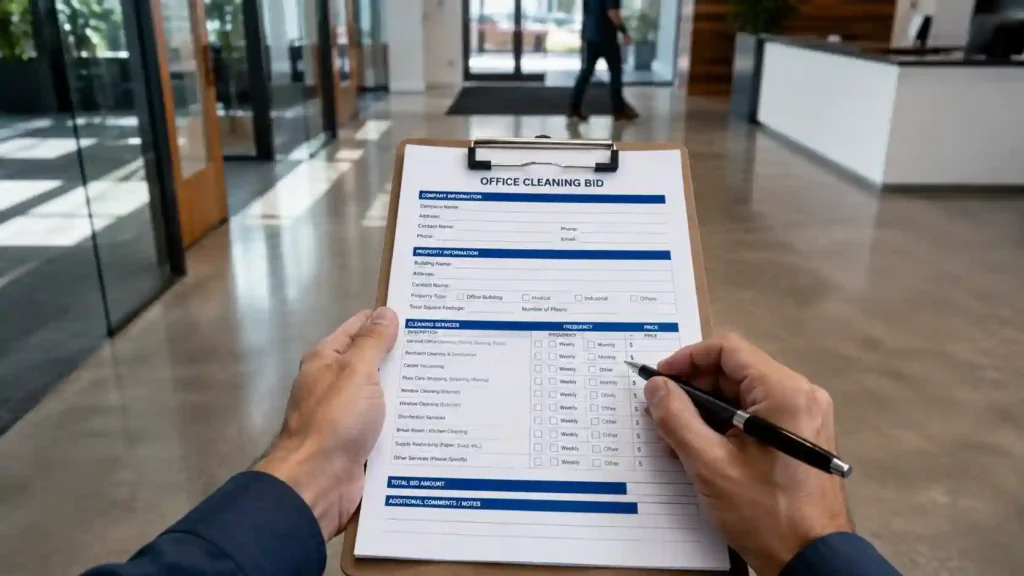
When presenting your quote, don’t just hand over a sheet with a flat price on it. Use a professional office cleaning bidding template that breaks down your scope of work. Property managers love transparency. Your proposal should clearly separate:
Daily Scope: Trash rotation, high-touch point sanitization, elevator track vacuuming, and restroom restocking.
Weekly Scope: Detail dusting, baseboards, and deep carpet vacuuming.
Periodic Scope: Hard floor burnishing, high-window cleaning, and carpet steam cleaning (typically quoted as optional add-ons to boost your job value).
Show them you have full Workers’ Comp, are fully bonded, and hold a comprehensive General Liability Insurance policy. In the commercial sector, this compliance is non-negotiable.
Frequently Asked Questions
How do you price the shared communal areas in a multi-tenant office building?
Direct Answer: Communal areas should be quoted as a fixed monthly base-building rate billed directly to the property manager or building management company.
You should calculate this by estimating the exact labor hours needed for high-traffic zones like foyers, shared elevators, and common restrooms, then adding a 15% buffer for seasonal weather changes (like extra salt, mud, and water tracked in during the winter months).
What should be included in an office cleaning bidding template for large corporate contracts?
Your bidding template must explicitly break down daily, weekly, and monthly tasks, alongside clear, separated pricing structures for both the base building and individual tenant suites. To look like a true professional to property managers, it should also showcase your compliance documentation upfront—specifically your General Liability Insurance certificate, proof of bonding, and a site-specific safety plan.
How do individual tenant changes affect a long-term corporate office cleaning contract?
Tenant turnover directly impacts your cleaning schedules and security access requirements. Your core agreement with the property manager should remain completely stable for the communal areas, but your individual tenant suite contracts must include a flexible clause. This allows you to adjust or pause services whenever a business moves out or a floor undergoes a fresh commercial build-out.
For commercial cleaning business owners, the growth ceiling isn’t defined by how fast your crew can clean—it’s defined by how fast your sales pipeline fills. When a cleaning company crosses the threshold from small local operations to chasing larger corporate accounts, leadership faces a critical crossroads: Should you build an in-house sales development team, or should you outsource to a dedicated partner?
Building a data scraping, cold calling, and prospecting infrastructure in-house sounds empowering. But when you look at the raw cost per acquisition (CPA), the math tells a wildly different story.
What is the Most Cost-Effective Way to Get Janitorial Leads?
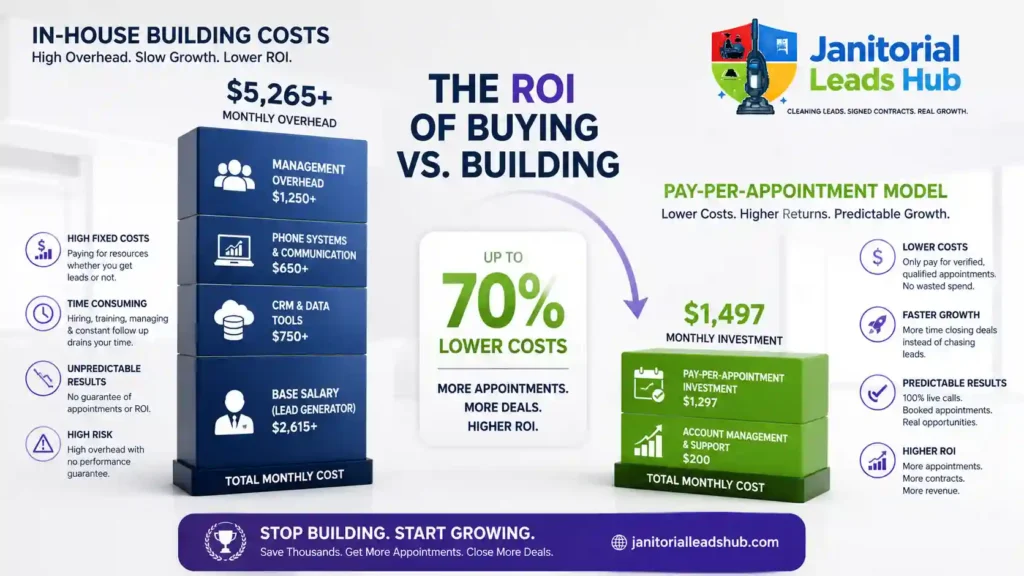
The B2B ROI Formula: The most cost-effective way to secure exclusive janitorial leads is to shift from a fixed-overhead “in-house building” model to a performance-based “pay-per-appointment” model. Outsourcing your commercial prospecting reduces lead acquisition friction, shifts overhead risk to a third party, and guarantees that your sales team only spends time on high-intent walkthroughs.
While hiring an internal Sales Development Representative (SDR) guarantees total control over your outreach, it ties your business to thousands of dollars in fixed monthly overhead long before a single commercial cleaning contract is signed. For most growing commercial cleaning companies, outsourcing provides immediate, predictable scale.
The Hidden Costs of Building an In-House B2B Prospecting Team
Many janitorial CEOs calculate the cost of an in-house team purely by looking at base salary. In reality, building a high-performing department for commercial cleaning lead generation involves substantial hidden overhead.
If you hire a dedicated inside sales rep to hunt for B2B cleaning leads, your monthly ledger looks closer to this:
Base Salary & Benefits: $3,500 – $4,500 / month
Data & Software Stack: $400 – $600 / month (Premium B2B contact databases, verified email tools, and CRM routing software)
Telecom & Auto-Dialers: $150 – $250 / month
Management & Training Time: 10–15 hours of executive time lost per week monitoring phone logs.
Before your internal rep makes their first dial, you are spending roughly $4,500 to $5,500 per month. If that rep experiences a standard industry slump and books only 4 or 5 walkthroughs in a month, your actual cost per appointment skyrockets past $1,000.
In-House Hiring vs. Pay Per Appointment Janitorial Models
To visualize the financial difference between these two strategies, let’s break down the metrics over a standard 90-day pipeline sprint.
Cost & Performance Metric
In-House SDR Team (Building)
Pay Per Appointment Model (Buying)
Upfront Setup Costs
High (Software, hiring, ramp-up time)
Zero
Monthly Fixed Overhead
$4,500+ (Regardless of performance)
$0 (Only pay for results)
Time to First Walkthrough
30 to 60 days (Training & warming lists)
24 to 48 hours
Risk Allocation
100% on the cleaning business owner
100% on the lead provider
Sales Team Focus
Diluted (Cold calling, data entry, prospecting)
Optimized (100% focused on closing contracts)
Lead Exclusivity
Exclusive, but relies heavily on rep skill
Guaranteed exclusive (if using a premium vendor)
Why Buying Appointments Beats Raw “Leads” Every Time
The term janitorial leads has been heavily diluted by generic marketing agencies selling old, scraped spreadsheets. If you buy a cold list of phone numbers, your sales team is still stuck doing the heavy lifting of cold outreach, navigating gatekeepers, and fighting for attention.
Opting for a pay per appointment janitorial program flips the dynamic entirely. Instead of purchasing raw data, you are purchasing a guaranteed calendar event with a facility manager who has already stated:
They are currently looking for a new commercial cleaning provider.
They are waiting for an official proposal.
They have confirmed a specific date and time for you to walk the building.
By bypassing the cold prospecting phase, your sales cycle shortens from months to days. Your sales managers spend their energy building relationships during the physical walkthrough, rather than burning out on unanswered cold calls.
Maximizing Your Outsourced Lead Generation ROI
If you decide to outsource your commercial cleaning lead generation, your operational focus must shift from finding leads to converting them. To achieve the highest possible return on investment:
Respond in Real Time: When an exclusive appointment is delivered, review the facility details instantly. Ensure your team confirms their attendance promptly so the facility manager perceives your brand as highly professional from the first touchpoint.
Standardize Your Walkthrough Script: Treat the appointment as a structured diagnostic evaluation. Do not just quote square footage; identify the prospect’s specific pain points with their previous cleaning crew (e.g., missed dustings, poor communication).
Deliver Proposals Within 24 Hours: Commercial decision-makers move fast. Pair your premium, on-demand appointments with an equally fast bidding process to seal the contract before competitors can even get on the phone.
Frequently Asked Questions About Janitorial Lead Generation and B2B Prospecting ROI.
1. What is the average close rate for outsourced janitorial appointments?
While closing rates depend heavily on your regional pricing and sales process, commercial cleaning companies using high-quality, exclusive, phone-verified appointments typically see close rates between 20% and 35%. Because the prospect has verified buying intent before you arrive, the close rate is significantly higher than cold outreach.
2. Why are exclusive janitorial leads better than shared leads?
Shared leads are sold to multiple cleaning companies simultaneously, resulting in an aggressive race-to-the-bottom price war. Exclusive leads are delivered to only one company in a specific territory, protecting your profit margins and allowing you to sell based on quality rather than the lowest bid.
3. Can outsourcing lead generation help scale specific commercial niches?
Yes. Professional lead generation agencies use sophisticated targeting parameters. This allows you to intentionally bypass small offices and focus your pipeline strictly on high-margin sectors like medical facilities, multi-tenant corporate complexes, industrial sites, or schools.
The Bottom Line: Play to Your Strengths
Building an internal sales machine is a massive operational distraction for a growing commercial cleaning business. Every hour your leadership spends managing phone systems, scraping databases, and training cold callers is an hour stolen from service quality control and high-level client relationship building.
By outsourcing your commercial prospecting to a dedicated partner, you turn a unpredictable, fluctuating internal operational struggle into a fixed, predictable cost. You stop paying for the effort of hunting for deals and start paying strictly for the results—leaving your team completely free to step onto properties, submit winning bids, and close lucrative contracts.
The janitorial industry has spent decades running on the same playbook — a set route, a checklist, and trust that the crew did what they said. That playbook is changing fast. Buildings now expect proof of work, faster turnaround on problems, and cleaning teams that can show their results instead of just claiming them.
Industry estimates put the global cleaning services market at roughly $442 billion in 2025, with projections climbing toward $770 billion by 2033 — growth that’s increasingly tied to how cleaning companies operate, not just how many buildings they service.
Staffing shortages are pushing this shift along. The U.S. Bureau of Labor Statistics expects about 351,300 janitorial job openings annually through 2034, much of it from people leaving the field rather than new positions being created.
Equipment, software, and data tools are stepping in to help cleaning teams do more with fewer hands — improving consistency, safety, labor planning, and how they report back to clients.
Here’s a look at the 11 trends and technologies actually shaping where janitorial services are headed — and what each one practically means for a commercial cleaning company trying to stay competitive.
1. Sensor-Driven Cleaning Equipment Is Replacing Guesswork
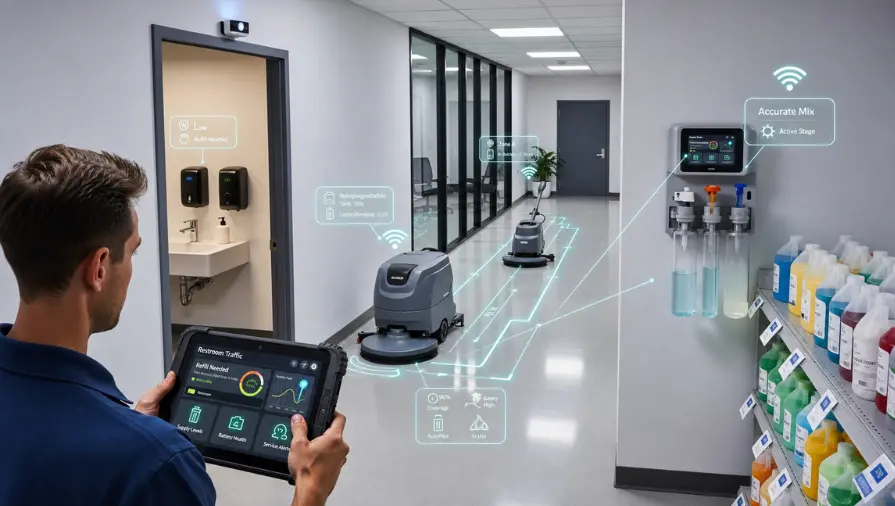
Cleaning equipment built with sensors, automation, and connected data is quickly becoming standard rather than optional. These tools tell a crew exactly where attention is needed, which supplies are running low, and when a machine needs servicing — removing a lot of the guesswork that used to come with fixed cleaning routes.
Restroom traffic sensors, touch-free dispensers, battery-operated vacuums, auto-scrubbers, and chemical dilution systems are now common in facilities that used to rely entirely on manual spot-checks. Industry groups like ISSA point to IoT sensors and cleaning analytics as some of the clearest signs of where the industry is heading — away from routine cleaning and toward cleaning based on actual demand.
Equipment
What It Actually Does
Restroom sensors
Flags traffic, supply levels, and refill timing
Connected floor machines
Tracks runtime, coverage area, battery health
Dilution control systems
Cuts down on wasted or mismeasured chemicals
Touch-free dispensers
Reduces contact points, supports hygiene goals
None of this replaces a trained cleaner’s judgment. What it does is give that cleaner better timing and fewer repeated mistakes — the technology supports the work, it doesn’t take it over.
2. Robots Are Handling the Repetitive Floor Work
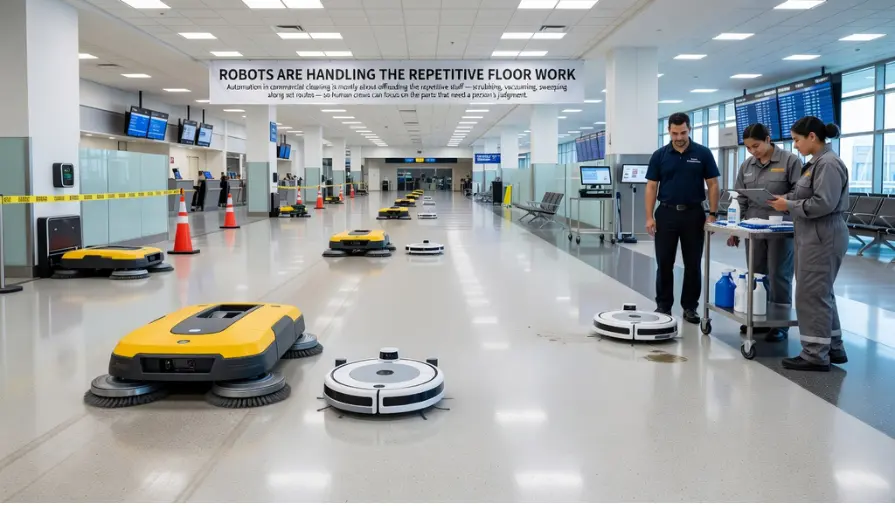
Automation in commercial cleaning is mostly about offloading the repetitive stuff — scrubbing, vacuuming, sweeping along set routes — so human crews can focus on the parts that need a person’s judgment. Robotic scrubbers and autonomous vacuums tend to perform best in large, open, predictable layouts: think airports, warehouses, big retail floors, or hospital corridors.
What robots still can’t do well is judge things a person notices instantly — a lingering odor, a stained corner, a spill that needs immediate attention, or a client complaint that requires a real response. That’s why the strongest setups treat automation as a layer added on top of a trained crew, not a replacement for one.
Getting good results from robotics in cleaning depends on the groundwork: mapped routes, properly trained operators, realistic charging schedules, clear safety protocols, and a manual backup plan for when something doesn’t go as expected.
3. Cleaning Decisions Are Becoming Data-Backed
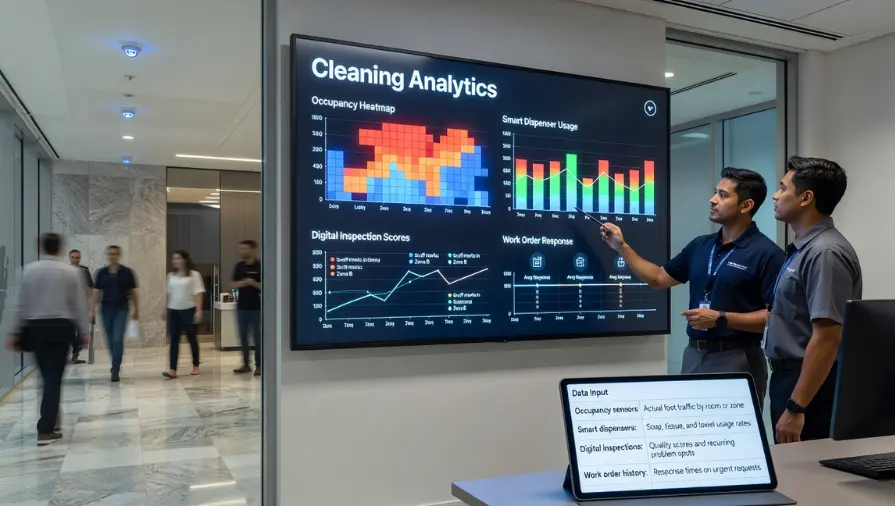
Data-driven cleaning is the practice of using real information from a building — not a fixed weekly schedule — to decide where and how often cleaning happens. A high-traffic lobby clearly needs more frequent attention than a hallway that barely sees foot traffic, and occupancy sensors, inspection history, and supply alerts make that obvious instead of left to guesswork.
This shift directly improves labor planning. Crews spend more time where it’s actually needed and less time over-servicing spaces that don’t require it. ISSA has flagged cleaning analytics dashboards as a meaningful piece of cleaning technology specifically because they hand managers real-time performance data instead of assumptions.
Data Input
What Managers Learn From It
Occupancy sensors
Actual foot traffic by room or zone
Smart dispensers
Soap, tissue, and towel usage rates
Digital inspections
Quality scores and recurring problem spots
Work order history
Response times on urgent requests
4. Scheduling and Work Orders Are Going Fully Digital
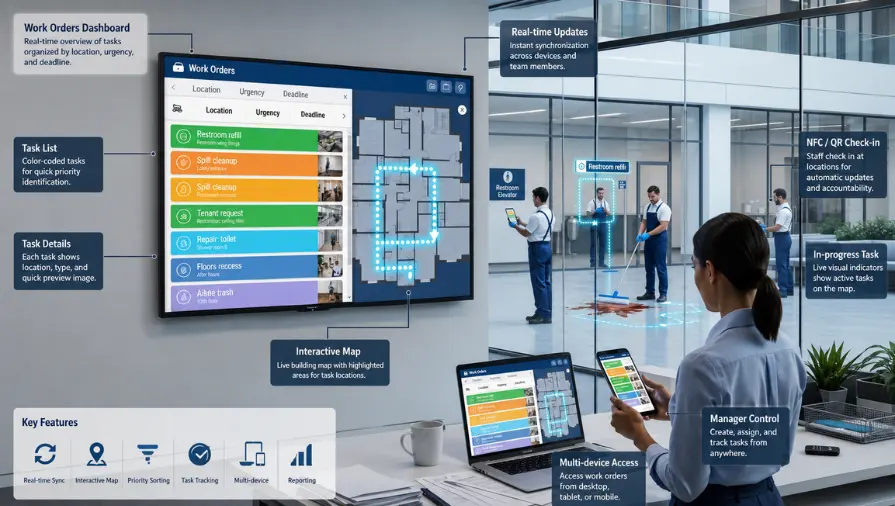
Smart scheduling and digital work order systems are quietly one of the most useful shifts on this entire list. They replace the usual mess of paper notes, group texts, and verbal shift instructions with a single organized workflow that everyone can actually see.
Cleaning needs shift constantly throughout a day — a restroom runs out of supplies, a spill needs immediate cleanup, a tenant calls in an extra request after hours. Digital work orders let a supervisor route the right task to the right person with location, urgency, deadline, and photo confirmation all attached.
Routing tools built into these platforms also save real time in larger buildings, cutting down the minutes crews lose walking between zones that aren’t next to each other.
5. Digital Inspections Are Replacing the Paper Checklist
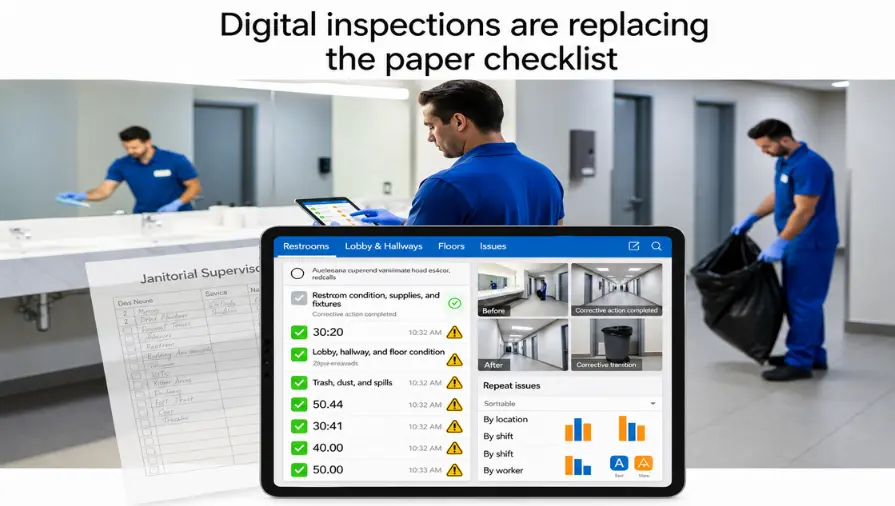
Digital inspection tools let janitorial teams check cleaning quality, document problems, and prove the work happened — with photos, scores, and timestamps that hold up better than a paper checklist ever could. Supervisors, cleaners, and clients can all pull up the same record.
Quality control matters because the small stuff is usually what triggers complaints. A restroom can look fine at a glance while an empty soap dispenser or a streaked mirror quietly shapes a client’s entire opinion of the service.
Restroom condition, supplies, and fixture status
Lobby, hallway, and floor condition by zone
Missed trash, dust buildup, or unaddressed spills
Photo evidence tied to corrective action notes
Repeat issues sorted by location, shift, or worker
That last point matters more than it sounds. A pattern of repeated failures in one spot usually points to a scheduling gap or training issue — not one careless cleaner having a bad day.
6. Disinfection Has Become More Science, Less Guesswork
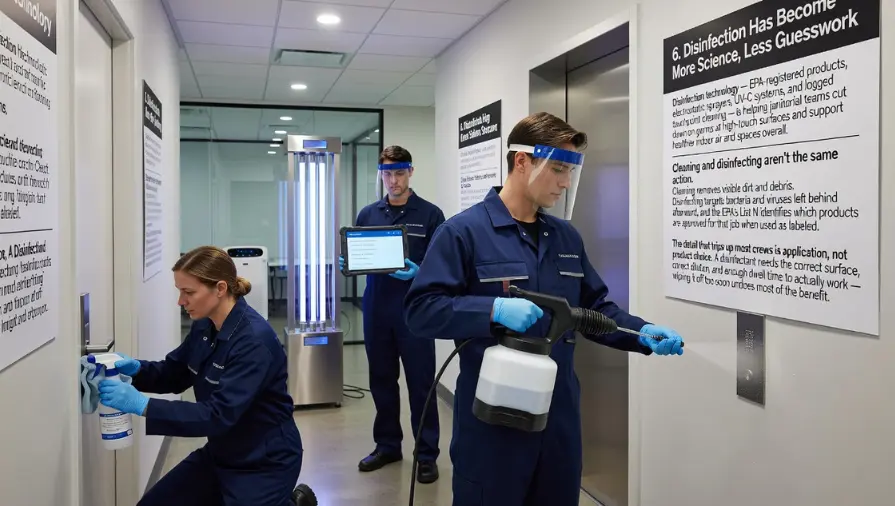
Disinfection technology — EPA-registered products, electrostatic sprayers, UV-C systems, and logged touchpoint cleaning — is helping janitorial teams cut down on germs at high-touch surfaces and support healthier indoor air and spaces overall.
Cleaning and disinfecting aren’t the same action. Cleaning removes visible dirt and debris. Disinfecting targets bacteria and viruses left behind afterward, and the EPA’s List N identifies which products are approved for that job when used as labeled.
The detail that trips up most crews is application, not product choice. A disinfectant needs the correct surface, correct dilution, and enough dwell time to actually work — wiping it off too soon undoes most of the benefit.
7. Sustainability Is Showing Up in Cleaning Innovation
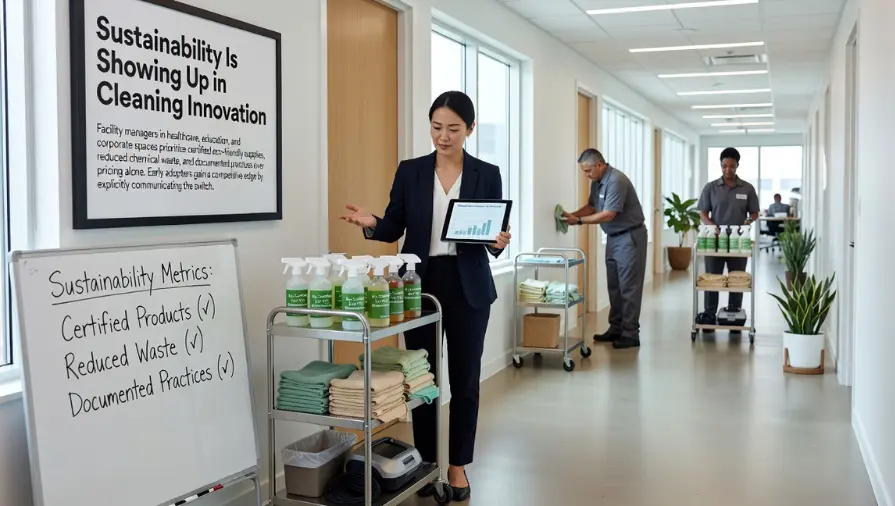
Green cleaning has moved well past being a marketing checkbox. Facility managers — particularly in healthcare, education, and corporate spaces with public sustainability goals — are increasingly asking about certified products, reduced chemical waste, and documented sustainable practices before they even discuss pricing.
This shift rewards cleaning companies willing to make the switch early. Certified eco-friendly supplies typically don’t cost dramatically more than standard products, but very few janitorial businesses mention the switch explicitly in their pitch — which makes saying it out loud a real point of difference.
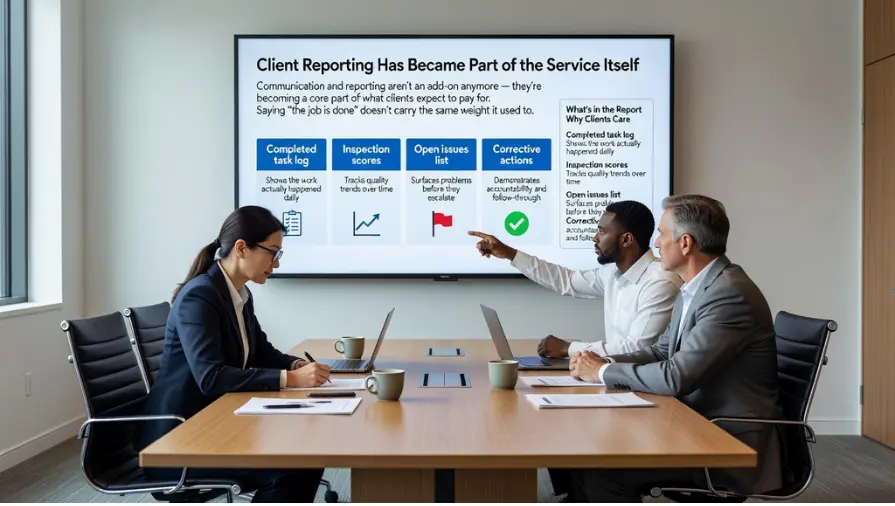
8. Client Reporting Has Become Part of the Service Itself
Communication and reporting aren’t an add-on anymore — they’re becoming a core part of what clients expect to pay for. Saying “the job is done” doesn’t carry the same weight it used to.
Facility managers want to see what got cleaned, when it happened, and what issues are still open.
Sharing inspection scores, completed task logs, open issues, and corrective actions matters most in offices, schools, healthcare facilities, and multi-site accounts where a missed task can quickly turn into a safety or satisfaction problem.
What’s in the Report
Why Clients Care
Completed task log
Shows the work actually happened daily
Inspection scores
Tracks quality trends over time
Open issues list
Surfaces problems before they escalate
Corrective actions
Demonstrates accountability and follow-through
9. Training and Safety Tools Are Moving to Mobile
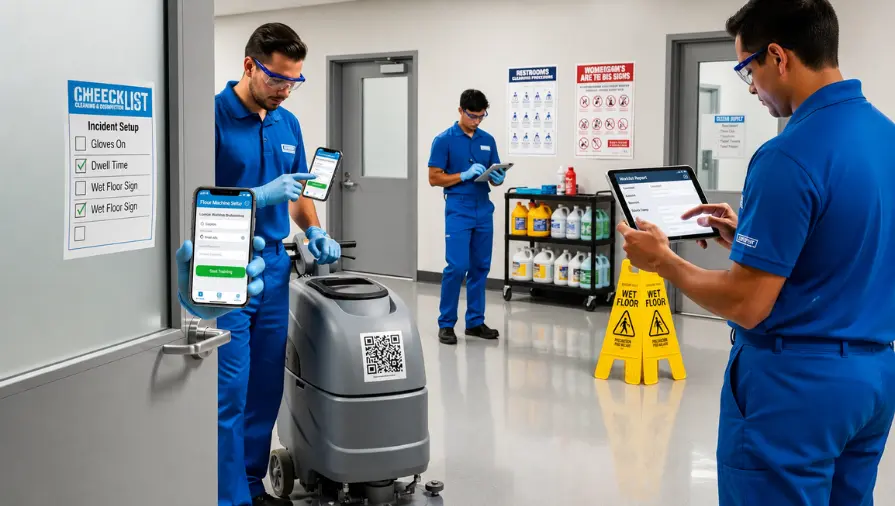
Workforce training and safety technology — mobile training modules, QR-code linked SOPs, digital safety checklists, and incident reporting apps — are helping janitorial teams stay consistent and safe across multiple sites without relying on memory from a single orientation day.
The work itself carries real risk. Cleaners regularly handle chemicals, work around wet floors, operate heavy machines, and sometimes work night shifts alone.
OSHA requires employers to train staff on these hazards — chemical safety, PPE use, equipment handling, emergency response — and digital tools are making that training easier to deliver in the moment it’s actually needed.
A QR code near a floor machine pulls up the correct setup instantly
Restroom checklists confirm dwell time, glove use, and signage requirements
Mobile incident reports get issues to a supervisor faster than a phone call chain
10. Data Privacy Has Entered the Cleaning Industry
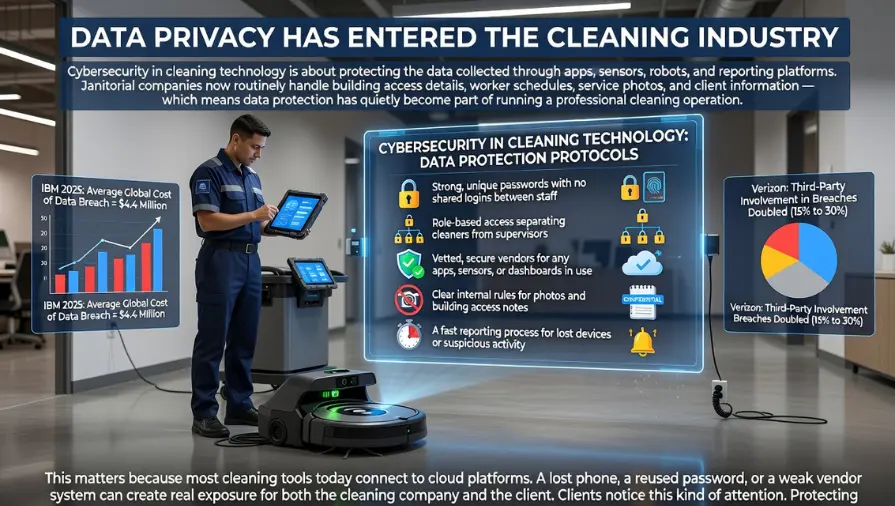
Cybersecurity in cleaning technology is about protecting the data collected through apps, sensors, robots, and reporting platforms. Janitorial companies now routinely handle building access details, worker schedules, service photos, and client information — which means data protection has quietly become part of running a professional cleaning operation.
This matters because most cleaning tools today connect to cloud platforms. A lost phone, a reused password, or a weak vendor system can create real exposure for both the cleaning company and the client.
IBM’s 2025 data put the average global cost of a data breach at $4.4 million, and Verizon found that third-party involvement in breaches roughly doubled — from 15% to 30% — in the same period.
Strong, unique passwords with no shared logins between staff
Role-based access separating cleaners from supervisors
Vetted, secure vendors for any apps, sensors, or dashboards in use
Clear internal rules for photos and building access notes
A fast reporting process for lost devices or suspicious activity
Clients notice this kind of attention. Protecting service records and building information with the same care given to cleaning quality builds a different level of trust.
11. Cost and ROI Decisions Are Getting More Scrutiny
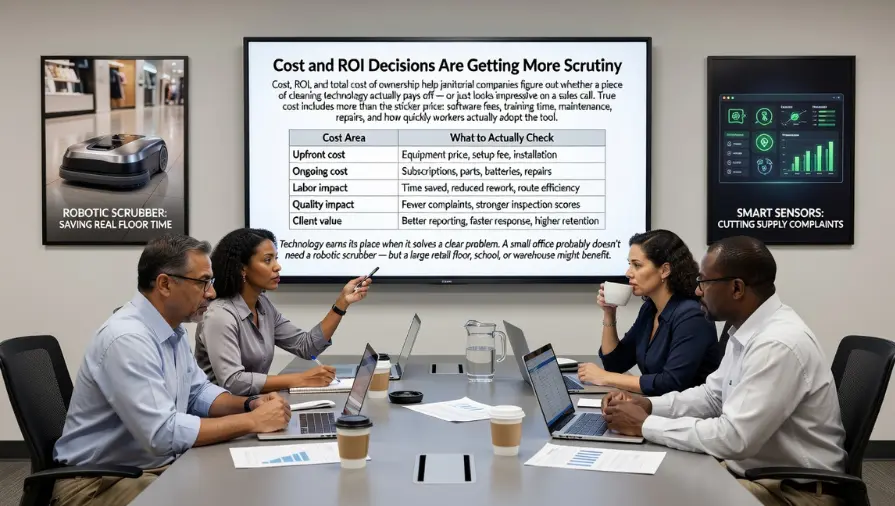
Cost, ROI, and total cost of ownership help janitorial companies figure out whether a piece of cleaning technology actually pays off — or just looks impressive on a sales call. True cost includes more than the sticker price: software fees, training time, maintenance, repairs, and how quickly workers actually adopt the tool.
A cheaper tool that breaks down often or slows a crew down can end up costing more over a year than a pricier option with better support and fewer interruptions. The real return on cleaning technology tends to come from practical gains — a robotic scrubber saving real floor-cleaning time, smart sensors cutting supply complaints, or scheduling software reducing the number of frantic supervisor calls.
Technology earns its place when it solves a clear problem. A small office probably doesn’t need a robotic scrubber — but a large retail floor, school, or warehouse might benefit significantly. Site size, layout, traffic, and cleaning frequency should all factor into whether the investment actually makes sense.
How to Roll Out New Cleaning Technology Without Disrupting Daily Work
Cleaning technology works best when it’s introduced in stages, not all at once. A smooth rollout starts by understanding current performance, testing the tool in one area, and expanding only once it proves real results — protecting day-to-day service quality while management figures out whether the tool genuinely helps.
New technology tends to fail when the process around it is vague. A robot, sensor, inspection app, or scheduling platform needs trained staff, clear ownership, and a defined goal — without that structure, it just becomes another task layered on top of the work instead of something that actually fixes a problem.
Step 1: Establish a Baseline Before Buying Anything
Measure current performance before introducing new technology — complaint frequency, inspection scores, labor hours, supply usage, equipment downtime, and response time all work as useful starting points. If restroom complaints spike after lunch, smart restroom sensors might help. If floor cleaning takes too long in a warehouse, a robotic scrubber might be worth testing.
Step 2: Pilot the Tool in One Zone First
Test new technology in a controlled, busy area before deploying it site-wide. A pilot running about 30 days gives a realistic picture, since cleaning demand naturally shifts with traffic, events, weather, and work schedules.
Technology Being Tested
Metric to Watch
Smart restroom sensors
Drop in supply-related complaints
Robotic scrubber
Reduction in floor cleaning time
Digital inspections
Improvement in inspection scores
Work order app
Faster response to issues
Step 3: Train the Team and Lock the Process
Training is what turns new technology into an actual daily habit rather than something workers avoid. Staff need to know how to use the tool, report problems, follow safety steps, and complete tasks consistently across every shift.
Supervisors need training too — dashboards and reports only create value if someone is actually reviewing and acting on them.
Step 4: Scale Gradually and Review Monthly
Expansion should only happen once the pilot has proven its value. Scaling tends to go more smoothly when similar sites are chosen first, with the process adjusted slightly for each new building.
Monthly reviews of complaints, labor time, inspection scores, supply waste, and response speed keep the rollout grounded in actual results rather than assumptions.
Frequently Asked Questions Janitorial Trend and Technology
1. What is the future of janitorial services?
The future of janitorial services is increasingly technology-supported rather than purely manual. Smart equipment, robotics, digital inspections, green cleaning practices, and data dashboards are helping cleaning teams improve consistency, safety, labor planning, and client communication — without replacing the trained workers who still handle judgment-based work.
2. How is technology changing janitorial services?
Technology is making cleaning operations more data-driven, trackable, and efficient overall. Sensors, robots, mobile apps, and inspection tools are letting teams clean based on actual building usage instead of fixed routes that treat every space the same way, regardless of demand.
3. Will robots eventually replace janitorial workers?
Not in any complete sense. Robots and automation handle repetitive tasks well — floor scrubbing, vacuuming, route-based cleaning — but they can’t judge odor, restroom condition, spills, clutter, or client complaints the way a trained person can. The realistic outcome is robots supporting crews on repetitive work while people continue handling detail and judgment-based cleaning.
4. What cleaning technologies are most commonly used in commercial janitorial services today?
Commercial janitorial operations are increasingly using smart sensors, robotic scrubbers, autonomous vacuums, digital inspection apps, work order software, chemical dilution systems, UV-C disinfection tools, air quality sensors, and client-facing reporting dashboards — though adoption varies heavily based on facility size and type.
5. How do smart sensors actually help a janitorial team day to day?
Smart sensors help janitorial teams track restroom traffic, supply levels, odor concerns, and overall occupancy patterns in real time. This lets crews respond faster, reduce wasted cleaning passes, prevent complaints before they happen, and focus attention on high-use areas at the right time instead of guessing.
Conclusion
The future of janitorial services isn’t really about swapping people out for machines — it’s about giving cleaning teams sharper tools, better information, better training, and a clearer way to prove the quality of their work. Smart equipment, robotics, digital inspections, green cleaning, disinfection technology, client reporting, and workforce safety tools are already reshaping how commercial cleaning operates day to day.
The janitorial companies that come out ahead will be the ones who adopt these tools thoughtfully, measure the actual results, and keep their workers at the center of the process instead of treating technology as a replacement for good people.
Cleaning technology earns its place when it solves a real problem. A company that starts with a clear pain point, tests one zone, trains its team properly, and reviews monthly results will improve service without throwing daily operations into chaos.
Commercial cleaning is one of the most accessible businesses anyone can start in the service industry. Startup costs are low compared to most businesses, the demand is consistent and growing, and once you land recurring monthly contracts, the revenue becomes predictable. There’s a reason thousands of people launch cleaning companies every year.
But starting right makes all the difference. The cleaning businesses that grow quickly and stay profitable are the ones that put the right foundation in place from day one — the right legal structure, insurance, pricing model, and a clear plan for getting their first clients. The ones that struggle are usually the ones that skip steps and figure it out as problems arise.
This guide walks you through every step required to start a commercial cleaning business in 2026 — from making your first decisions before you spend a dollar, all the way to landing your first contract and building toward growth.
Why Commercial Cleaning — And Why 2026 Is a Good Time to Start
The U.S. commercial cleaning market generated over $91 billion in 2024 and is projected to keep growing steadily through the next decade. The demand isn’t seasonal and it isn’t slowing down — businesses, healthcare facilities, schools, and retail spaces all need consistent, professional cleaning regardless of what’s happening in the broader economy.
Commercial cleaning also offers something most service businesses don’t: recurring revenue. When you sign a monthly janitorial contract, that same client pays you every month without you having to resell them. That predictability is what makes this industry so attractive as a business model.
Factor
Commercial Cleaning
Residential Cleaning
Franchise
Startup cost
$2,000–$10,000
$500–$5,000
$17,000–$225,000+
Revenue model
Recurring monthly contracts
One-time or weekly
Royalty-based
Avg contract value
$800–$5,000+/month
$100–$300/visit
Varies
Profit margin
40–60% (no royalties)
30–50%
Net 20–30% after fees
Growth potential
High
Moderate
Limited by territory
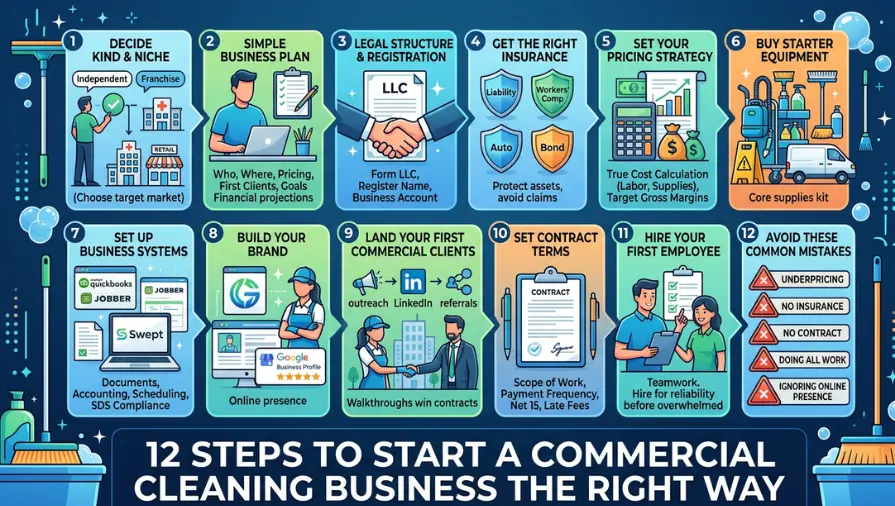
12 Steps to Start a Commercial Cleaning Business the Right Way
Starting a commercial cleaning business doesn’t have to be complicated — but it does have to be done in the right order. Skip a step early on and it tends to cost you time, money, or clients down the road. Here’s the exact sequence that works.
Step 1 — Decide What Kind of Cleaning Business You’re Starting
Before registering anything or buying a single supply, get clear on what you’re actually building. This decision shapes your insurance needs, equipment list, pricing, and which clients you’ll target.
Independent Operator vs. Franchise
A commercial cleaning franchise gives you a brand name, training program, and some built-in systems — but you pay for it through royalty fees that typically run between 5-12% of your gross revenue. An independent cleaning business keeps 100% of what it earns and has no territory restrictions.
Most commercial cleaning entrepreneurs in mid-sized markets are better served going independent.
Choose Your Niche Early
Generalists struggle. Specialists grow faster. Picking a niche — even loosely — sharpens your marketing message and helps you win clients who are looking for someone who understands their specific environment.
Office buildings — the most common starting point; predictable scope, consistent hours
Medical and dental offices — higher billing rates, compliance requirements (more on that below)
Retail spaces — often after-hours, high-traffic floor care emphasis
Post-construction cleanup — project-based, high per-job value
Not sure which niche fits your market? Browse the commercial industries we serve to see where demand is highest in your area.
Expert tip: Don’t try to serve every facility type from day one. Pick one or two niches, get very good at serving them, then expand. Specialized cleaning companies close contracts at higher rates than generalists.
Step 2 — Write a Simple Business Plan
You don’t need a 40-page document. You need a clear, honest plan that answers five questions before you spend any money:
Who are you cleaning for — what types of commercial facilities?
What geographic area will you serve?
What will you charge, and does that cover your actual costs?
How will you find your first clients?
What does the business look like at 6 months and 12 months?
Financial Projections to Include
Estimate your startup costs, your monthly operating expenses (supplies, insurance, transportation, software), and the minimum number of contracts needed to break even. This exercise alone prevents the pricing mistakes that sink most new cleaning businesses in their first year.
Step 3 — Choose Your Legal Structure and Register
Most new cleaning business owners register as either a sole proprietor or an LLC. The difference matters more than most people realize.
LLC Is the Right Choice for Most Cleaners
A Limited Liability Company (LLC) protects your personal assets — your savings, your car, your home — from business liability claims. In a service business where employees work in clients’ buildings and handle chemicals, that protection matters. An LLC also signals professionalism when you’re approaching commercial property managers for contracts.
Forming an LLC is straightforward in most states — typically involves filing Articles of Organization with your state’s Secretary of State office and paying a filing fee. The process can usually be completed online in a single afternoon.
Register Your Business Name
Your business name should be clean, professional, and available as a domain name. Check your state’s business name database, search the U.S. Patent and Trademark Office database for trademark conflicts, and secure the .com domain before you commit to the name.
Open a Dedicated Business Checking Account
Keep business and personal finances completely separate from day one. This makes bookkeeping cleaner, simplifies taxes, and is required by most banks if you want a business credit card or line of credit later.
Step 4 — Get the Right Insurance
This is not optional. If an employee damages a client’s property, slips on a wet floor, or a chemical causes surface damage, the right insurance is the only thing standing between you and a claim that could end the business. Most commercial facility managers will also ask for your insurance certificates before signing any contract.
Essential Coverage for Commercial Cleaning
General Liability Insurance — covers property damage and third-party injury claims (industry standard minimum: $1 million per occurrence)
Workers’ Compensation — legally required in most states the moment you hire your first employee
Commercial Auto Insurance — covers vehicles used for business purposes; personal auto policies typically exclude business use
Janitorial Bonds (Surety Bond) — protects clients against theft by your employees; many facility managers require this
Expert tip: Get certificates of insurance issued in the client’s name before every new contract. Having them ready in advance is a small detail that signals professionalism — and it removes one of the most common last-minute objections before signing.
Step 5 — Set Your Pricing Strategy
Pricing is where most new cleaning businesses make their biggest early mistake. They price to win the bid rather than to cover their costs and generate profit — and end up running busy schedules that barely break even.
Know Your True Cost Before You Quote
Every estimate needs to account for:
Labor — your time or your employee’s time, including drive time
Cleaning supplies and chemicals per job
Equipment wear and replacement
Insurance and bonding allocated per job
Overhead — software, phone, vehicle costs, etc.
Common Pricing Models
Model
How It Works
Best For
Typical Range
Square footage
Price per sq ft cleaned
Office buildings
$0.05–$0.25/sq ft
Hourly rate
Charge per hour of labor
Variable scope jobs
$35–$75/hour
Flat monthly rate
Fixed recurring fee
Standard recurring contracts
$500–$5,000+/month
Per service
Price per visit
Infrequent cleaning clients
$150–$800/visit
Target a gross margin of at least 40-50% on every contract. If the numbers don’t work at that margin, the pricing needs to go up — not the hours.
Step 6 — Buy Your Starter Equipment
You don’t need to spend a fortune on equipment to start. A focused starter kit gets you into your first contracts, and you add specialized equipment as the client base grows.
Reliable vehicle — cargo van or truck preferred for supply storage
Budget Expectation
A solid starter equipment kit for a solo commercial operator typically runs between $1,500 and $3,500. Add vehicle costs and initial insurance premiums and a realistic launch budget for most new cleaning businesses falls between $3,000 and $8,000 total.
Step 7 — Set Up Your Business Systems
The systems you build early will either support your growth or create chaos later. Setting these up before you land your first client is worth the time.
Accounting and Invoicing
QuickBooks Online or FreshBooks are the most practical starting points for a new cleaning business. Recurring invoicing for monthly contracts, expense tracking, and simple financial reports are all you need at this stage. Wave is a free alternative if budget is tight.
Scheduling and Job Management
As soon as you have more than two or three accounts, a scheduling tool like Jobber or Swept helps you track jobs, manage crews, and keep client communication organized — without relying on your memory or a stack of notes.
Safety Data Sheets and Compliance Records
Keep a current Safety Data Sheet (SDS) for every chemical you use. OSHA requires this for all cleaning operations with employees. Facility managers — particularly in medical settings — will ask for your SDS records as part of their vendor approval process.
Step 8 — Build Your Brand
Your brand is the first impression a facility manager gets before they ever meet you. A professional appearance at this stage costs very little but creates outsized credibility.
What You Actually Need at the Start
A clean, professional business name and logo
A simple website with your services, service area, and a contact form
Branded uniforms — even a simple polo shirt with your company name signals professionalism
A Google Business Profile with your accurate address, service area, and category
Business cards to leave after walkthroughs
Expert tip: Your Google Business Profile is one of the most valuable free tools available to a new cleaning business. Set it up completely, include photos, and start collecting reviews from your very first clients. Reviews from real clients convert skeptical facility managers faster than any sales pitch.
Step 9 — Land Your First Commercial Cleaning Clients
This is the step most guides gloss over — and the one that actually determines whether the business survives its first year. Getting good at client acquisition early is the difference between a business that grows and one that struggles to get off the ground.
Where to Find Commercial Cleaning Clients
Direct outreach to local office buildings, medical offices, and retail centers
LinkedIn — search for facility managers and property managers in your city
Google Business Profile — optimized profiles show up when people search for cleaning near them
Referral partnerships with commercial real estate agents and general contractors
Verified janitorial lead providers — who deliver appointment-ready prospects to your calendar
The Walkthrough Is Your Most Powerful Sales Tool
Never quote a commercial job remotely. Getting into the building, measuring the space, asking questions about their current pain points, and leaving a detailed, professional proposal behind is what separates cleaning companies that close contracts from ones that keep sending emails that go unanswered.
Walk the space. Dress professionally. Ask about their last cleaner. Then address exactly what they complained about in your proposal. This one-step approach wins more contracts than any marketing campaign.
“The first commercial contract is always the hardest. The second one is where you realize this business actually works.”
Step 10 — Set Your Contract Terms
Never start work without a signed service agreement. Your contract should clearly state the scope of work, service frequency, payment terms, notice period for cancellation, and liability limitations.
Keep it simple and readable — a one or two-page agreement is enough at this stage.
Payment Terms That Protect Your Cash Flow
Invoice at the beginning of each month for that month’s service
Net 15 payment terms — not Net 30 — to keep cash flow healthy
Late payment clause — a clear penalty for invoices paid after the due date
Auto-pay option — clients who pay automatically rarely miss a payment
Step 11 — Hire Your First Employee
Most cleaning businesses start with the owner doing the cleaning. That’s the right approach — you learn the work, understand the scope, and build your first client relationships personally. But at some point, usually around three to five accounts, you need to make your first hire.
What to Look for in Your First Hire
Reliability matters more than cleaning experience at this stage. Someone who shows up on time every day, follows instructions, and communicates problems can learn your cleaning process through your checklists.
Someone with perfect technique who calls in sick regularly is a liability.
Don’t Wait Until You’re Overwhelmed
Hire before you’re desperate. Training a new employee while you’re already stretched across five accounts running every job yourself is how quality slips and clients start complaining.
Bring someone on when you have three solid contracts — not when you have six and no time to breathe.
Step 12 — Avoid These 5 Common Mistakes
These are the mistakes that consistently hold back new commercial cleaning businesses — and they’re all avoidable.
Mistake 1 — Underpricing to Win the Bid
Winning a contract at a price that doesn’t cover your labor and supplies isn’t growth — it’s a slow drain on your energy and cash flow. Price for profit from the start, even if it means losing some early bids.
Mistake 2 — Starting Without Insurance
One damaged piece of equipment, one slip-and-fall in a client’s building, and an uninsured cleaning business is looking at a claim that can wipe out everything built so far. Get covered before you clean your first commercial building.
Mistake 3 — No Written Contract
A handshake agreement works fine until scope creep sets in, a client disputes an invoice, or someone wants to cancel without notice. A simple written service agreement prevents all of those problems.
Mistake 4 — Doing Everything Yourself Too Long
Staying in the cleaning role too long prevents the business from growing. At some point, every hour spent mopping floors is an hour not spent on sales, operations, and client relationships — the work that actually scales a cleaning business.
Mistake 5 — Ignoring Your Online Presence
A facility manager who can’t find you online assumes you’re not legitimate. Even a basic Google Business Profile with a few reviews is enough to establish credibility with local prospects who’ve never heard of you.
Conclusion
Starting a commercial cleaning business in 2026 comes down to making the right foundational decisions early — the right legal structure, the right insurance, the right pricing model, and a clear plan for finding clients before you need them urgently.
The steps in this guide aren’t complicated. They’re sequential. Work through them in order, don’t skip the ones that feel like paperwork, and focus the bulk of your energy on client acquisition from the very first week.
The businesses that succeed in commercial cleaning aren’t the ones with the fanciest equipment or the lowest prices. They’re the ones that show up professionally, deliver consistent work, and never stop filling their pipeline with new opportunities.
Managing money in a commercial cleaning business sounds simple on the surface. You invoice clients, pay your crew, buy supplies, and keep track of what comes in and goes out.
But once you’re juggling a dozen recurring contracts, multiple job sites, subcontractors, and a full payroll cycle — all while trying to actually run the business — the spreadsheet approach stops working fast.
Most janitorial business owners don’t realize how much money they’re losing to billing delays, missed invoices, and untracked expenses until those problems have already compounded. The right accounting software doesn’t just save you time — it plugs financial leaks that quietly drain profit from contracts you’ve already won.
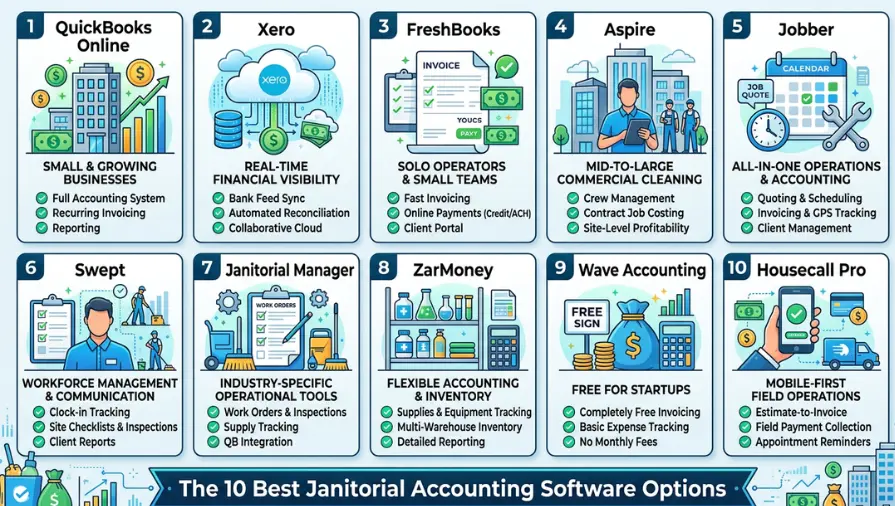
This guide covers the 10 best janitorial accounting software options available in 2026, including who each one is built for, what it does well, where it falls short, and the ideal use case for each. Whether you’re a solo operator looking for something simple or a growing commercial cleaning company managing multiple crews and clients, there’s a right tool for your situation.
The 10 Best Janitorial Accounting Software Options
1. QuickBooks Online
The most widely trusted accounting platform for small and growing cleaning businesses.
Best for: Small to mid-sized janitorial businesses that need a full accounting system with recurring invoicing and strong financial reporting.
Pros:
Automated recurring invoicing for monthly and weekly contracts
Expense tracking by category — supplies, labor, fuel, equipment
Real-time bank reconciliation and transaction matching
Profit & loss, cash flow, and balance sheet reports
Payroll add-on available for managing employee wages
Mobile app for invoicing and payment tracking on the go
Integrates with hundreds of apps including Jobber and Swept
Limitations:
Payroll costs extra on top of the base subscription
Built-in job costing is limited compared to janitorial-specific tools
Can feel complex for first-time users without accounting experience
Higher-tier plans needed for multi-user access
Ideal use case: QuickBooks Online is the go-to choice for cleaning businesses that are growing beyond basic bookkeeping and need a reliable, full-featured accounting system. If your accountant or bookkeeper already uses QuickBooks, this makes collaboration seamless.
2. Xero
Cloud-based accounting built for business owners who need real-time financial visibility across multiple sites.
Best for: Janitorial businesses managing multiple client locations or working with a remote bookkeeper.
Pros:
Real-time bank feed syncing and automatic reconciliation
Automated recurring invoices for ongoing cleaning contracts
Tracks income and expenses across multiple accounts
Strong integration with payroll tools like Gusto
Clean dashboard that’s easy to navigate without accounting experience
Accessible from any device, anywhere
Limitations:
No built-in payroll — requires a third-party integration
Reporting is less detailed than QuickBooks at similar price points
No dedicated janitorial or field service features
Customer support response times can be slow
Ideal use case: Xero works particularly well for cleaning business owners who want real-time financial data and clean bank reconciliation — especially if they work with an external accountant who prefers a collaborative, cloud-based platform.
3. FreshBooks
The simplest invoicing and expense tracking tool for cleaning business owners who want clean, fast billing without complexity.
Best for: Solo operators and small cleaning businesses that prioritize quick invoicing and easy client payment collection.
Pros:
Simple, clean invoicing with recurring billing options
Online payment acceptance via credit card and ACH
Time tracking built in — useful for billing hourly clients
Client portal for viewing and paying invoices online
Expense tracking with receipt photo capture from mobile
Professional invoice templates that look great
Limitations:
Limited financial reporting compared to QuickBooks or Xero
Not built for complex multi-site job costing
Client limit on lower-tier plans can be restrictive as you grow
Not ideal for businesses with large payroll needs
Ideal use case: FreshBooks is the right fit for a cleaning business owner who wants professional invoicing, fast payments, and simple expense tracking — without spending time learning a complex accounting system.
4. Aspire
A comprehensive business management platform built specifically for janitorial and landscaping companies at scale.
Best for: Mid to large commercial cleaning companies that need contract-level job costing, crew management, and operational reporting in one system.
Pros:
Contract-based job costing down to the individual site level
Built-in bid and proposal management for commercial contracts
Crew scheduling and work order management
Real-time profitability tracking per account
Client portal and communication tools
Designed specifically for janitorial and field services
Limitations:
Custom pricing with no publicly listed rates — requires a sales call
Learning curve is steep for smaller teams
May be more than a small cleaning business needs
Implementation takes time and training
Ideal use case: Aspire is built for commercial cleaning companies with multiple crews, complex contract structures, and a need for site-level financial reporting. If you’re running 30+ accounts and need to track profitability per client, Aspire is in a different league than general accounting tools.
5. Jobber
The best all-in-one tool for cleaning businesses that want scheduling, invoicing, and client management in a single platform.
Best for: Growing cleaning businesses that want to eliminate the need for separate scheduling software and accounting tools.
Pros:
Combines scheduling, quoting, invoicing, and payment collection
Automated follow-up reminders for unpaid invoices
Client hub where customers can approve quotes and pay online
QuickBooks and Xero integration for clean financial records
Mobile app with GPS and job tracking for field crews
Online booking for new client acquisition
Limitations:
Not a full accounting replacement — best paired with QuickBooks
Higher-tier plans needed for advanced reporting
Some users find the mobile app slower on older devices
Pricing increases as your team and client list grow
Ideal use case: Jobber is the top recommendation for cleaning businesses that want one platform to handle client-facing operations — quoting, scheduling, invoicing — while syncing clean financial data to QuickBooks or Xero in the background.
6. Swept
A janitorial-specific workforce management platform with time tracking, communication, and client reporting.
Best for: Janitorial business owners managing multiple cleaning crews across different commercial sites.
Pros:
Clock-in/clock-out tracking for each employee at each site
Built-in messaging between owner, supervisors, and cleaners
Cleaning checklists and inspection reports tied to each location
Supplies tracking to manage inventory across job sites
Client-facing inspection reports for contract renewals
Integrates with QuickBooks for payroll and billing
Limitations:
Not a standalone accounting tool — requires pairing with QuickBooks or Xero
Less useful for very small operations with one or two employees
Mobile interface can be slow in areas with poor connectivity
Setup requires time to configure each site and employee
Ideal use case: Swept is the right operational layer for a janitorial business that already has an accounting tool and needs a specialized system for managing crew performance, site-level checklists, and client communication.
7. Janitorial Manager
A cleaning-industry-specific platform that combines work orders, inspections, and QuickBooks integration for streamlined management.
Best for: Mid-sized janitorial businesses that want industry-specific tools alongside solid financial management.
Pros:
Work order management specific to janitorial accounts
Site inspection tools with client reporting features
QuickBooks integration for invoicing and financial tracking
Crew scheduling tied to contract and location data
Supply ordering and tracking within the same platform
Client communication and service history records
Limitations:
Pricing requires contacting the vendor directly — no public listing
Interface design feels dated compared to newer platforms
Better suited for established businesses than startups
Integration depth varies by QuickBooks plan
Ideal use case: Janitorial Manager works well for cleaning companies that want an industry-specific operational system with QuickBooks handling the financial side — particularly businesses that run formal inspections as part of their client service model.
8. ZarMoney
A flexible accounting platform with strong inventory management features — useful for cleaning businesses that track chemical supplies at scale.
Best for: Cleaning businesses that manage a significant amount of physical inventory — chemicals, consumables, and equipment.
Pros:
Customizable invoicing with item-level tracking
Inventory management for cleaning supplies and equipment
Multi-warehouse tracking for businesses with storage across locations
Financial reporting with profit and loss and balance sheets
Multi-user access with role-based permissions
Integrates with shipping and fulfillment tools
Limitations:
Less recognized than QuickBooks or Xero among accountants
Customer support quality reported as inconsistent
Interface can feel cluttered for users who don’t need inventory features
Fewer integration options than larger platforms
Ideal use case: ZarMoney is a good fit for janitorial businesses that need solid inventory management alongside invoicing — particularly those purchasing and distributing cleaning chemicals and consumables across multiple sites.
9. Wave Accounting
A completely free accounting platform that covers invoicing, expense tracking, and basic reporting — ideal for cleaning businesses just starting out.
Best for: Solo operators and startups who need professional invoicing and expense tracking without a monthly software bill.
Pros:
Completely free invoicing and accounting tools
Bank connection and transaction tracking at no cost
Professional invoice templates with recurring billing
Basic income and expense reports
Mobile app for on-the-go invoicing
Paid add-ons available for payroll and payment processing
Limitations:
Free plan has limited customer support
Payment processing and payroll features cost extra
Not built for complex multi-site job tracking
Fewer integrations than paid platforms
Reporting depth is limited compared to QuickBooks or Xero
Ideal use case: Wave is the right starting point for a solo cleaning operator or brand-new cleaning business that needs professional invoicing and basic financial tracking without spending on software. When you outgrow it, the data is easy to export.
10. Housecall Pro
A mobile-first field service platform with strong estimate-to-invoice workflows and payment collection — built for businesses that run from the field.
Best for: Cleaning business owners who manage their operation primarily from a mobile device and prioritize fast payments.
Pros:
Estimate-to-invoice workflow with one-tap approval
Credit card and ACH payment collection in the field
Automated appointment reminders and follow-ups for clients
Customer review request automation after job completion
QuickBooks integration for accounting sync
Reporting dashboard for revenue and job tracking
Limitations:
Higher starting price point than some alternatives
Full feature set requires higher-tier plan
Better suited for smaller contract counts than large commercial operations
Some advanced reporting requires a QuickBooks connection
Ideal use case: Housecall Pro is the right tool for a cleaning business where the owner is regularly in the field and needs to quote, invoice, and collect payment from a phone — with a professional client experience built in.
What to Look for in Janitorial Accounting Software
Not every accounting tool is built with a cleaning business in mind.
Before reviewing the list, here are the four features that matter most for janitorial companies:
Recurring invoicing — contracts bill weekly or monthly, so automation here saves hours
Job-level expense tracking — you need to know what each account actually costs to service
Payroll integration or management — labor is your biggest cost and needs clean records
Mobile access — owners and supervisors need to check invoices and payments from the field
Integration with field service tools — syncing with Jobber, Swept, or Janitorial Manager prevents double-entry
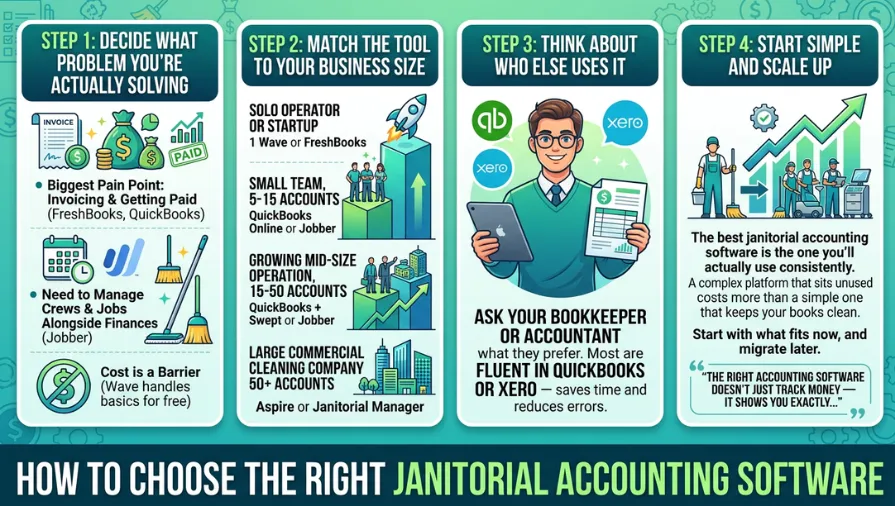
How to Choose the Right Janitorial Accounting Software
With ten solid options on this list, the choice comes down to a few practical questions about your business:
Step 1 — Decide What Problem You’re Actually Solving
If your biggest pain point is invoicing and getting paid on time, start with FreshBooks or QuickBooks. If you need to manage crews and jobs alongside finances, Jobber covers both. If cost is a barrier, Wave handles the basics for free.
Step 2 — Match the Tool to Your Business Size
Solo operator or startup — Wave or FreshBooks
Small team, 5-15 accounts — QuickBooks Online or Jobber
Large commercial cleaning company, 50+ accounts — Aspire or Janitorial Manager
Step 3 — Think About Who Else Uses It
If you have a bookkeeper or accountant, ask what they prefer. Most accounting professionals are fluent in QuickBooks or Xero — using a tool they already know saves you time and reduces errors.
Step 4 — Start Simple and Scale Up
The best janitorial accounting software is the one you’ll actually use consistently.
A complex platform that sits unused costs more than a simple one that keeps your books clean. Start with what fits now, and migrate to something more powerful when your operation demands it.
“The right accounting software doesn’t just track money — it shows you exactly where you’re making it and where it’s leaking out.”
Conclusion
Managing the financial side of a janitorial business gets more complex as you grow — and the tools you choose either support that growth or slow it down. The platforms on this list cover every stage, from a solo operator sending their first invoice to a commercial cleaning company managing dozens of accounts and a full crew.
QuickBooks Online remains the strongest all-around choice for most cleaning businesses. Jobber is the best option if you want field operations and billing in one place. And Wave is the right starting point when cost is the primary concern.
Pick the tool that fits where your business is right now — and that gives you room to grow into over the next few years.
Every commercial cleaning business owner reaches a point where word-of-mouth and referrals aren’t enough to sustain the growth they’re after. At that point, investing in a professional lead generation service becomes a logical next step — and almost immediately, a question comes up that doesn’t have a single obvious answer.
Pay per lead or subscription? Both models promise a pipeline of new prospects.
Both have their advocates. And depending on how your business is structured, which stage of growth you’re in, and what your cash flow looks like, the right answer can be genuinely different from one company to the next.
This guide breaks down exactly how both models work, where each one delivers value, and which one tends to produce better results for janitorial and commercial cleaning businesses — based on how the industry actually operates, not just how these services market themselves.
How Each Model Works
What Is Pay Per Lead?
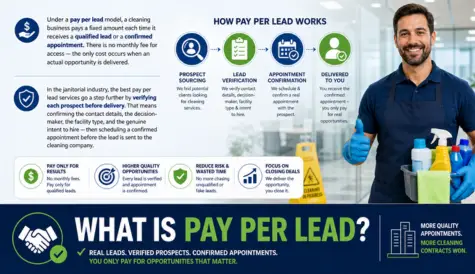
Under a pay per lead model, a cleaning business pays a fixed amount each time it receives a qualified lead or a confirmed appointment. There is no monthly fee for access — the only cost occurs when an actual opportunity is delivered.
In the janitorial industry, the best pay per lead services go a step further by verifying each prospect before delivery. That means confirming the contact details, the decision-maker, the facility type, and the genuine intent to hire — then scheduling a confirmed appointment before the lead is sent to the cleaning company.
What Is a Subscription Model?
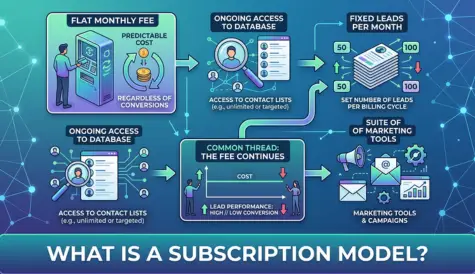
A subscription-based lead service charges a flat monthly fee in exchange for ongoing access to a database of contacts, a set number of leads per month, or a suite of marketing tools and campaigns. The cost stays the same regardless of how many leads convert.
Some subscription services offer unlimited access to contact lists. Others promise a fixed number of leads per billing cycle. The common thread is that the fee continues whether the leads perform well or not.
Side-by-Side Comparison of Pay Per Lead vs Subscription Cleaning
Factor
Pay Per Lead
Subscription
Winner
Upfront cost
None
Monthly fee required
Pay Per Lead ✅
Cost during slow months
Zero — no leads, no cost
Flat fee continues
Pay Per Lead ✅
Lead exclusivity
Exclusive (quality providers)
Often shared
Pay Per Lead ✅
Lead quality control
Verified before delivery
Varies widely
Pay Per Lead ✅
Volume flexibility
Scale up or down freely
Capped by plan tier
Pay Per Lead ✅
Cost predictability
Variable per lead
Fixed monthly cost
Subscription ✅
Access to contact database
No direct database access
Often included
Subscription ✅
Best for established volume
High-converting niches
High-volume outreach
Depends
The Real Case for Pay Per Lead
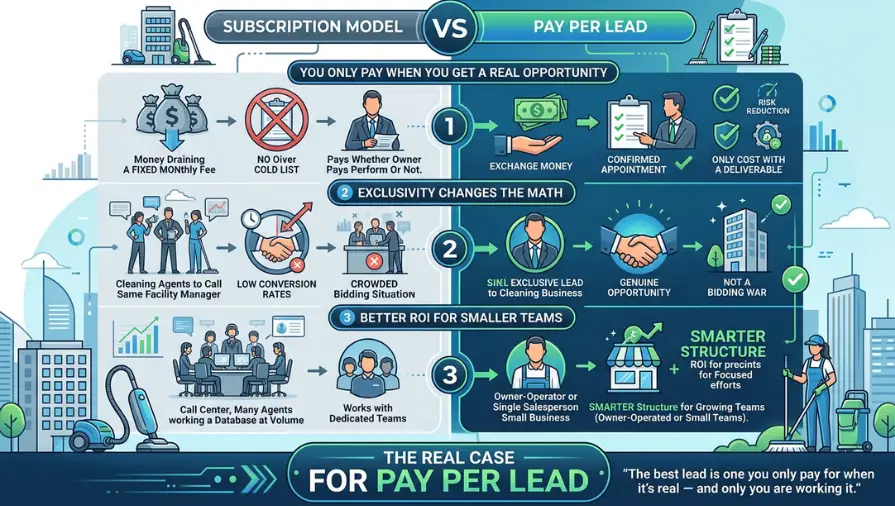
For the majority of commercial cleaning businesses — particularly those in the growth phase between a handful of accounts and a full-scale operation — pay per lead consistently outperforms subscription models. Here’s why.
1. You Only Pay When You Get a Real Opportunity
This is the single most significant advantage. A subscription charges you whether the leads perform or not.
If your contact list goes cold, if the quality dips one month, or if your team simply doesn’t have capacity to follow up on every name in the database, the fee still hits your account.
Pay per lead eliminates that risk entirely. There is no cost without a deliverable — and with a high-quality provider, that deliverable is a confirmed appointment with a real decision-maker, not just a name and a phone number.
2. Exclusivity Changes the Math
One of the most common frustrations with subscription-based lead databases is that the same contacts are being worked by multiple cleaning companies simultaneously. When five cleaners are all reaching out to the same facility manager, the conversion rate drops and the close rate suffers.
Exclusive pay per lead arrangements eliminate that problem. When a lead comes to you, it goes to you only — meaning the appointment you walk into is a genuine opportunity, not a competitive bidding situation triggered by a shared database.
3. Better ROI for Smaller Teams
A subscription service often makes more financial sense when a business has a dedicated sales team that can work a large database at volume. For most janitorial businesses — where the owner or one salesperson handles client acquisition alongside everything else — paying only for what actually comes through the door is simply the smarter structure.
“The best lead is one you only pay for when it’s real — and only you are working it.”
When a Subscription Model Makes Sense
Subscription-based services aren’t without merit. There are specific situations where the fixed monthly model does offer genuine advantages.
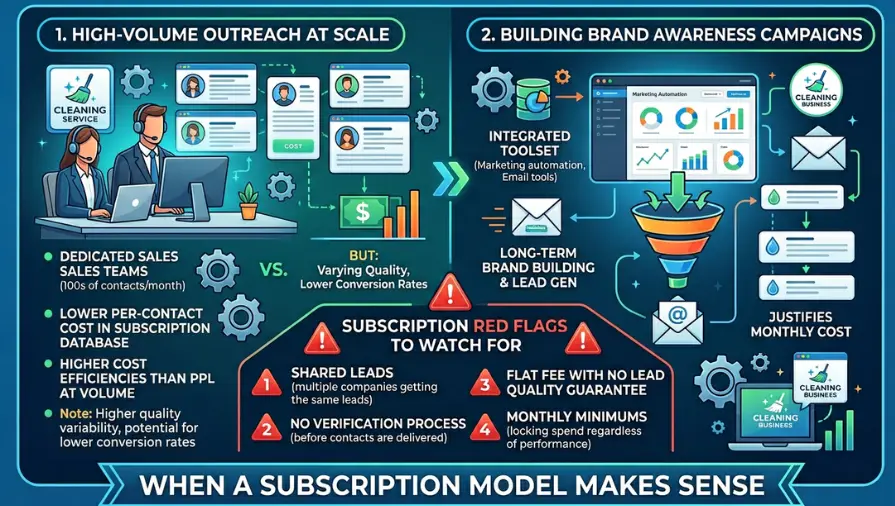
1. High-Volume Outreach at Scale
If a cleaning business has a dedicated outbound sales team that can work hundreds of contacts per month, a subscription database can deliver cost efficiencies that pay per lead cannot match at volume. The per-contact cost in a subscription database is typically lower — the trade-off is that quality varies and conversion rates tend to be lower as a result.
2. Building Brand Awareness Campaigns
Some subscription platforms include marketing automation, email campaign tools, and drip sequences. For businesses investing in longer-term brand awareness alongside direct lead generation, this kind of integrated toolset can justify the monthly cost.
The Subscription Red Flags to Watch For
Shared leads sold to multiple companies simultaneously
No verification process before contacts are delivered
Flat fee with no lead quality guarantee
Monthly minimums that lock in spend regardless of performance
What the Numbers Say
The cost of commercial cleaning leads varies significantly by source and model:
Shared leads from subscription databases — typically on the lower end per contact
Exclusive verified leads with appointment setting — higher cost per lead but significantly higher conversion rates
Google Local Services Ads — pay per call/lead model with strong local intent
Organic SEO leads — near-zero marginal cost after initial investment, highest long-term ROI
The key metric isn’t cost per lead — it’s cost per signed contract. A lower-cost lead that converts at a low rate is almost always more expensive in total than a higher-cost lead that converts at a high rate.
A cleaning company that closes 40% of appointment-set, exclusive leads is generating far more revenue per dollar spent than one closing 10% of a shared database — even if the database subscription cost is a fraction of the per-lead price.
How to Choose the Right Model for Your Business
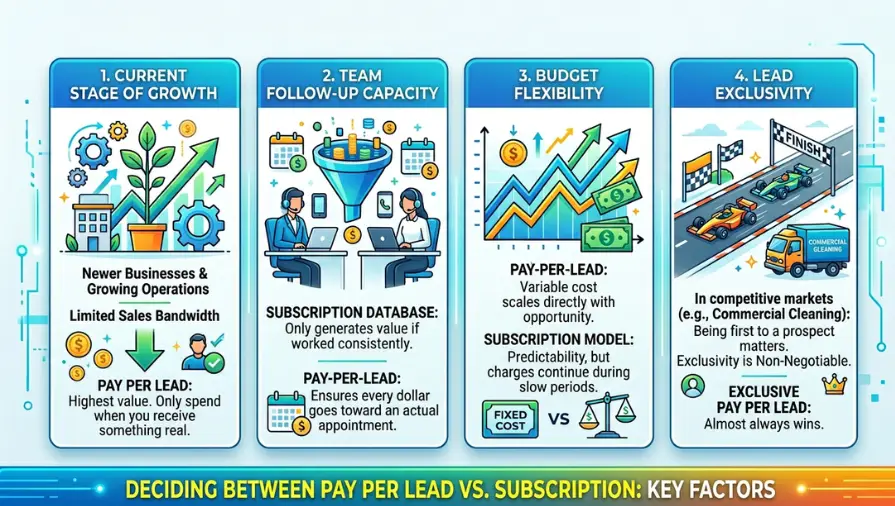
The decision between pay per lead and subscription comes down to four practical factors:
1. Your Current Stage of Growth
Newer businesses and growing operations with limited sales bandwidth get the most value from pay per lead. Only spend when you receive something real.
2. Your Team’s Follow-Up Capacity
A subscription database only generates value if someone is working it consistently. If your team can’t commit to high-volume outreach, a pay per lead model ensures every dollar spent goes toward an actual appointment.
3. Your Budget Flexibility
Pay per lead is inherently variable — which can feel uncertain, but also means cost scales directly with opportunity. Subscription models offer predictability but continue charging during slow periods.
4. Lead Exclusivity Requirements
If you’re in a competitive market where being first to a prospect matters — and in commercial cleaning, it almost always does — exclusivity is non-negotiable. Pay per lead with an exclusive model almost always wins here.
Conclusion
For most commercial cleaning and janitorial businesses actively working to grow their client base, pay per lead is the better model.
It aligns cost directly with value delivered, ensures exclusivity, eliminates the risk of paying during slow months, and — whensourced from a quality provider — delivers verified, appointment-ready prospects instead of raw contact lists.
Subscription models have their place — particularly for high-volume operations with dedicated sales teams — but for the majority of cleaning businesses in growth mode, paying only when a real opportunity arrives is simply the smarter financial decision.
“Don’t pay for access to a database. Pay for a real appointment with a real decision-maker who is expecting your call.”
You convert janitorial sales leads by qualifying them fast, running a sharp on-site walkthrough that exposes what your competitor is missing, sending a custom itemized proposal instead of a flat-rate quote, and following up consistently until the timing is right.
That’s the whole process in one sentence. But most cleaning companies lose contracts at every single one of those four steps — usually without realizing it.
B2B cleaning contracts are high-value, low-frequency decisions. A facility manager doesn’t switch cleaners on a whim — they switch when trust breaks down with their current provider and a better option is sitting right in front of them at exactly the right moment.
The companies that land the best opportunities are not always the cheapest. They are the ones that appear professional, stay visible, follow up quickly, and build trust before the decision is made.
“A janitorial lead isn’t won in the first phone call. It’s won in the follow-up nobody else bothered to send.”
Here’s exactly how to convert janitorial sales leads the right way.
Step 1 — Qualify Immediately, Before You Waste a Single Hour
Don’t Chase Every Lead — Chase the Right Ones
This is the step almost every cleaning company skips, and it’s the most expensive mistake in the entire sales process.
Define Your Ideal Client First
Decide your sweet spot before you ever pick up the phone — square footage range, target industry, contract type. In 2026, specialization wins.
Instead of saying “we provide commercial cleaning services,” say “we specialize in medical office cleaning with OSHA-compliant protocols,” or “we focus on large office buildings over 20,000 square feet.”
A defined niche doesn’t shrink your pipeline — it sharpens it. Specialization reduces price competition and increases average contract size, because you’re no longer competing against every generic cleaner in the city.
Ask the Three Questions That Actually Matter
During initial contact, find out:
What specifically frustrates them about their current cleaner
When their existing contract actually expires
What budget range they’re realistically working with
Expert Tip: If a lead can’t answer when their current contract ends, that’s your cue to ask if you can follow up closer to that date instead of pushing for an immediate decision.
Step 2 — Win the Walkthrough, Win the Contract
This Is Your One Real Chance to Outshine the Competition
The on-site walkthrough is where deals are actually won or lost — not the phone call, not the proposal. Trust is everything in the cleaning industry. Facility managers and property management companies prefer reliable partners, not one-time cleaners.
Find Out What’s Actually Wrong With Their Current Cleaner
Ask directly: what do you dislike about your current service? This single question often reveals exactly what to emphasize in your proposal — and what your competitor is failing to deliver.
Show Expertise They Didn’t Expect
Point out specific issues most cleaners miss on a casual walkthrough — high dusting that’s been neglected, floor buffing that’s overdue, scuffed baseboards nobody’s addressed in months. Then explain exactly how your team handles each one.
This single move does more to differentiate you than any pricing discussion ever will. It demonstrates expertise the prospect can see with their own eyes, not just hear in a sales pitch.
Expert Tip: Bring a tablet and take photos of problem areas during the walkthrough — referencing those specific photos in your follow-up proposal proves you actually looked, not just toured.
Step 3 — Deliver a Proposal That Sells Itself
Generic Pricing Sheets Lose to Itemized Value Breakdowns Every Time
Never send a flat-rate quote. It’s the fastest way to get compared purely on price — and price-only comparisons almost always go to the cheapest bidder, not the best one.
Break Down Pricing by Frequency and Scope
Itemize daily, weekly, and monthly service tiers separately rather than bundling everything into one number. This shows the prospect exactly what they’re paying for at each frequency — and makes it easy to see where they might add or reduce scope later.
Sell the ROI, Not Just the Clean
A strong commercial cleaning lead generation service prioritizes quality over quantity, ensuring your sales team speaks only with serious decision makers. When you do get in front of a serious decision-maker, make the proposal demonstrate return — not just cleanliness.
Show how consistent professional cleaning protects flooring, carpets, and fixtures from premature wear, and how a cleaner environment measurably improves employee morale and reduces sick days. Facility managers care about asset protection and budget justification — not just shiny floors.
Expert Tip: Include a simple before-and-after photo set from a comparable property in every proposal — visual proof outperforms written claims in every commercial cleaning pitch.
Step 4 — Follow Up Like the Sale Depends On It (Because It Does)
The Long Sales Cycle Is Where Most Cleaning Companies Give Up Too Early
Commercial cleaning contracts rarely close on the first conversation. A lot of janitorial businesses deliver excellent service but still struggle to grow. The pipeline stays inconsistent because of weak follow-up, not weak service.
Stay Visible Without Being Annoying
Follow up every few weeks with something genuinely useful — a relevant case study, a fresh set of before-and-after photos, information about eco-friendly products if that matters to their brand. Every touchpoint should add value, not just ask “are you ready yet?”
Time Your Follow-Up to Their Actual Contract Calendar
If a prospect is currently locked into a competitor’s contract, ask permission to add them to a mailing list and reach back out roughly 60 days before that contract ends. This is precisely when facility managers start evaluating alternatives — and being in their inbox at that exact moment beats cold outreach every time.
Expert Tip: Set a calendar reminder tied to their contract renewal date the moment you learn it — most lost opportunities aren’t lost to a competitor, they’re lost to bad timing.
What Separates Companies That Convert From Companies That Don’t
Weak Approach
Strong Approach
Pitches every lead the same way
Qualifies by size, industry, and budget fit first
Phone or email quote only
Always conducts an in-person walkthrough
Generic flat-rate pricing sheet
Itemized, frequency-based custom proposal
One follow-up, then gives up
Multi-touch nurture sequence over months
Talks only about cleaning tasks
Sells ROI — asset protection, morale, reliability
Cold-calls regardless of contract status
Times outreach to competitor contract expir
Conclusion
Converting janitorial sales leads isn’t about working harder on more leads — it’s about working smarter on the right ones.
Qualify fast so you’re not wasting time on poor-fit prospects. Win the walkthrough by showing expertise your competitor never demonstrated.
Send a proposal that sells value, not just a price. And follow up consistently, timed to when the prospect is actually ready to switch.
In commercial cleaning, great service helps you keep clients. Smart lead generation and conversion is what helps you win them in the first place.
Do these four steps consistently, and your close rate stops depending on luck — it starts depending on process.
Most cleaning business owners spend their week chasing leads that never turn into a contract. The problem usually isn’t the pitch — it’s that nobody ever booked a real appointment in the first place.
Commercial cleaning appointment setting is the process of securing face-to-face or virtual walkthroughs with the actual decision-maker at a facility — not a receptionist, not an assistant, the person who signs the contract.
Get this right, and your pipeline fills itself. Get it wrong, and you’ll spend months dialing numbers that go nowhere.
What Appointment Setting Actually Requires
Commercial cleaning appointment setting relies on highly targeted B2B outreach — cold calling, cold email, and property manager referrals — designed specifically to bypass gatekeepers and lock in time with qualified decision-makers.
It’s not about selling the cleaning service on the call. It’s about selling the meeting. That single mindset shift is what separates cleaning businesses with full calendars from the ones still cold calling the same dead leads three months later.
“Nobody buys a cleaning contract over the phone. They buy a fifteen-minute walkthrough. Everything else follows from there.”
Step 1 Identify the Right Decision-Makers First
Who You Should Actually Be Calling
Calling the front desk rarely leads anywhere. Your outreach should be aimed directly at Property Managers, Facility Managers, Office Administrators, or HR Directors — the people with the authority to actually approve a new cleaning vendor.
The Verticals Worth Your Time
Not every business is worth the call. Focus your energy on medical and dental offices, auto dealerships, multi-tenant commercial buildings, and daycares — these facilities need specialised, consistent cleaning and tend to have steady budgets allocated for it.
Qualify Before You Book
Only push for a meeting if one of these is true:
The prospect is unhappy with their current janitorial service
Their contract is coming up for renewal
They don’t currently have a cleaner at all
Booking appointments with unqualified leads wastes time on both ends. A qualified lead books faster and closes faster.
Step 2 Build a Multi-Channel Outreach Cadence
Time Your Cold Calls Properly
Call between 1:30 PM and 4:00 PM. Most facility and office managers are buried in their morning rush, but the early afternoon window is when they’re far more likely to actually pick up and talk.
What to Say — and What Not to Say
Don’t sell the cleaning service on the call. Sell the meeting.
A simple, low-pressure approach works best: introduce yourself, mention you work with similar buildings in the area, and ask for fifteen minutes for a complimentary walkthrough and estimate. The goal of every cold call is one outcome only — get the appointment on the calendar.
Use Cold Email to Reinforce the Call
Short, hyper-personalised emails outperform long pitches every time. Reference a specific detail about their building or industry, mention other local properties you service, and close with a simple ask for a short call or walkthrough.
Platforms like Apollo for B2B contact data and Smartlead for automated email sequencing make this process far more scalable than manual outreach alone.
Don’t Overlook Property Management Referrals
Local commercial real estate professionals are often the first to know when a new business signs a lease or a building changes management. Build a running relationship with two or three property management firms, and you’ll hear about new opportunities before your competitors do.
Step 3 Decide Between In-House and Outsourced Calling
Running It In-House
Hiring a dedicated remote cold caller or virtual assistant gives you full control over the script, the target list, and how your brand sounds on every call.
Outsourcing to a Specialist Agency
Agencies that specialise in B2B appointment setting for cleaning businesses handle the volume dialing and pre-vetting for you, freeing up your time to focus on walkthroughs and closing.
Neither option is automatically better — it depends on whether you’d rather control the process or scale the volume.
Step 4 Track Everything in a CRM
A CRM like HubSpot or Pipedrive keeps every touchpoint visible, so no lead falls through the cracks.
A standard, effective cadence runs three to four touchpoints across a ten-to-fourteen day window before archiving a cold lead. Beyond that point, most leads simply aren’t going to convert without a new angle.
Prepare Before Every Walkthrough
Before you ever step on-site, review the company size, the building layout, and any recent changes in their operations. Showing up with that knowledge already in hand is what makes a walkthrough feel like a consultation instead of a sales pitch.
Conclusion
Appointment setting for cleaning businesses isn’t about dialing more numbers — it’s about dialing the right numbers, at the right time, with one clear goal.
Sell the meeting, not the service. Qualify before you book. Track every touchpoint. Do that consistently, and your calendar stays full of walkthroughs that actually turn into signed contracts.
The janitorial industry remains one of the most resilient sectors in commercial services, with demand driven by a simple reality: every office, clinic, and retail space needs consistent, professional cleaning to operate. For business owners who have built a foundation of three or four loyal clients, the next stage of growth often presents a different challenge altogether — one that has less to do with cleaning quality and more to do with how the business itself is structured.
Many janitorial business owners reach a plateau not because demand is lacking, but because their operations were never built to handle scale. The systems, staffing, and sales processes that worked well at a small size start to strain under added volume, and without intervention, growth stalls before it truly begins.
This guide breaks down exactly how to grow a janitorial business fast — covering the contract types worth pursuing, the operational systems that protect quality, the staffing structure that allows an owner to step back from daily cleaning, and the local lead generation tactics that keep new opportunities arriving consistently.
1. Land High-Value Commercial Contracts
Commercial janitorial work offers something residential cleaning rarely does: predictable, recurring revenue. The challenge is identifying which commercial clients are worth pursuing — and approaching them the right way.
Target Smaller Clients With Higher Standards
Retail centers, warehouses, and other facility types all have different needs. Browse the industries we serve to find the highest-value targets in your market. These businesses tend to have smaller physical footprints but stricter cleanliness expectations, which creates room for premium, specialized pricing.
Don’t Underestimate Traditional Outreach
Cold calling and in-person visits remain effective in this industry. Visiting a business, requesting to speak with the office manager, and leaving a professional brochure behind still opens doors — particularly when followed up with a phone call or a personalized email within the week.
Build Relationships With Facility Managers
LinkedIn has become a practical tool for connecting directly with property and facility managers in a local area. A short, genuine introduction message often leads to conversations that cold outreach alone cannot.
“The janitorial businesses that grow fastest aren’t chasing more leads — they’re chasing the right ones, consistently.”
2. Standardize Your Operations
Growth without operational structure tends to create more problems than it solves. Standard operating procedures ensure that service quality remains consistent across every property, regardless of which employee is assigned to the job.
Document Property-Specific Checklists
Each building should have its own detailed task list — covering vacuuming schedules, restroom sanitizing procedures, and supply restocking requirements. This documentation forms the backbone of a scalable janitorial business growth strategy and significantly reduces training time for new hires.
Adopt Cleaning Management Software
Platforms such as Swept or Jobber allow owners to track employee clock-ins, manage supply inventory, and handle client inspections from a single system. As contract volume increases, this kind of software replaces the spreadsheets and informal tracking methods that quickly become unmanageable.
3. Build a Team Structure That Doesn’t Depend on the Owner
A janitorial business cannot scale while its owner remains the primary person performing the cleaning. At some point, the physical labor must transition fully to a trained team.
Hire for Reliability
Job boards such as Indeed and ZipRecruiter make sourcing cleaning staff straightforward. Reliability and communication should be prioritized in the hiring process, since cleaning technique can be taught effectively through standardized checklists.
Promote a Field Supervisor
Once multiple contracts are in place, promoting a trusted employee to a Field Supervisor role becomes essential. This person can manage random quality inspections, handle supply deliveries, and address minor client concerns directly — freeing the owner to focus on sales and overall business strategy.
4. Optimize Local Lead Generation
Sustainable growth depends on a steady stream of new business opportunities, which requires maintaining visibility wherever potential clients are actively searching.
Strengthen Your Google Business Profile
A fully completed Google Business Profile, supported by genuine client reviews, improves visibility in local search results — often the first place a facility manager looks when evaluating cleaning providers in their area.
Establish Referral Partnerships
Commercial real estate brokers, property managers, and office interior designers regularly work with businesses that require cleaning services. Offering a referral commission for every successful introduction transforms their existing professional network into a consistent source of new contracts.
Capture Active Searchers With Paid Ads
Google Local Services Ads place a business directly in front of decision-makers who are actively searching for commercial cleaning services. While organic strategies build momentum over time, this approach can generate qualified leads more immediately.
Conclusion
Growing a janitorial business fast is rarely the result of working harder — it is the outcome of building systems that allow growth to happen without the owner personally managing every detail. Identifying the right commercial clients, standardizing daily operations, developing a capable team structure, and maintaining consistent local lead generation are the four pillars that support sustainable expansion.
When these elements work together, fast growth stops being an aspiration and becomes a predictable outcome of well-structured operations.