Follow Us: Facebook

Answer Capsule: How to Get Medical Cleaning Leads

To win high-ticket medical cleaning leads and secure lucrative medical facility cleaning contracts, commercial cleaners must position themselves as compliance partners rather than just a janitorial service. Healthcare decision-makers prioritize risk mitigation. By demonstrating formal mastery of OSHA Bloodborne Pathogens (BBP) standards, HIPAA patient privacy rules, and specialized disinfection workflows, you remove the risk of cross-contamination and heavy compliance fines for the facility. This specific expertise is what transforms low-value bids into high-value, recurring healthcare janitorial leads.

1. Why Healthcare Facility Managers Reject Standard Cleaning Bids

Most commercial cleaning companies approach a medical office the same way they approach a standard corporate headquarters. They pitch a sparkling floor, wiped-down desks, and a low price point.

To a healthcare facility manager or compliance officer, that pitch is an immediate red flag.

Medical environments—ranging from local dental clinics to multi-theater surgical centers—operate under strict regulatory oversight. When evaluating medical facility cleaning contracts, decision-makers are actively scanning your pitch for two specific compliance pillars:

  1. Patient Privacy (HIPAA): A cleaning crew operating after hours has unprecedented access to areas containing Protected Health Information (PHI), such as patient charts on desks, un-shredded documents, or open computer terminals.
  2. Infection Control (OSHA): Exposure to blood, bodily fluids, and transmissible pathogens requires rigorous, documented protocols that protect both the cleaning staff and the facility’s patients.

If your proposal doesn’t explicitly outline how your team handles these risks, you won’t even make it past the initial screening.

Image Asset 1: The Healthcare Compliance Advantage

2. Positioning HIPAA Compliance as a Sales Asset

The Health Insurance Portability and Accountability Act (HIPAA) isn’t just for doctors and nurses. As a business associate, your commercial cleaning company can inadvertently trigger a massive data breach if a cleaner handles or looks at sensitive data.

To turn this into a magnet for high-value healthcare janitorial leads, build these two strategies directly into your sales process:

3. Mastering OSHA Bloodborne Pathogens for Premium Bids
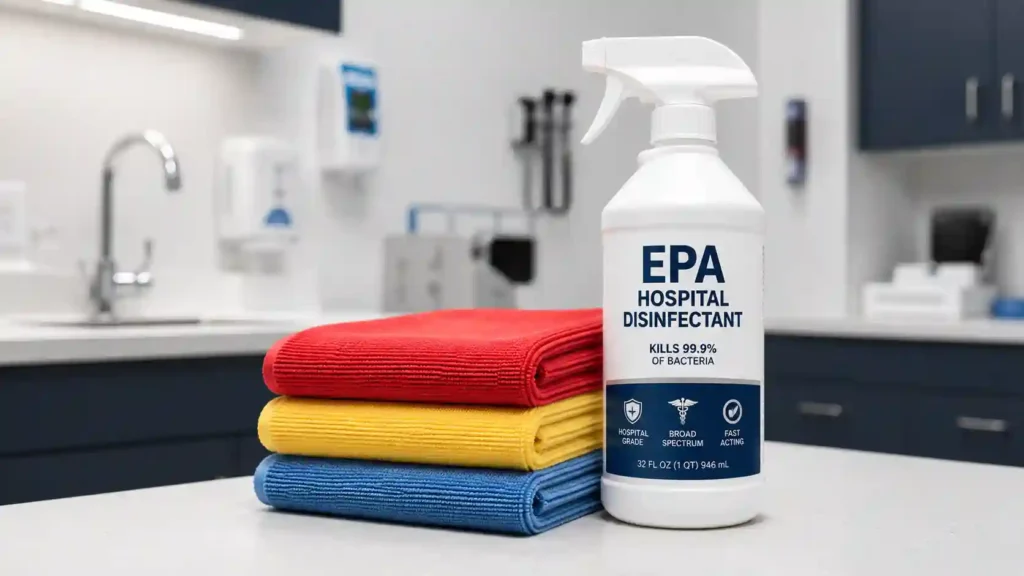
Color-coded microfiber cloths and hospital-grade disinfectant used to secure medical facility cleaning contracts through strict cross-contamination protocols.

You cannot safely secure medical accounts without a formal Bloodborne Pathogens (BBP) training program. Under OSHA standard 29 CFR 1910.1030, any employee with occupational exposure to blood or other potentially infectious materials (OPIM) must receive annual training.

When submitting terminal cleaning bids or general medical office proposals, include copies of your team’s BBP training certifications. Highlight your mastery of the following technical protocols:

Image Asset 2: Infection Control Standards

4. How to Structure Winning Terminal Cleaning Bids
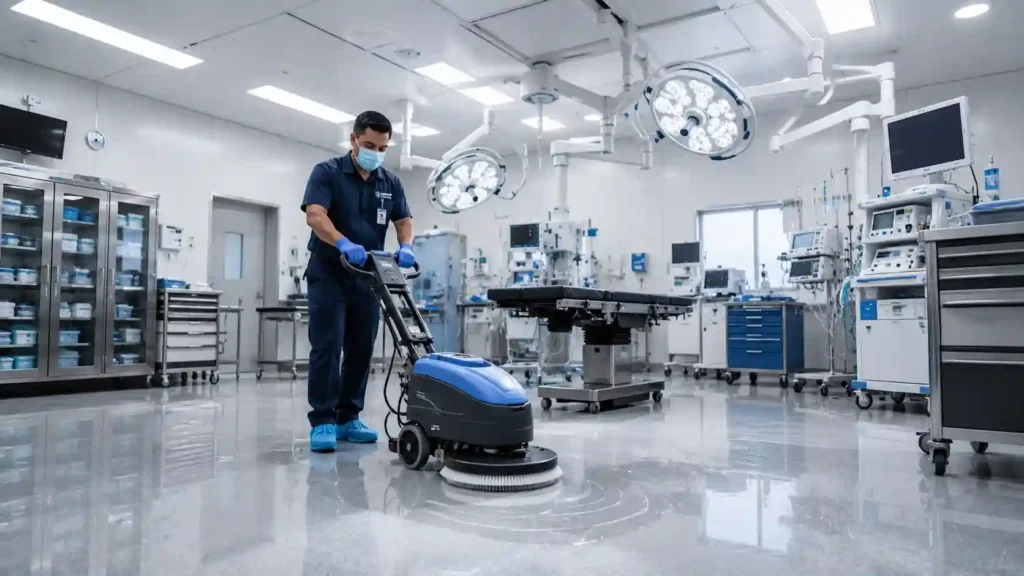
A commercial cleaning technician performing deep decontamination inside a surgical theater to secure high-ticket terminal cleaning bids.

True high-ticket revenue lives in surgical centers, outpatient clinics, and urgent care facilities that require terminal cleaning bids. Terminal cleaning is a specialized, intensive disinfection process designed to completely decontaminate an operating room or clinical space between procedures or at the close of the day.

When bidding on these contracts, your scope of work should detail a strict, top-down, clockwise cleaning pattern:

Step-by-Step Terminal Decontamination Protocol

  1. Ceiling Fixtures & High Surfaces: Dusting and disinfecting surgical lights, vents, and track systems first, ensuring any dislodged particles fall downward.
  2. The Clinical Zone: Intensive disinfection of all touchpoints within the patient zone, including examination tables, IV poles, Mayo stands, and digital diagnostic equipment.
  3. Perimeter & Low Touchpoints: Moving outward to disinfect countertops, cabinets, sinks, and waste disposal bins.
  4. Bio-Hazard Waste Handling: Safe removal of regulated medical waste using proper sharps and biohazard bag handling techniques.
  5. Floor Flood Disinfection: Applying hospital-grade disinfectant to the entire floor surface, allowing optimal dwell time before wet-vacuuming or microfiber mopping out of the room.

Image Asset 3: Specialized Terminal Cleaning

Final Strategy: Packaging the Proposal to Close the Lead

When a healthcare provider evaluates proposals, a cheap price tag looks dangerous. They know that cheap rates often mean undertrained staff, high turnover, and skipped compliance steps—risks that could cost the facility millions in fines or malpractice lawsuits.

To lock in premium medical cleaning leads, bundle your technical compliance directly into your final proposal package:

By selling compliance, safety, and risk reduction, you elevate your janitorial business above the competition and command the premium rates that high-ticket healthcare clients are more than willing to pay.

Frequently Asked Questions (FAQ)

What is a Business Associate Agreement (BAA) in medical cleaning?

A Business Associate Agreement (BAA) is a legally binding contract required by HIPAA between a healthcare provider and a third-party vendor (like a commercial cleaning company) that may encounter Protected Health Information (PHI). Proactively offering a signed BAA proves to medical facility managers that your janitorial staff is legally committed to maintaining strict patient data privacy.

How often must medical cleaning staff receive Bloodborne Pathogen training?

Under OSHA standard 29 CFR 1910.1030, any commercial cleaning employees who have occupational exposure to blood or other potentially infectious materials (OPIM) must receive formal Bloodborne Pathogen (BBP) training at least once every 12 months. Keeping interactive, updated training logs is a critical step to winning competitive medical facility cleaning contracts.

What disinfectants are required for healthcare janitorial leads?

To satisfy compliance checks for high-ticket healthcare janitorial leads, your team must exclusively use hospital-grade disinfectants listed on the EPA’s “List N.” These products are officially registered to kill resilient pathogens like MRSA, Norovirus, Influenza, and Bloodborne viruses (such as Hepatitis B and HIV) within specific dwell times.

What is included in a terminal cleaning bid for a surgical center?

A terminal cleaning bid outlines an exhaustive, top-down, clockwise decontamination process designed to completely sterilize a clinical space or operating room at the end of the day. Unlike standard janitorial services, it includes the meticulous disinfection of surgical lights, diagnostic equipment, Mayo stands, biohazard waste removal, and a full-floor flood disinfection.
Most commercial cleaning proposals lose contracts before the facility manager even finishes reading them. A flat-rate number at the bottom of a single page, no scope of work, no breakdown by frequency or task, and no reason for the client to understand what makes your company different — that’s what most proposals look like. And that’s exactly why they lose.

Facility managers and property managers receive multiple bids for most cleaning contracts. The ones who win consistently aren’t always the cheapest. They’re the ones whose proposals answer every question a decision-maker has before they have to ask it, and present that information in a format that makes signing feel like the obvious next step.

If you’re wondering how to write a commercial cleaning proposal that actually converts, this guide covers exactly how to structure and write one that stands out from generic competitors, justifies your pricing, and moves the prospect toward a decision.

Short answer: A winning commercial cleaning proposal includes a cover page, executive summary, detailed scope of work broken down by frequency, pricing structure, compliance documentation, and a clear call to action. It never presents just a single flat price.

Why Generic Proposals Lose Contracts

A generic proposal says the same thing to every prospect: here’s what we clean, here’s the price. A targeted proposal says something entirely different: here’s what we understand about your facility’s specific needs, here’s how we address the gaps your current provider is missing, and here’s the investment required to do it properly.

The difference between a generic proposal and a targeted one is the walkthrough. If you didn’t walk the facility and take notes, you cannot write a proposal that feels personalized — because it won’t be.

The 7-Part Commercial Cleaning Proposal Structure

Part 1 — The Cover Page

Your cover page is the first impression. It should include your company logo, your company name, the client’s company name and address, the proposal date, and a professional tagline or value statement. Keep it clean, branded, and professional.

Expert tip: Include the client’s property address and the exact date of your walkthrough on the cover page. This signals immediately that this proposal was prepared specifically for their facility — not copy-pasted from a template.

Part 2 — Executive Summary

The executive summary is one paragraph that captures the decision-maker’s attention by showing you understood what they told you during the walkthrough. Reference their specific pain points — slow response from their current provider, inconsistent restroom service, missed tasks that were never addressed — and explain directly how your company addresses each one.

Part 3 — Scope of Work by Frequency

This is the most critical section of the entire proposal. Never present cleaning as a single bundled service. Break it down by frequency — what happens daily, what happens weekly, what happens monthly. This approach does two important things: it shows the depth of your planning, and it creates natural upselling opportunities.

Daily tasks: High-touch surface disinfection, restroom servicing, trash removal, common area wipe-down, supply restocking
Weekly tasks: Detailed dusting, baseboards, interior glass, kitchen deep clean, carpet vacuuming
Monthly tasks: Hard floor burnishing, high dusting, vent cleaning, deep restroom descaling

Optional add-ons presented separately: carpet steam cleaning, exterior window washing, post-event cleanup — items that can increase contract value without being required for the base scope.

Part 4 — Pricing Structure

Never present a single flat price. Always present three pricing tiers: a standard package covering the core daily scope, a comprehensive package adding weekly detail tasks, and a premium package including monthly deep services. Pricing tiers serve two purposes: they give budget-conscious prospects an entry point, and they anchor the middle tier as the obvious value choice for most facility managers.

“A facility manager choosing between three options feels empowered. A facility manager staring at a single price feels pressured. Give them options.”

Part 5 — Your Qualifications and Compliance Documentation

Before the pricing section, many commercial clients want to see evidence that your company is qualified to operate in their facility. Include:

Presenting compliance documentation in the proposal itself removes a common objection before it’s raised and signals that your company operates at a commercial professional level, not a residential service level.

Part 6 — About Your Company

A brief ‘About Us’ section builds credibility — how long you’ve been operating, what types of facilities you specialize in, and any relevant industry experience or certifications. Keep it to 2-3 short paragraphs. This isn’t a marketing brochure; it’s a trust signal.

Part 7 — Terms and Call to Action

End with clear terms — contract length options, payment schedule, cancellation notice period — and a specific, direct call to action. ‘To begin service by [date], please sign and return this proposal by [date].’ A deadline, even a soft one, creates forward momentum that open-ended proposals never achieve.

Pricing Strategy — How to Present Numbers That Don’t Lose Bids on Price Alone

Anchor Pricing With Your Scope

When a facility manager sees a monthly price of $3,200 without context, the first instinct is to compare it to the cheapest alternative. When they see $3,200 preceded by three pages of exactly what that price delivers — daily disinfection, weekly detail tasks, monthly deep cleaning, full compliance documentation, and a replacement guarantee — the comparison looks very different.

Show the ROI, Not Just the Clean

Commercial cleaning has measurable business value beyond aesthetics. Consistent professional cleaning extends the life of carpets and hard floors, reduces employee sick days, and protects sensitive equipment from dust and contamination. Including two or three sentences about these outcomes reframes your pricing as an investment rather than a cost.

Proposal Follow-Up — What to Do After You Send It

Follow Up Within 48 Hours

Send a brief email or text 48 hours after delivering the proposal to confirm they received it and ask if they have any questions. Most cleaning companies send the proposal and wait — and silence almost always means the prospect moved on to another company that followed up more quickly.

Build In a Soft Deadline

Proposals with no expiration date create no urgency. Include a line that pricing is valid for 30 days, and follow up on day 25 if you haven’t heard back. This gives the prospect a real reason to make a decision rather than leaving the proposal in a pile indefinitely.

The Bottom Line

A commercial cleaning proposal that wins contracts is specific to the facility, breaks scope into clear frequencies, presents three pricing tiers instead of a single flat price, leads with compliance documentation, and ends with a clear call to action. The cover page shows them you prepared this for their building specifically. The scope shows them you know what the job actually involves. The pricing shows them they have options. The compliance documentation shows them you’re ready to sign today.

Most competitors are sending flat-rate quotes on a single page. A structured, thorough proposal is genuinely rare in this industry — which is exactly why it consistently wins against cheaper competitors.

A strong proposal is only as good as the walkthrough that precedes it. Need more verified, appointment-ready walkthroughs to practice on? Janitorial Leads Hub delivers confirmed meetings with qualified decision-makers — visit janitorialleadshub.com to get started.

Medical office cleaning is one of the most profitable niches in commercial janitorial services — and one of the most underserved.

Most general cleaning companies avoid healthcare facilities because of the compliance requirements, the stricter expectations, and the more demanding client oversight. That avoidance creates a real opportunity for cleaning businesses willing to prepare properly.

Healthcare facility managers are some of the most loyal commercial cleaning clients in the industry. When they find a provider who understands infection control, communicates reliably, and consistently meets their compliance requirements, they stay.

Annual recurring contract values for medical office cleaning typically run significantly higher than standard office accounts of comparable square footage — and turnover is lower.

This guide covers exactly how to get medical office cleaning leads — what it takes to qualify, how to find and approach decision-makers, and what separates cleaning companies that win healthcare contracts from the ones that get declined at the vendor approval stage.

Why Medical Office Cleaning Is Worth Pursuing

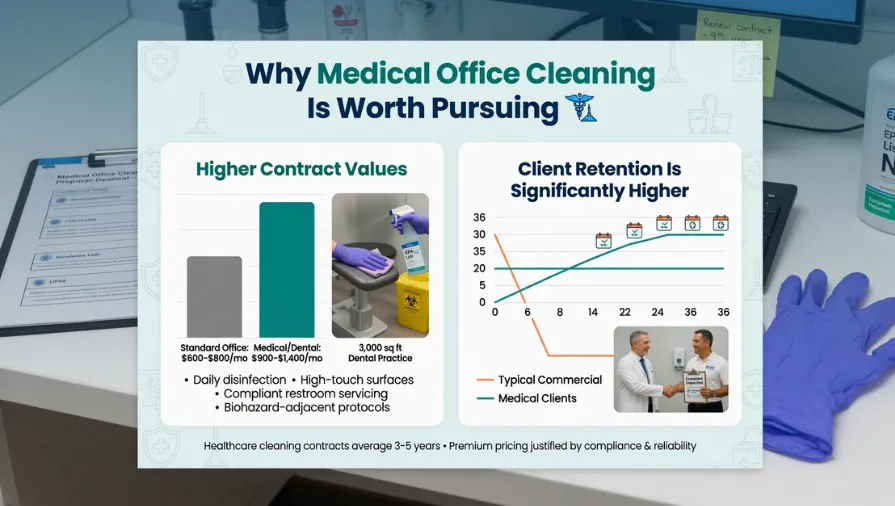
Infographic comparing medical office cleaning contract values and client retention, highlighting higher revenue and long-term healthcare cleaning opportunities for janitorial businesses.

Higher Contract Values

Medical offices require daily cleaning, specialized disinfection of high-touch surfaces, compliant restroom servicing, and often biohazard-adjacent protocols — all of which justify premium pricing compared to standard commercial cleaning. A 3,000 square-foot dental practice that would cost $600-$800/month to clean at standard office rates often runs $900-$1,400/month when properly scoped for healthcare.

Client Retention Is Significantly Higher

Healthcare clients who find a reliable, compliant cleaning vendor tend to stay for years rather than months. The qualification process for new vendors is more involved, the disruption of switching is greater, and facility managers who’ve dealt with the compliance issues of the wrong cleaning company are highly motivated to keep a good one.

What Healthcare Clients Look for in a Cleaning Company

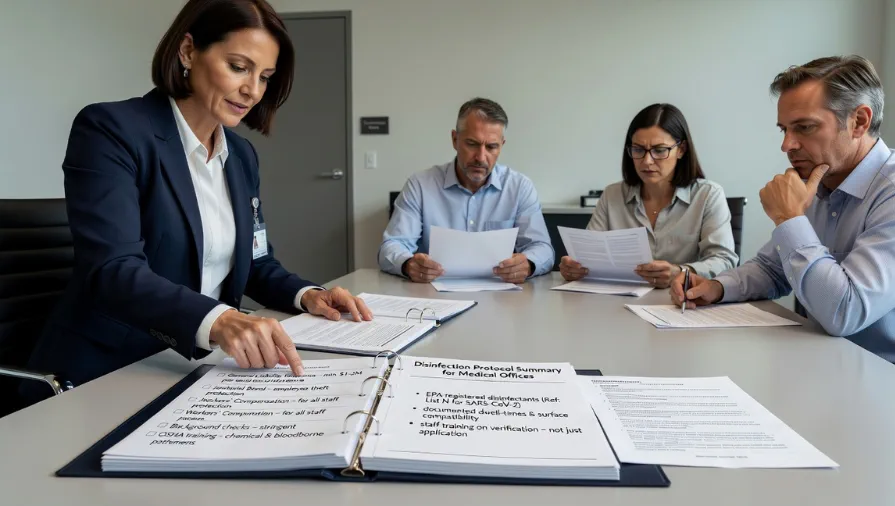
Healthcare facility managers reviewing a commercial cleaning proposal with documented disinfection protocols, OSHA compliance, EPA-approved procedures, and medical office cleaning qualifications.

Compliance Documentation First

Before any discussion of pricing or scheduling, healthcare facility managers want to see your compliance documentation. Walking into a meeting without these prepared — or worse, not having them at all — immediately disqualifies most cleaning companies from consideration.

Disinfection Protocol Documentation

Facility managers at medical offices want to know specifically which EPA-registered disinfectants you use, what the correct dwell times are for each product, and how your staff verifies that disinfection was completed correctly. This isn’t about impressive equipment — it’s about documented process.

GBAC STAR Accreditation — The Credential That Opens Healthcare Doors

GBAC (Global Biorisk Advisory Council) STAR accreditation is the cleaning industry’s most recognized credential for biohazard cleaning and disinfection programs. It requires documented training and protocols across 20 program elements, and it’s increasingly requested by healthcare systems as a baseline vendor qualification.

For a cleaning company actively pursuing medical office leads, GBAC STAR accreditation signals to facility managers that your cleaning protocols meet a globally recognized standard — which often removes compliance concerns entirely and allows the conversation to focus on fit and pricing rather than qualifications.

How to Find Medical Office Cleaning Leads

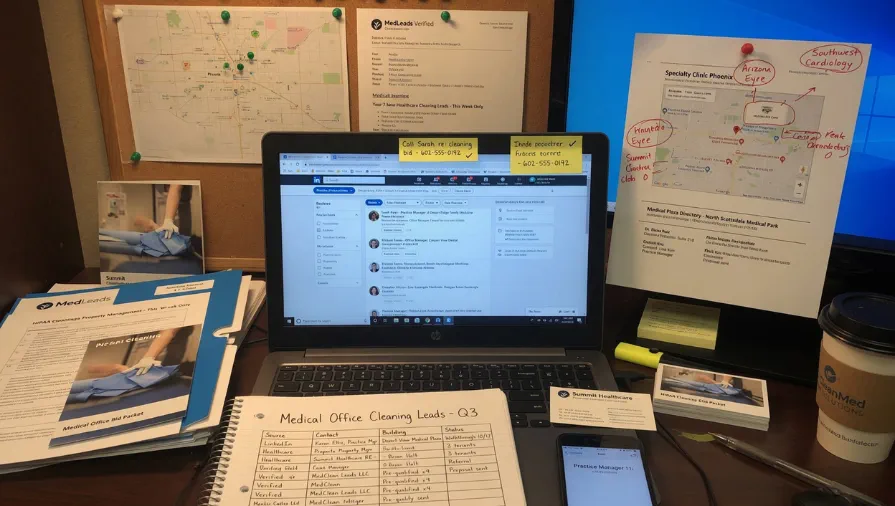
Workspace showing medical office cleaning lead generation process with LinkedIn outreach, clinic directories, healthcare contact lists, and qualified commercial cleaning leads.

1. Direct Outreach to Practice Managers

Standalone medical practices — primary care, specialty care, dental, and vision — are typically managed by a Practice Manager or Office Manager who also oversees facility vendors. These contacts are findable through LinkedIn, medical practice directories, and Google Maps searches for clinics in your service area.

2. Connect With Healthcare Real Estate and Property Management

Medical office parks and healthcare real estate companies manage multiple clinical tenants under one roof. One relationship with a healthcare property management company can produce multiple medical office cleaning leads from different practices in the same building — each requiring the same compliance preparation you’ve already done.

3. Work With Verified Lead Providers Who Source Healthcare Leads

Medical office cleaning leads are among the most sought-after commercial janitorial leads — and also among the most difficult to source independently without existing healthcare industry connections. A verified lead provider that sources and pre-qualifies healthcare facility contacts can compress months of prospecting into weeks of walkthroughs.

Positioning Your Company for Healthcare Facility Contracts

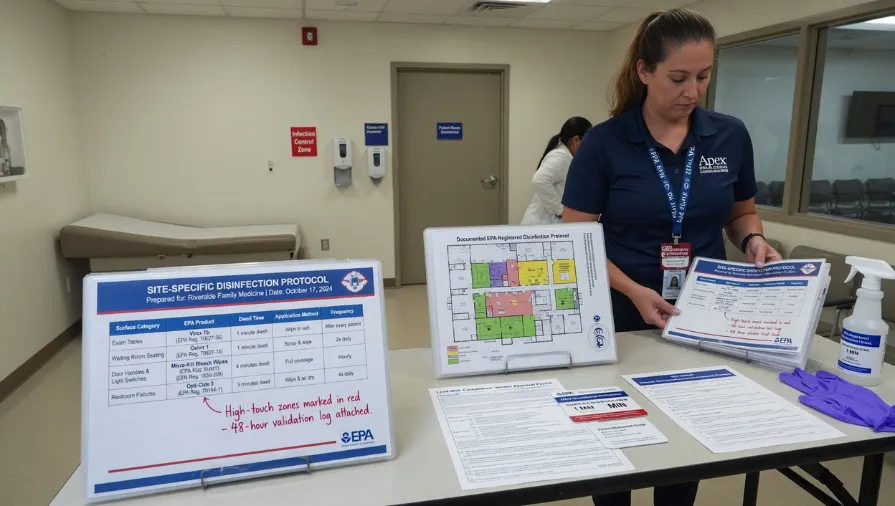
Janitorial professional presenting EPA-registered disinfection protocols, compliance documents, and healthcare cleaning safety procedures for a medical office cleaning contract.

Lead With Compliance in Every Conversation

General cleaning companies lead with ‘we clean offices.’ Healthcare-focused companies lead with ‘we operate documented EPA-registered disinfection protocols with staff trained on OSHA bloodborne pathogen awareness.’ The second positioning gets you through the vendor approval process. The first one often doesn’t.

Offer a Site-Specific Disinfection Protocol

For every medical office walkthrough, prepare a site-specific disinfection protocol that references the exact EPA-registered products you’ll use for each surface category — exam tables, waiting room seating, door handles, restrooms — with documented dwell times for each. No other competitor is doing this, and it converts walkthroughs into signed contracts at a notably higher rate.

Conclusion

Medical office cleaning leads represent some of the highest-value, most loyal commercial contracts available to janitorial businesses in 2026. The compliance requirements are real — but they’re also the barrier that keeps most competitors out.

A cleaning company that invests in the right documentation, training, and credentials positions itself for a niche where competition is thin, contract values are strong, and client retention is genuinely high.

Start with the compliance foundation. Get the insurance, the bond, and the OSHA training documentation in order. Then approach healthcare decision-makers with a proposal that leads with compliance — not just price.

Advertising a cleaning business in 2026 looks nothing like it did five years ago. Facebook posts that used to generate inquiries now get ignored. Generic Google Ads drain budgets without producing qualified commercial leads. And word-of-mouth — while still valuable — moves too slowly for any cleaning company trying to grow predictably.

The cleaning businesses pulling ahead right now are running a mix of strategies: some paid, some free, and some that require time instead of money. The key is knowing which channel fits your current stage and budget — and not spending on six things when three would do the job better.

This guide covers every advertising channel that actually works for cleaning businesses in 2026 — including which ones to prioritize first and what to skip entirely.

Google Local Service Ads deliver the fastest ROI for commercial cleaning client acquisition. Combined with an optimized Google Business Profile and consistent direct outreach, these three channels alone can fill a pipeline without expensive brand advertising.

The Problem With Most Cleaning Business Advertising

Most cleaning business owners try to advertise everywhere at once — Facebook, Google, flyers, Nextdoor, Instagram — and get thin results across all of them because no single channel is funded or managed well enough to work properly. Scattered advertising is almost always worse than focused advertising.

Pick the right two or three channels for where your business is right now and work them consistently for 90 days before adding anything else. That’s what actually builds a pipeline.

1. Google Local Service Ads — Best Paid Channel for Commercial Cleaning

Google Local Service Ads (LSAs) appear at the very top of search results — above regular Google Ads, above the map pack, above organic listings. They carry a Google Guaranteed badge and charge per lead rather than per click, which makes them significantly more budget-efficient than standard search campaigns.

Why LSAs Work Better Than Regular Google Ads for Cleaning

What You Need to Run LSAs

Expert tip: Your review count directly affects your LSA ranking. Before launching, collect reviews from current clients by sending a direct review request link via text or email. Even 8-10 reviews puts most cleaning companies ahead of local competitors.

2. Google Business Profile — Best Free Channel, Period

An optimized Google Business Profile consistently appears when local facility managers search for commercial cleaning companies in their area. It’s completely free, it works around the clock, and the reviews it collects compound in value over time as more clients add them.

What an Optimized GBP Actually Looks Like

The single highest-impact action on a Google Business Profile is collecting reviews. Businesses with 20+ recent reviews consistently outrank better-resourced competitors who haven’t prioritized them.

3. LinkedIn Outreach — Best for Reaching Commercial Decision-Makers Directly

LinkedIn is where property managers, facility directors, office managers, and commercial real estate professionals actually spend time during business hours. Cold outreach on LinkedIn consistently outperforms cold calling for commercial cleaning prospecting because the message arrives in a professional context and doesn’t interrupt the recipient mid-task.

A Simple LinkedIn Outreach System That Works

4. Facebook and Instagram Ads — Best for Brand Awareness, Not Direct Leads

Social media advertising for commercial cleaning produces better brand awareness than direct lead generation. Facility managers who see your ads consistently are more likely to respond positively when you reach out through another channel — but the ads alone rarely generate phone calls from commercial decision-makers.

Budget: $200-$300/month is enough to maintain visibility in your target area if you’re already running Google ads. Spend more here only after your other channels are working.

5. Direct Mail — Underrated for Large Commercial Targets

While most cleaning companies chase digital attention, the decision-makers at large commercial properties — office parks, healthcare campuses, multi-tenant buildings — still receive relatively little physical mail. A professionally designed postcard or folder, delivered to the right contact, stands out in a way that email simply can’t.

How to Make Direct Mail Work for Cleaning

6. Referral Partnerships — Lowest Cost, Highest-Quality Leads

Commercial real estate agents, general contractors, office interior designers, and property management companies are constantly in contact with businesses that need cleaning services. A referral from any one of these partners carries far more weight than a cold call — because the prospect already trusts the person who sent you.

A $100 referral gift card or a small commission per signed contract is often enough to keep a reliable referral partner actively sending opportunities your way.

7. Verified Lead Providers — Best When Time Is the Bottleneck

Every advertising channel above requires time — time to optimize, time to build relationships, time to see results. When a cleaning business needs to fill its pipeline faster than organic and outbound channels allow, a verified lead provider delivers appointment-ready prospects without the prospecting work.

The difference between a generic lead list and a verified lead provider is the appointment. A quality provider confirms the decision-maker, confirms their hiring intent, and books the walkthrough directly on your calendar — so you show up to a meeting that’s already warm.

The Bottom Line

Advertising a cleaning business in 2026 doesn’t require a big budget — it requires the right channels worked consistently. Google Local Service Ads and an optimized Google Business Profile handle the digital foundation. LinkedIn outreach and referral partnerships build the relationship layer. And a verified lead provider fills the gaps when you need faster results than organic channels deliver.

Start with Google LSAs and your GBP. Get 10 reviews. Run a simple LinkedIn outreach sequence in parallel. Add everything else once those three are producing consistent results.

Want to add a consistent stream of verified, appointment-ready commercial cleaning leads while your advertising strategy builds momentum? Janitorial Leads Hub delivers exclusive janitorial leads matched to your target industries — appointments set, delivered in 24 hours. Visit janitorialleadshub.com.

AI tools for cleaning businesses are everywhere in 2026, and cleaning business owners are being sold on the idea that they change everything. Some of it is real. A lot of it is hype. And the difference between the two matters when you’re running a service operation where every wasted dollar and wasted hour comes directly out of your margin.

The cleaning companies actually benefiting from AI tools aren’t the ones chasing the latest software announcement. They’re using AI for specific, high-frequency tasks where automation genuinely saves time — writing proposals, optimizing routes, drafting client emails, generating training materials — and ignoring the rest.

This guide breaks down the AI tools that actually deliver measurable value for cleaning businesses in 2026 — what each one does, what it costs, and whether it’s worth your time or just another subscription to cancel in three months.

Why AI Is Genuinely Useful for Cleaning Businesses Right Now

The cleaning industry has two chronic problems that AI is actually positioned to help with: repetitive admin tasks that eat owner time, and written communication that most cleaning business owners find genuinely difficult or time-consuming to do well.

Proposals, client emails, training documentation, job postings, and social media posts all follow repeatable structures. AI handles that kind of structured, repeatable text generation faster and more consistently than most people writing from scratch — which is where the real time savings come from.

The Best AI Tools for Cleaning Businesses in 2026

1. ChatGPT or Claude — Best for Writing Tasks

Large language model tools like ChatGPT (OpenAI) and Claude (Anthropic) are the most immediately useful AI tools available to cleaning business owners in 2026. They handle every writing task that cleaning companies face regularly — often in minutes.

2. Google Maps Route Optimization — Best for Multi-Stop Scheduling

If your crews service multiple accounts in a single shift, the order in which they visit accounts directly affects total drive time and labor cost. Google Maps’ built-in route optimization feature (available in the mobile app under ‘Add stops’) calculates the most efficient route sequence automatically.

For a crew visiting 4-5 accounts per night, route optimization typically saves 20-40 minutes of drive time per shift — which at a $20/hour labor cost translates to $7-$13 saved per shift, per crew, every night. It adds up fast across a year of operations.

3. Jobber’s AI Features — Best Integrated Operations AI

Jobber has integrated AI-powered features into its core platform — including automated client follow-up sequences, AI-generated invoice reminders, and smart scheduling that suggests crew assignments based on proximity and past performance. For cleaning businesses already using Jobber for scheduling and invoicing, these features activate without additional cost at higher-tier plans.

4. Swept AI Features — Best for Janitorial-Specific Automation

Swept, the janitorial-specific workforce platform, has added AI-powered inspection flagging that automatically identifies recurring issues in quality inspection reports and surfaces them to supervisors — so problems get caught as a pattern rather than individually complaint by complaint.

5. Canva AI — Best for Marketing Materials

Canva’s AI design tools let cleaning businesses create professional-looking proposal cover pages, before-and-after social media posts, company brochures, and business cards without design skills or a designer. The Magic Design feature generates a complete design from a text description in seconds.

6. Notion AI or Zapier — Best for Business Automation

For cleaning businesses managing multiple workflows — lead tracking, client onboarding, supply ordering, staff scheduling — Notion AI helps create and maintain documented processes, while Zapier connects different tools to automate handoffs between them. When a new lead comes in, Zapier can automatically add them to your CRM, send a follow-up email, and create a scheduling task — without any manual steps.

Where AI Doesn’t Help (And Why You Shouldn’t Try)

Client Relationship Management

AI can draft an email but it can’t build a relationship. The reason commercial facility managers renew contracts isn’t because of automated communication — it’s because of consistent quality, fast problem resolution, and the human reliability that comes from a real team they trust. AI augments communication; it doesn’t replace relationship building.

Quality Control and Inspection

Photo-based inspection apps with AI flagging help surface patterns, but a supervisor walking a facility still catches things that no algorithm identifies — the smell that signals a floor hasn’t been properly rinsed, the restroom where paper supply placement is technically correct but practically wrong, the corner that looks clean in a photo but isn’t on inspection.

How to Start Using AI Without Overwhelming Your Operation

Step 1 — Start With One Writing Task

Pick the most time-consuming writing task in your business — proposals, job ads, or client emails — and use ChatGPT or Claude exclusively for that task for 30 days. Measure how much time you save before adding anything else.

Step 2 — Add Route Optimization to Every Multi-Stop Shift

Before sending any crew out on a multi-stop shift, spend 3 minutes building the optimal route in Google Maps. Track the before-and-after drive time for one month to quantify the savings.

Step 3 — Evaluate Platform-Native AI Features

If you’re already using Jobber or Swept, check which AI features are available at your current plan tier before subscribing to any separate AI tools. Most platform-native AI features are significantly more useful than standalone tools because they work with your existing data.

The Bottom Line

AI isn’t going to run your cleaning business for you in 2026. But it will handle the writing tasks that slow you down, help optimize routes that waste crew time, and automate the follow-up sequences that most cleaning companies let go cold. That’s where the real value is — not in replacing what makes a cleaning business work, but in removing the friction around the edges.

Start with ChatGPT for your next proposal. Use Google Maps route optimization on your next multi-stop shift. Measure the time saved. Then decide what else is worth adding based on what you actually find valuable — not based on what the latest AI newsletter says you should be doing.

Pricing is where more cleaning businesses quietly fail than at any other point in their growth. Not because the work is bad or the clients are hard to find — but because the bids are wrong.

Either priced too low to win the contract fast, or priced without understanding true labor costs well enough to stay profitable once the contract starts.

The cleaning companies that grow consistently and stay healthy financially are the ones that understand exactly what every hour of cleaning actually costs their business — and price from that number upward, not from what a competitor quoted.

This guide covers every janitorial pricing model available in 2026 — how each one works, when to use it, what the market rates look like, and how to calculate your true cost before you ever put a number on paper.

The 4 Janitorial Pricing Models — How Each One Works

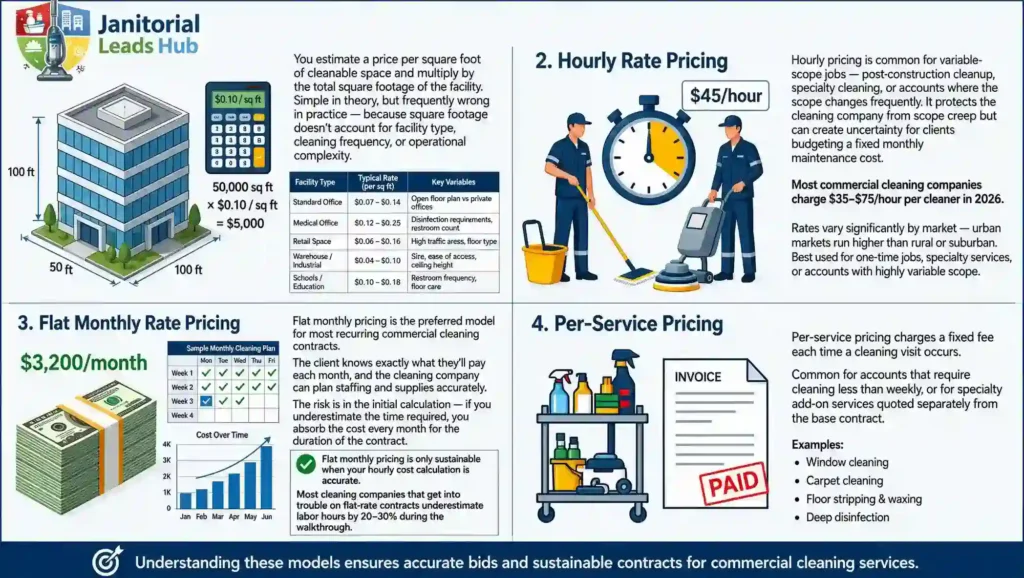
Infographic explaining the four janitorial pricing models including square footage pricing, hourly rates, flat monthly pricing, and per-service pricing for commercial cleaning contracts.

1. Square Footage Pricing

Square footage pricing is the most common starting point for commercial cleaning bids. You estimate a price per square foot of cleanable space and multiply by the total square footage of the facility.

Simple in theory, but frequently wrong in practice — because square footage doesn’t account for facility type, cleaning frequency, or operational complexity.

Facility TypeTypical Rate Per Sq FtKey Variables
Standard office$0.07–$0.14/sq ftOpen floor plan vs private offices
Medical office$0.12–$0.25/sq ftDisinfection requirements, restroom count
Retail space$0.08–$0.16/sq ftHigh-traffic areas, floor type
Warehouse / industrial$0.04–$0.09/sq ftFloor care complexity, facility size
Schools / education$0.10–$0.18/sq ftRestroom frequency, floor care

2. Hourly Rate Pricing

Hourly pricing is common for variable-scope jobs — post-construction cleanup, specialty cleaning, or accounts where the scope changes frequently. It protects the cleaning company from scope creep but can create uncertainty for clients budgeting a fixed monthly maintenance cost.

3. Flat Monthly Rate Pricing

Flat monthly pricing is the preferred model for most recurring commercial cleaning contracts. The client knows exactly what they’ll pay each month, and the cleaning company can plan staffing and supplies accurately.

The risk is in the initial calculation — if you underestimate the time required, you absorb the cost every month for the duration of the contract.

Flat monthly pricing is only sustainable when your hourly cost calculation is accurate. Most cleaning companies that get into trouble on flat-rate contracts underestimated labor hours by 20-30% during the walkthrough.

4. Per-Service Pricing

Per-service pricing charges a fixed fee each time a cleaning visit occurs. Common for accounts that require cleaning less than weekly, or for specialty add-on services quoted separately from the base contract.

How to Calculate Your True Hourly Cost

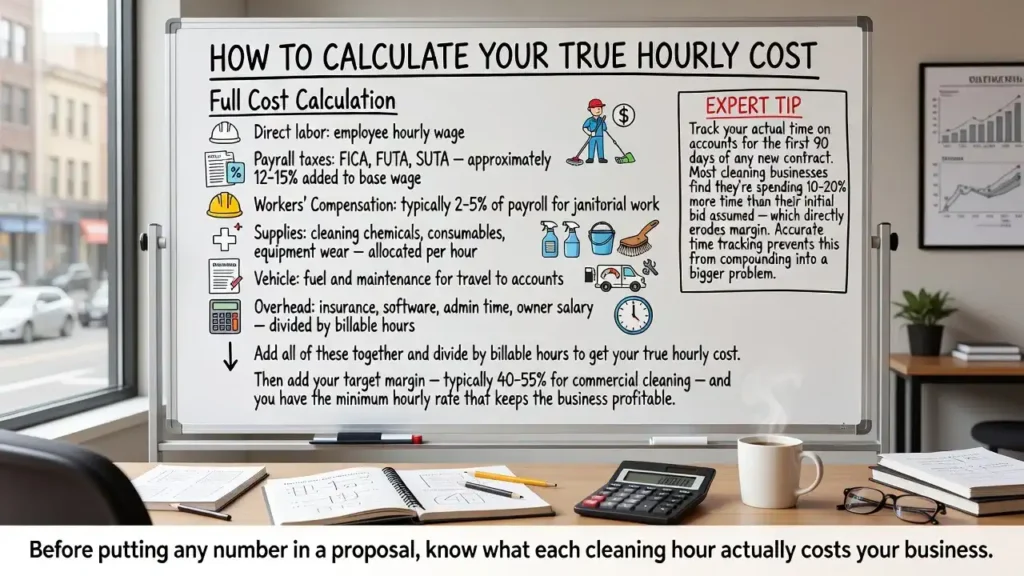
Commercial cleaning hourly cost calculator showing labor, payroll taxes, workers' compensation, supplies, overhead, and profit margin calculations for janitorial services.

Before putting any number in a proposal, you need to know what each cleaning hour actually costs your business. Most owners underestimate this by a significant margin because they calculate direct labor but forget the indirect costs that attach to every hour of work.

The Full Cost Calculation

Add all of these together and divide by billable hours to get your true hourly cost. Then add your target margin — typically 40-55% for commercial cleaning — and you have the minimum hourly rate that keeps the business profitable.

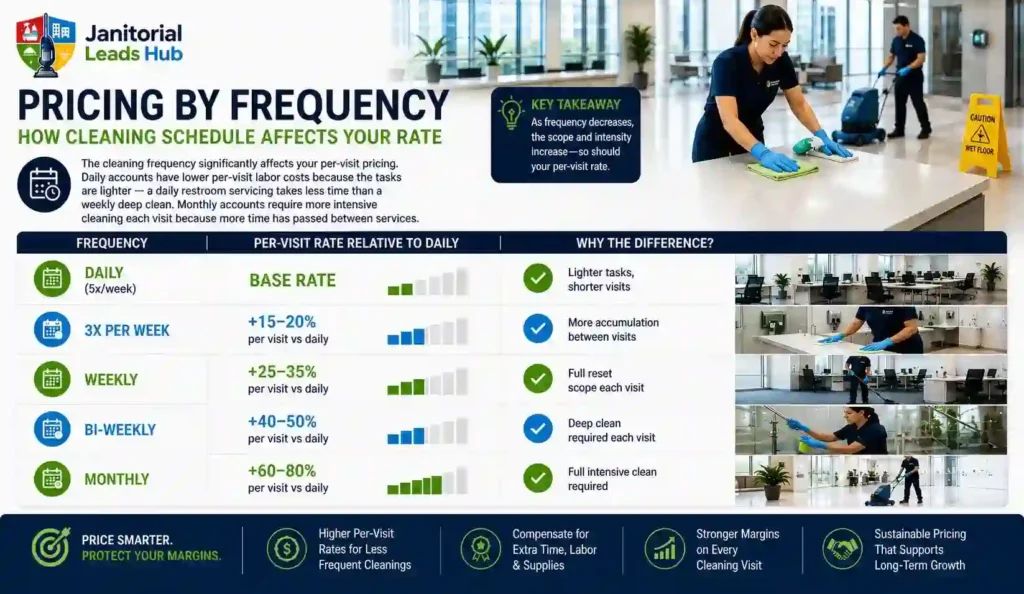
Pricing by Frequency — How Cleaning Schedule Affects Your Rate

Pricing by frequency chart showing daily, weekly, bi-weekly, and monthly commercial cleaning rates and how cleaning schedules affect janitorial service pricing.

Daily vs Weekly vs Monthly Accounts

The cleaning frequency significantly affects your per-visit pricing. Daily accounts have lower per-visit labor costs because the tasks are lighter — a daily restroom servicing takes less time than a weekly deep clean.

Monthly accounts require more intensive cleaning each visit because more time has passed between services.

FrequencyPer-Visit Rate Relative to DailyWhy the Difference
Daily (5x/week)Base rateLighter tasks, shorter visits
3x per week+15-20% per visit vs dailyMore accumulation between visits
Weekly+25-35% per visit vs dailyFull reset scope each visit
Bi-weekly+40-50% per visit vs dailyDeep clean required each visit
Monthly+60-80% per visit vs dailyFull intensive clean required

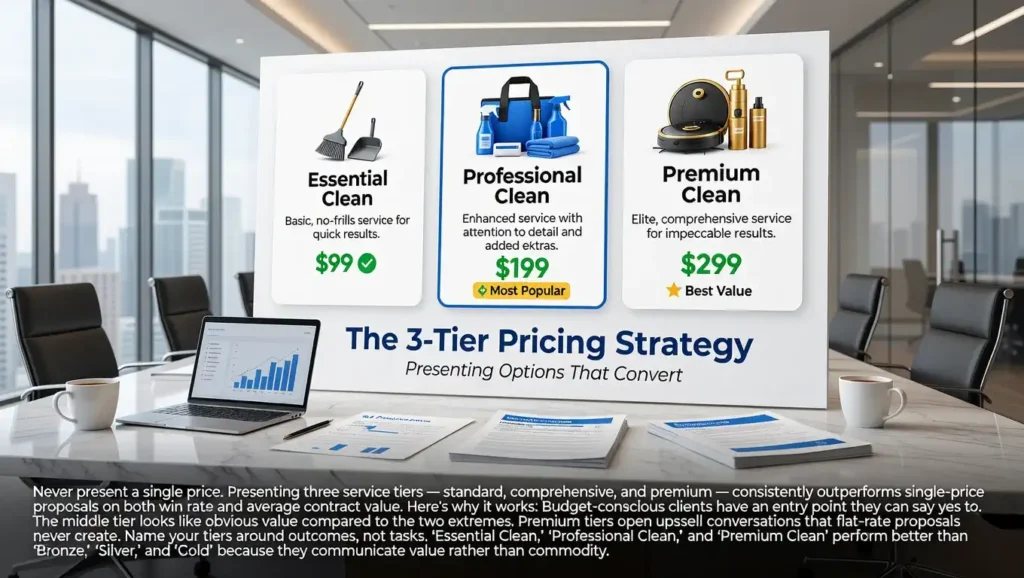
The 3-Tier Pricing Strategy — Presenting Options That Convert

Three-tier janitorial pricing strategy comparing Essential, Professional, and Premium commercial cleaning service packages to improve proposal conversions and profit margins.

Never present a single price. Presenting three service tiers — standard, comprehensive, and premium — consistently outperforms single-price proposals on both win rate and average contract value.

Here’s why it works:

Name your tiers around outcomes, not tasks. ‘Essential Clean,’ ‘Professional Clean,’ and ‘Premium Clean’ perform better than ‘Bronze,’ ‘Silver,’ and ‘Gold’ because they communicate value rather than commodity.

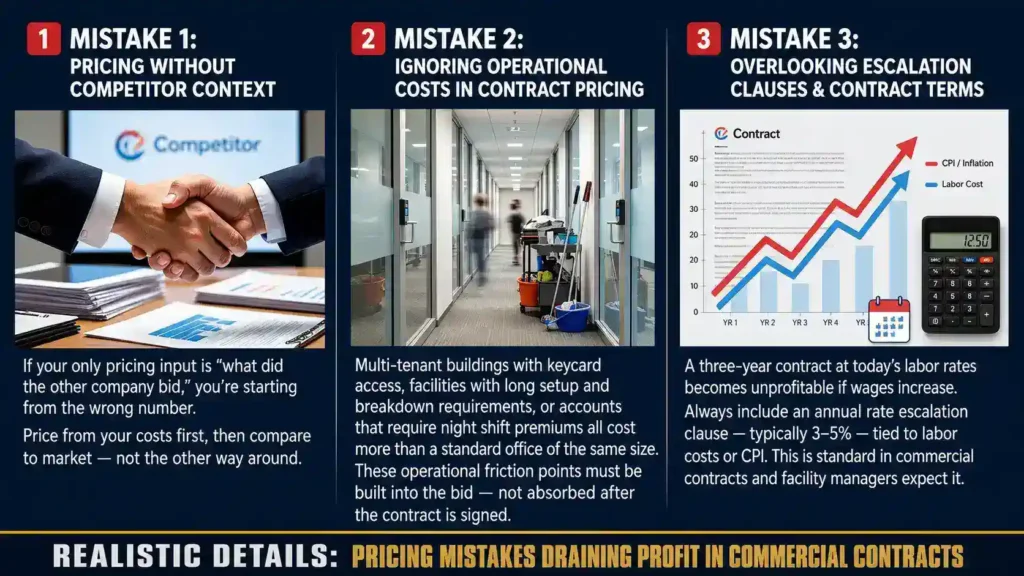
Common Pricing Mistakes That Quietly Drain Profit

Common janitorial pricing mistakes infographic showing competitor-based pricing, operational cost errors, and missing contract escalation clauses that reduce cleaning business profits.

Mistake 1 — Pricing to Beat the Competition

If your only pricing input is ‘what did the other company bid,’ you’re starting from the wrong number. Price from your costs first, then compare to market — not the other way around.

Mistake 2 — Not Accounting for Operational Friction

Multi-tenant buildings with keycard access, facilities with long setup and breakdown requirements, or accounts that require night shift premiums all cost more than a standard office of the same size. These operational friction points must be built into the bid — not absorbed after the contract is signed.

Mistake 3 — Ignoring Contract Escalation Clauses

A three-year contract at today’s labor rates becomes unprofitable if wages increase. Always include an annual rate escalation clause — typically 3-5% — tied to labor costs or CPI. This is standard in commercial contracts and facility managers expect it.

Conclusion

Pricing janitorial services correctly starts with an accurate understanding of what every hour of cleaning truly costs your business — not just the cleaner’s wage. Build your bid from that number upward, use a three-tier presentation, include an escalation clause for multi-year contracts, and track actual time against estimates in the first 90 days of every new account.

The contracts that drain a cleaning business aren’t the ones that were hard to win. They’re the ones that were easy to win because the price was too low. Price for profit from the start, and the accounts you land will still be worth holding 18 months from now.

Insurance is the one thing in a cleaning business that most owners don’t think about until they need it — and by then, it’s already too late. A single broken item in a client’s office, one slip-and-fall on a wet floor, or an employee who causes accidental damage can turn into a five-figure claim that puts an uninsured cleaning company out of business overnight.

Most commercial facility managers also require proof of insurance before signing any contract. No certificate of insurance means no walkthrough, no proposal, and no contract — regardless of how competitive your pricing is.

This guide covers every type of janitorial business insurance you need in 2026 — what each one protects you from, what it typically costs, and how to get covered before your next walkthrough.

Every janitorial business needs General Liability Insurance at minimum — typically $1 million per occurrence. Add a Janitorial Bond, Workers’ Compensation the moment you hire your first employee, and Commercial Auto if any vehicle is used for business purposes.

Why Janitorial Businesses Face Higher Insurance Risk Than Most

Commercial cleaning companies work inside other people’s buildings, handle chemicals, use heavy equipment, and access sensitive areas. The Bureau of Labor Statistics consistently reports above-average nonfatal workplace injury rates for janitorial and building cleaning occupations — making insurance both a legal requirement in many states and a basic business necessity.

Clients know this. Facility managers at hospitals, corporate offices, and schools almost universally require a certificate of insurance naming them as an additional insured before any cleaning crew sets foot in the building.

The 4 Types of Janitorial Business Insurance You Need

1. General Liability Insurance — The Non-Negotiable

General Liability Insurance is the foundation of any cleaning business insurance package. It covers third-party property damage, bodily injury claims, and personal injury arising from your operations — meaning if your cleaner accidentally knocks over a client’s expensive monitor or leaves a wet floor unmarked that someone trips on, your policy responds.

Expert tip: Get certificates of insurance issued in your client’s name before every new contract starts. Having them pre-staged with your insurance agent means you can send the COI the same day you close the deal — not scrambling a week later.

2. Janitorial Bond (Surety Bond) — Protects Against Employee Theft

A janitorial bond protects your clients against financial loss from theft committed by your employees. When your crew has unsupervised access to client offices, medical facilities, or retail stores, a bond signals to the facility manager that they’re protected if something goes missing.

3. Workers’ Compensation — Required the Moment You Hire

Workers’ compensation is legally required in most states as soon as you have even one employee. It covers medical expenses and lost wages for employees injured on the job — and in commercial cleaning, injuries from chemical exposure, slips, and equipment use happen more often than in many other industries.

4. Commercial Auto Insurance — Covers Business Vehicle Use

If any vehicle is used for business purposes — driving to job sites, transporting supplies, hauling equipment — a personal auto policy won’t cover accidents that happen on the way to a cleaning job. Commercial auto insurance fills that gap.

What Does Janitorial Business Insurance Actually Cost in 2026?

Coverage TypeTypical Annual Cos Who Needs It
General Liability ($1M)$500–$900/yrEvery cleaning business
Janitorial Bond ($10K)$100–$175/yrEvery cleaning business
Workers’ Compensation 2–5% of payrollAny business with employees
Commercial Auto$1,200–$2,500/yrAny business vehicle
Business Owner’s Policy$1,500–$3,000/yrBundles GL + property

A realistic baseline insurance budget for a solo commercial cleaning operator is roughly $700–$1,100 per year for General Liability and a Janitorial Bond combined. Add a vehicle and one employee and that figure typically climbs to $4,000–$6,000 annually.

Where to Get Janitorial Business Insurance

Option 1 — Online Insurance Marketplaces

Platforms like Insureon, Next Insurance, and Simply Business let you compare quotes from multiple carriers in one place. Most cleaning business owners can get a General Liability quote in under 10 minutes and have a certificate of insurance the same day.

Option 2 — Independent Insurance Brokers

A broker who works with cleaning businesses regularly understands the specific risks involved — chemical storage, unsupervised building access, healthcare facility requirements — and can package coverage more accurately than a generalist carrier. Worth the extra call for anything beyond basic GL.

Option 3 — Industry Association Group Rates

ISSA members and members of local cleaning associations often have access to group insurance rates that beat what’s available on the open market. If you’re not already affiliated with a trade group, the insurance savings alone can justify membership fees.

Expert tip: Before your next walkthrough, email your insurance agent and ask them to pre-stage a generic Certificate of Insurance template. When you close the deal, you can fill in the client’s name and have a COI in their inbox the same day — it’s a small detail that signals serious professionalism.

Common Insurance Mistakes Cleaning Businesses Make

Mistake 1 — Using Personal Auto for Business Trips

Personal auto policies typically exclude accidents that happen during business use. One at-fault accident while driving to a cleaning job — with no commercial policy in place — can result in a denied claim and full out-of-pocket liability.

Mistake 2 — Not Listing the Client as Additional Insured

Most commercial clients require their name to appear on your certificate of insurance as an additional insured. Sending a generic COI that doesn’t name them specifically often fails the vendor approval process.

Mistake 3 — Waiting Until After the First Hire to Get Workers’ Comp

Workers’ compensation requirements kick in the moment you hire — not after your first payroll cycle. Operating without it, even briefly, creates legal exposure and can result in significant fines depending on your state.

The Bottom Line

Janitorial business insurance isn’t a cost to minimize — it’s a foundational investment that keeps everything you’re building protected. A General Liability policy, a Janitorial Bond, Workers’ Compensation the moment you hire, and Commercial Auto the moment a vehicle touches business use covers the vast majority of risk a cleaning company faces day to day.

Get covered before your next walkthrough. The certificate of insurance you hand over at the start of a proposal meeting says more about your professionalism than almost anything else in that conversation.

Building a cleaning business that’s properly insured and ready to close contracts? Janitorial Leads Hub delivers verified, exclusive commercial cleaning leads with appointments already set — so your insured, professional operation has a full pipeline of qualified walkthroughs waiting. Visit janitorialleadshub.com to get started.

Cold calling has a reputation problem in the cleaning industry. Most people who’ve tried it remember the awkward silences, the gatekeepers who never put calls through, and the dead-end conversations that went nowhere. But those experiences almost always trace back to the same root problem: a weak script, the wrong target list, or calling the wrong person at the wrong time.

Done correctly, janitorial telemarketing is still one of the most cost-effective ways to book walkthroughs with commercial decision-makers — faster than SEO, cheaper than paid ads, and more direct than social media. The cleaning companies that use it well aren’t better talkers. They have better systems.

This guide breaks down exactly how to run janitorial telemarketing that books real appointments — from building the right target list to handling the most common objections without losing momentum.

Short answer: Effective janitorial telemarketing starts with the right target (Property Manager, Facility Director, or Office Manager — never the front desk), a script that asks for a walkthrough not a contract, and a follow-up system that keeps you top of mind until the timing is right.

Why Most Janitorial Cold Calls Fail Before the First Sentence

The most common mistake in cleaning business cold calling is targeting the wrong person. Calling a general company number and asking to ‘speak to whoever handles cleaning’ almost never reaches a decision-maker. The receptionist doesn’t know who that is, doesn’t care, and has instructions to filter exactly these kinds of calls.

Start with research. Use LinkedIn, Google Maps, or a basic ZoomInfo trial to identify the specific name and direct number of the Property Manager, Facility Director, or Office Manager before you dial. Getting to the right person on the first call changes everything about the rest of the conversation.

Building a High-Quality Janitorial Call List

Who to Target

Where to Build Your List

Expert tip: Build a list of 50-75 targeted contacts before you start calling. Quality beats quantity every time in janitorial telemarketing — 25 well-researched calls to the right people produce more walkthroughs than 150 random dials to general company lines.

The Cold Call Script That Actually Gets Walkthroughs

The Opening That Gets Past the Gatekeeper

When calling a general number, ask for the person by name — not by role. ‘Can I speak with Sarah Mitchell?’ gets through more often than ‘Can I speak with your Facility Manager?’ When they ask what it’s about, keep it brief and professional:

‘I’m calling to follow up on a cleaning services inquiry.’ — This phrasing is vague enough to avoid a hard screen but professional enough to pass through most gatekeepers.

The Core Script — Aim for the Walkthrough, Not the Contract

Once you reach the decision-maker, your entire goal is to schedule an in-person walkthrough — not to sell anything on the phone. Contracts are never signed based on a cold call. The call is only to earn the right to show up in person.

‘Hi [Name], this is [Your Name] with [Company Name]. I’m reaching out to find out who handles your cleaning services and whether we could schedule a quick, free walkthrough — just to put together a backup bid for your files. We specialize in [their building type] and I’d just like 20 minutes to walk the space. Would Wednesday or Thursday work better for you?’

The key elements: name their specific building type, ask for a 20-minute walkthrough (not a meeting), offer two specific day options, and frame it as a ‘backup bid’ — which removes urgency pressure from their side.

Handling the 4 Most Common Objections

‘We already have a cleaning company.’

‘I completely understand — most of the facilities I work with do. That’s actually why I’m calling. Most of our clients started as a backup provider and came on board when service consistency slipped with their current company. Could we schedule a walkthrough just to keep us on file? It costs you nothing and gives you options when you need them.’

‘We’re not looking right now.’

‘Totally fair. When does your current contract typically come up for review?’ — If they give you a date, note it and ask if you can check back 60 days before. If they don’t know, ask if you can send a company profile to keep on file and follow up quarterly.

‘Send me information first.’

‘Of course — what’s the best email to send it to?’ Then ask the follow-up: ‘Once you’ve had a chance to look it over, would it be okay if I called back next week to see if a walkthrough makes sense?’ This keeps the conversation moving forward instead of dying in an inbox.

“We handle cleaning through corporate / headquarters.’

Ask: ‘Is there someone at the corporate level I should speak with directly?’ or ‘Do local locations ever have discretion over supplemental or specialized cleaning?’ — You’d be surprised how often there’s a local budget for specific services even when the main contract is handled centrally.

Building a Follow-Up System That Keeps You Relevant

The 5-Touch Follow-Up Sequence

Most janitorial contracts are won on the 4th or 5th contact — but most cleaning companies give up after one or two. A simple, consistent follow-up system changes that outcome.

“The best janitorial salespeople aren’t the ones who talk the best. They’re the ones who show up the most consistently.”

When to Outsource Janitorial Telemarketing

In-house calling works well when the business owner or a dedicated sales person can commit 2-3 hours per day to it consistently. When that time isn’t available — which is most of the time once you’re also managing crews, clients, and operations — outsourcing or using a verified lead provider that handles appointment setting delivers a better result.

The difference between a lead list and a verified appointment is that the appointment already has a decision-maker who’s expecting your call, a confirmed time slot, and a confirmed intent to receive a proposal. That’s what a good janitorial appointment setting delivers — and it’s why cleaning companies use it to fill calendars faster than cold calling alone can manage.

The Bottom Line

Janitorial telemarketing works when it targets the right person, uses a script aimed at the walkthrough not the contract, handles objections without pressure, and follows up consistently over 60-90 days. The companies that build this into a weekly system — not a one-time burst when business slows down — are the ones with full pipelines year-round.

Start with a list of 50 targeted contacts. Call 10 per day. Follow up consistently. And measure whether walkthrough bookings increase over 30 days — that’s the only metric that matters.

Want appointment-ready commercial cleaning walkthroughs delivered to your calendar without the cold calling grind? Janitorial Leads Hub handles the sourcing, verification, and booking — so you show up to a confirmed meeting with a qualified decision-maker. Visit janitorialleadshub.com.

Getting the bid right is where janitorial contracts are won or lost before the walkthrough is even finished. Bid too low and you win a contract that drains your margin every month. Bid too high without a professional proposal to back it up and the facility manager moves on to the next company. The right janitorial bidding software fixes both problems.

It gives you accurate, room-by-room pricing calculations based on real production rates, a professional proposal output that looks like it came from a larger company, and enough speed to quote jobs the same day you walk the building.

This guide compares the 10 best janitorial bidding software options available in 2026 — covering what each one does well, where it falls short, and which type of cleaning business it’s actually built for.

BidLoom and CleanGuru are the best purpose-built options for janitorial bidding specifically. Jobber wins if you also need scheduling and invoicing in the same platform. Wave works as a free starting point if budget is the main concern.

Why Generic Estimates Are Costing You Contracts

Most cleaning companies still price jobs using a flat square-foot rate pulled from memory or a basic spreadsheet. The problem is that a 15,000 square-foot office building with seven restrooms, a commercial kitchen, and a fitness area is a completely different job than a 15,000 square-foot open warehouse — even though both have the same footprint.

Bidding software built for janitorial work accounts for these differences — task by task, zone by zone — so your quote reflects what the job actually costs to deliver, not what you guessed it might be.

The 10 Best Janitorial Bidding Software Options in 2026

1. BidLoom — Best for Accurate Commercial Bids

BidLoom was designed specifically for commercial cleaning companies and uses ISSA 612 production rates — the industry standard for calculating how long each cleaning task takes. It breaks bids down by facility type, calculates full labor burden by state including FICA, workers’ comp, and benefits, and outputs branded PDF proposals.

Expert tip:Use BidLoom’s facility type presets during the walkthrough itself. Walking in with a tablet and completing the bid on-site impresses facility managers and cuts turnaround time to the same day.

2. CleanGuru — Best All-in-One for Cleaning Businesses

CleanGuru combines bidding, scheduling, and client management in one platform built exclusively for commercial cleaning. It’s been around long enough to have genuine industry-specific depth — cleaning production rates, inspection templates, and recurring contract tracking all come standard.

3. Jobber — Best for Field Operations + Bidding

Jobber isn’t purpose-built for janitorial bidding, but it’s the strongest platform if you want quoting, scheduling, invoicing, and client management all in one place. The estimate-to-invoice workflow is seamless, and QuickBooks integration keeps your financial records clean.

4. Swept — Best for Workforce + Basic Bidding

Swept is primarily a workforce management platform — time tracking, checklists, crew messaging — but it includes basic scope-of-work building that connects directly to scheduling. It works best for businesses that already have a separate quoting process and want to connect it to operations.

5. Aspire — Best for Large Commercial Operations

Aspire is the enterprise option — full job costing, contract management, site-level profitability tracking, and bid management built for companies running 30 or more accounts. The learning curve and cost are both significant, but for large operations the ROI is real.

6. PandaDoc — Best for Proposal Design

PandaDoc isn’t janitorial-specific, but its proposal templates are the most visually professional option on this list. For companies bidding on corporate accounts where presentation matters, PandaDoc-created proposals can make a genuine difference — especially when combined with a separate pricing calculator.

7. Housecall Pro — Best for Mobile-First Bidding

Housecall Pro handles estimate-to-invoice on mobile better than almost anything else on this list. Field-based owners who complete walkthroughs and want to send a proposal from the parking lot before they drive away get the most value from this platform.

8. Janitorial Manager — Best for Inspections + Bids

Janitorial Manager combines work order management, quality inspections, and basic bid building in one janitorial-specific system. It pairs naturally with QuickBooks and works best for mid-size operations that run regular client inspections as part of their service model.

9. ZarMoney — Best If Inventory Is Part of Your Bid

ZarMoney adds inventory tracking to the bidding process — useful for companies that include supply costs in their proposals and need accurate real-time data on chemical and consumable stock levels when building quotes.

10. Wave — Best Free Starting Point

Wave doesn’t do janitorial-specific bidding, but it’s completely free and lets you build professional-looking estimates and invoices from a clean template. For solo operators who aren’t yet ready to invest in purpose-built software, it handles basic quoting without cost.

Quick Comparison — Which Tool Fits Your Stage

Software Best ForJanitorial SpecificStarting Cost
BidLoomAccurate commercial bidsYesFree → $19/mo
CleanGuruAll-in-one cleaning platformYes$79+/mo
JobberQuoting + scheduling + invoicingNo $39+/mo
SweptWorkforce + basic bids Yes$24+/mo
AspireLarge commercial operationsYesCustom pricing
WaveFree starting pointNo Free

How to Choose the Right Bidding Software for Your Business

Step 1 — Start With Your Biggest Pain Point

If you’re losing bids because your proposals look unprofessional, prioritize platforms with strong PDF output — BidLoom or PandaDoc. If you’re losing because your prices are wrong, prioritize platforms with ISSA production rates built in — BidLoom or Aspire.

Step 2 — Decide How Much Integration You Need

A standalone bidding tool is fine if you already have scheduling and invoicing handled separately. If you want one platform for everything, Jobber or CleanGuru makes more sense even if the bidding features are slightly less specialized.

Step 3 — Pilot It on Your Next Walkthrough

Don’t buy software without testing it on a real job first. Most platforms on this list offer a free trial or a free tier. Use your next site walkthrough to build a bid inside the tool before you commit to a paid plan.

Expert tip: The fastest ROI from any bidding tool comes from sending proposals the same day as the walkthrough. Facilities that receive a detailed, professional proposal within hours of the visit close at significantly higher rates than those that wait days.

The Bottom Line

The best janitorial bidding software is the one that gets you accurate numbers and a professional proposal fast — before the facility manager has a chance to accept someone else’s quote. BidLoom is the best purpose-built option for commercial cleaning bids specifically. Jobber wins if you want the complete field service package. And if cost is the barrier right now, Wave gets you started without spending anything.

Pick one, pilot it on your next walkthrough, and measure whether your close rate improves. That’s all the evidence you need to know if it’s the right fit.

Looking for more qualified walkthroughs to use that new bidding software on? Janitorial Leads Hub delivers verified, exclusive janitorial leads with appointments already set — so you walk in with the meeting booked and a proposal ready to go. Visit janitorialleadshub.com to get started.

What licenses do you need to start a cleaning business? That’s one of the first questions anyone starting a cleaning business runs into. The short answer is yes, you need licenses — but not in the way most people expect. There’s no national “cleaning license” that covers all states. Instead, the licensing requirements for a cleaning business are a combination of business registration, local permits, bonding, and sometimes state-specific compliance depending on the services you offer and the clients you target.

Getting this wrong doesn’t just create legal exposure — it can cost you contracts. Commercial facility managers regularly ask for your business registration, insurance certificates, and bonding documentation before signing anything. Walking into a proposal meeting without these in order signals that your operation isn’t ready for a serious commercial account.

This guide breaks down exactly what licenses and registrations a cleaning business needs in 2026 — starting with what’s required nearly everywhere, and then covering the state and industry-specific requirements that catch new business owners off guard.

Short answer: Most cleaning businesses need a local business license, an EIN (tax ID number), a DBA registration if using a trade name, General Liability Insurance, and a Janitorial Bond. State-specific licenses apply if you’re handling hazardous chemicals or working in healthcare settings.

The Foundation: What Almost Every Cleaning Business Needs

1. Business Structure Registration

Before you can legally operate, your business needs to exist as a legal entity. Most cleaning business owners register as either a sole proprietorship, a Limited Liability Company (LLC), or a corporation. An LLC is the right choice for most — it protects your personal assets from business liability claims while remaining simple enough to manage without a lawyer.

Expert tip: In most states, you can form an LLC online in a single afternoon through your state’s Secretary of State website. Filing fees typically run $50-$200 depending on the state.

2. Local Business License

Most cities and counties require a general business license to operate any commercial service business — cleaning included. This is separate from your state business registration and is usually renewed annually. Fees are typically modest, ranging from $25 to $150 per year depending on location.

3. Federal EIN (Employer Identification Number)

Your EIN is your business’s federal tax ID — required to open a business bank account, hire employees, and file business taxes. It’s free to apply for through the IRS website and is issued immediately upon application.

4. DBA Registration (if using a trade name)

If you’re operating under a business name that’s different from your legal name — for example, running ‘Sparkling Commercial Cleaning’ as an LLC registered under your personal name — most states require a DBA (Doing Business As) filing, also called a fictitious business name registration.

Bonding and Insurance — Required Before Most Commercial Contracts

Janitorial Bond

A janitorial bond is a type of surety bond that protects clients against employee theft. Most commercial facility managers require proof of bonding before allowing any cleaning crew into their building — particularly in healthcare, financial, and educational settings.

General Liability Insurance Certificate

Not technically a license, but treated as one by virtually every commercial client. A certificate of insurance showing General Liability coverage of at least $1 million per occurrence is required before most commercial cleaning contracts can be signed. See our dedicated guide on Janitorial Business Insurance for full details on coverage types and costs.

State-Specific and Industry-Specific Requirements

Hazardous Chemical Handling

If your cleaning operation uses chemicals classified as hazardous — certain disinfectants, floor strippers, or industrial cleaners — OSHA requires documented employee training, proper labeling, and Safety Data Sheets (SDS) maintained on-site. Some states add additional chemical handling certification requirements for commercial cleaning operations.

Healthcare and Medical Facility Cleaning

Cleaning companies servicing hospitals, clinics, dental offices, or any facility regulated under HIPAA face additional compliance requirements. These often include specific training certifications, background checks for all staff, and sometimes GBAC STAR accreditation — a biological cleaning and disinfection credential recognized by healthcare facility managers.

School and Government Facility Cleaning

Background checks for all employees are standard for any cleaning company working in schools or government buildings. Some states require these background checks to be conducted through a specific state agency rather than a private service.

State-by-State Overview — What Varies Most

StateNotable RequirementWhere to Check
CaliforniaContractors license board registration for some cleaning servicesCSLB website
Tennessee (Nashville)Local business license + Metro permit in some citiesTennessee SOS website
New YorkNYC requires additional permits for chemical use in some buildingsNYC Business portal
FloridaSome counties require county-level occupational licenseCounty Clerk office
TexasNo state-level cleaning license but local permits varyCity/county websites

The most reliable source for your specific state requirements is your state’s Secretary of State website and your local Small Business Development Center (SBDC) — both offer free guidance on business registration and licensing requirements.

The Compliance Checklist Before Your First Contract

Before You Sign Any Commercial Client

The Bottom Line

The licensing requirements for a cleaning business aren’t complicated — but they are non-negotiable for anyone trying to win commercial contracts. An LLC or business registration, a local business license, an EIN, a janitorial bond, and a General Liability Insurance certificate covers the vast majority of what commercial clients and state regulators will ask for.

Get the paperwork right before the walkthrough. The facility managers who sign the biggest contracts are the ones most likely to check — and the ones most impressed when you hand over a complete compliance folder without being asked.

With the legal foundation in place, the next step is filling your pipeline with verified commercial cleaning opportunities. Janitorial Leads Hub delivers exclusive, appointment-ready janitorial leads — so your properly licensed, insured operation has qualified walkthroughs waiting. Visit janitorialleadshub.com.