Managing money in a commercial cleaning business sounds simple on the surface. You invoice clients, pay your crew, buy supplies, and keep track of what comes in and goes out.
But once you’re juggling a dozen recurring contracts, multiple job sites, subcontractors, and a full payroll cycle — all while trying to actually run the business — the spreadsheet approach stops working fast.
Most janitorial business owners don’t realize how much money they’re losing to billing delays, missed invoices, and untracked expenses until those problems have already compounded. The right accounting software doesn’t just save you time — it plugs financial leaks that quietly drain profit from contracts you’ve already won.
This guide covers the 10 best janitorial accounting software options available in 2026, including who each one is built for, what it does well, where it falls short, and the ideal use case for each. Whether you’re a solo operator looking for something simple or a growing commercial cleaning company managing multiple crews and clients, there’s a right tool for your situation.
The 10 Best Janitorial Accounting Software Options
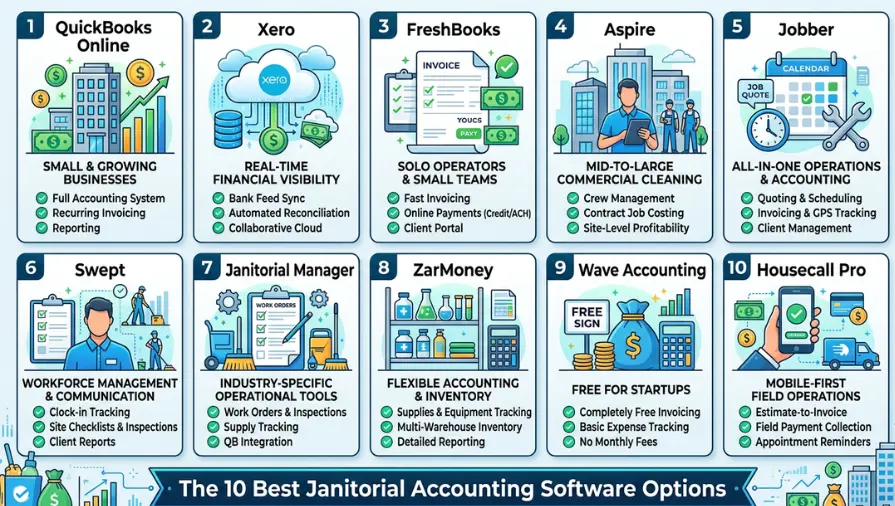
1. QuickBooks Online
The most widely trusted accounting platform for small and growing cleaning businesses.
Best for: Small to mid-sized janitorial businesses that need a full accounting system with recurring invoicing and strong financial reporting.
Pros:
- Automated recurring invoicing for monthly and weekly contracts
- Expense tracking by category — supplies, labor, fuel, equipment
- Real-time bank reconciliation and transaction matching
- Profit & loss, cash flow, and balance sheet reports
- Payroll add-on available for managing employee wages
- Mobile app for invoicing and payment tracking on the go
- Integrates with hundreds of apps including Jobber and Swept
Limitations:
- Payroll costs extra on top of the base subscription
- Built-in job costing is limited compared to janitorial-specific tools
- Can feel complex for first-time users without accounting experience
- Higher-tier plans needed for multi-user access
Ideal use case: QuickBooks Online is the go-to choice for cleaning businesses that are growing beyond basic bookkeeping and need a reliable, full-featured accounting system. If your accountant or bookkeeper already uses QuickBooks, this makes collaboration seamless.
2. Xero
Cloud-based accounting built for business owners who need real-time financial visibility across multiple sites.
Best for: Janitorial businesses managing multiple client locations or working with a remote bookkeeper.
Pros:
- Real-time bank feed syncing and automatic reconciliation
- Automated recurring invoices for ongoing cleaning contracts
- Tracks income and expenses across multiple accounts
- Strong integration with payroll tools like Gusto
- Clean dashboard that’s easy to navigate without accounting experience
- Accessible from any device, anywhere
Limitations:
- No built-in payroll — requires a third-party integration
- Reporting is less detailed than QuickBooks at similar price points
- No dedicated janitorial or field service features
- Customer support response times can be slow
Ideal use case: Xero works particularly well for cleaning business owners who want real-time financial data and clean bank reconciliation — especially if they work with an external accountant who prefers a collaborative, cloud-based platform.
3. FreshBooks
The simplest invoicing and expense tracking tool for cleaning business owners who want clean, fast billing without complexity.
Best for: Solo operators and small cleaning businesses that prioritize quick invoicing and easy client payment collection.
Pros:
- Simple, clean invoicing with recurring billing options
- Online payment acceptance via credit card and ACH
- Time tracking built in — useful for billing hourly clients
- Client portal for viewing and paying invoices online
- Expense tracking with receipt photo capture from mobile
- Professional invoice templates that look great
Limitations:
- Limited financial reporting compared to QuickBooks or Xero
- Not built for complex multi-site job costing
- Client limit on lower-tier plans can be restrictive as you grow
- Not ideal for businesses with large payroll needs
Ideal use case: FreshBooks is the right fit for a cleaning business owner who wants professional invoicing, fast payments, and simple expense tracking — without spending time learning a complex accounting system.
4. Aspire
A comprehensive business management platform built specifically for janitorial and landscaping companies at scale.
Best for: Mid to large commercial cleaning companies that need contract-level job costing, crew management, and operational reporting in one system.
Pros:
- Contract-based job costing down to the individual site level
- Built-in bid and proposal management for commercial contracts
- Crew scheduling and work order management
- Real-time profitability tracking per account
- Client portal and communication tools
- Designed specifically for janitorial and field services
Limitations:
- Custom pricing with no publicly listed rates — requires a sales call
- Learning curve is steep for smaller teams
- May be more than a small cleaning business needs
- Implementation takes time and training
Ideal use case: Aspire is built for commercial cleaning companies with multiple crews, complex contract structures, and a need for site-level financial reporting. If you’re running 30+ accounts and need to track profitability per client, Aspire is in a different league than general accounting tools.
5. Jobber
The best all-in-one tool for cleaning businesses that want scheduling, invoicing, and client management in a single platform.
Best for: Growing cleaning businesses that want to eliminate the need for separate scheduling software and accounting tools.
Pros:
- Combines scheduling, quoting, invoicing, and payment collection
- Automated follow-up reminders for unpaid invoices
- Client hub where customers can approve quotes and pay online
- QuickBooks and Xero integration for clean financial records
- Mobile app with GPS and job tracking for field crews
- Online booking for new client acquisition
Limitations:
- Not a full accounting replacement — best paired with QuickBooks
- Higher-tier plans needed for advanced reporting
- Some users find the mobile app slower on older devices
- Pricing increases as your team and client list grow
Ideal use case: Jobber is the top recommendation for cleaning businesses that want one platform to handle client-facing operations — quoting, scheduling, invoicing — while syncing clean financial data to QuickBooks or Xero in the background.
6. Swept
A janitorial-specific workforce management platform with time tracking, communication, and client reporting.
Best for: Janitorial business owners managing multiple cleaning crews across different commercial sites.
Pros:
- Clock-in/clock-out tracking for each employee at each site
- Built-in messaging between owner, supervisors, and cleaners
- Cleaning checklists and inspection reports tied to each location
- Supplies tracking to manage inventory across job sites
- Client-facing inspection reports for contract renewals
- Integrates with QuickBooks for payroll and billing
Limitations:
- Not a standalone accounting tool — requires pairing with QuickBooks or Xero
- Less useful for very small operations with one or two employees
- Mobile interface can be slow in areas with poor connectivity
- Setup requires time to configure each site and employee
Ideal use case: Swept is the right operational layer for a janitorial business that already has an accounting tool and needs a specialized system for managing crew performance, site-level checklists, and client communication.
7. Janitorial Manager
A cleaning-industry-specific platform that combines work orders, inspections, and QuickBooks integration for streamlined management.
Best for: Mid-sized janitorial businesses that want industry-specific tools alongside solid financial management.
Pros:
- Work order management specific to janitorial accounts
- Site inspection tools with client reporting features
- QuickBooks integration for invoicing and financial tracking
- Crew scheduling tied to contract and location data
- Supply ordering and tracking within the same platform
- Client communication and service history records
Limitations:
- Pricing requires contacting the vendor directly — no public listing
- Interface design feels dated compared to newer platforms
- Better suited for established businesses than startups
- Integration depth varies by QuickBooks plan
Ideal use case: Janitorial Manager works well for cleaning companies that want an industry-specific operational system with QuickBooks handling the financial side — particularly businesses that run formal inspections as part of their client service model.
8. ZarMoney
A flexible accounting platform with strong inventory management features — useful for cleaning businesses that track chemical supplies at scale.
Best for: Cleaning businesses that manage a significant amount of physical inventory — chemicals, consumables, and equipment.
Pros:
- Customizable invoicing with item-level tracking
- Inventory management for cleaning supplies and equipment
- Multi-warehouse tracking for businesses with storage across locations
- Financial reporting with profit and loss and balance sheets
- Multi-user access with role-based permissions
- Integrates with shipping and fulfillment tools
Limitations:
- Less recognized than QuickBooks or Xero among accountants
- Customer support quality reported as inconsistent
- Interface can feel cluttered for users who don’t need inventory features
- Fewer integration options than larger platforms
Ideal use case: ZarMoney is a good fit for janitorial businesses that need solid inventory management alongside invoicing — particularly those purchasing and distributing cleaning chemicals and consumables across multiple sites.
9. Wave Accounting
A completely free accounting platform that covers invoicing, expense tracking, and basic reporting — ideal for cleaning businesses just starting out.
Best for: Solo operators and startups who need professional invoicing and expense tracking without a monthly software bill.
Pros:
- Completely free invoicing and accounting tools
- Bank connection and transaction tracking at no cost
- Professional invoice templates with recurring billing
- Basic income and expense reports
- Mobile app for on-the-go invoicing
- Paid add-ons available for payroll and payment processing
Limitations:
- Free plan has limited customer support
- Payment processing and payroll features cost extra
- Not built for complex multi-site job tracking
- Fewer integrations than paid platforms
- Reporting depth is limited compared to QuickBooks or Xero
Ideal use case: Wave is the right starting point for a solo cleaning operator or brand-new cleaning business that needs professional invoicing and basic financial tracking without spending on software. When you outgrow it, the data is easy to export.
10. Housecall Pro
A mobile-first field service platform with strong estimate-to-invoice workflows and payment collection — built for businesses that run from the field.
Best for: Cleaning business owners who manage their operation primarily from a mobile device and prioritize fast payments.
Pros:
- Estimate-to-invoice workflow with one-tap approval
- Credit card and ACH payment collection in the field
- Automated appointment reminders and follow-ups for clients
- Customer review request automation after job completion
- QuickBooks integration for accounting sync
- Reporting dashboard for revenue and job tracking
Limitations:
- Higher starting price point than some alternatives
- Full feature set requires higher-tier plan
- Better suited for smaller contract counts than large commercial operations
- Some advanced reporting requires a QuickBooks connection
Ideal use case: Housecall Pro is the right tool for a cleaning business where the owner is regularly in the field and needs to quote, invoice, and collect payment from a phone — with a professional client experience built in.
What to Look for in Janitorial Accounting Software
Not every accounting tool is built with a cleaning business in mind.
Before reviewing the list, here are the four features that matter most for janitorial companies:
- Recurring invoicing — contracts bill weekly or monthly, so automation here saves hours
- Job-level expense tracking — you need to know what each account actually costs to service
- Payroll integration or management — labor is your biggest cost and needs clean records
- Mobile access — owners and supervisors need to check invoices and payments from the field
- Integration with field service tools — syncing with Jobber, Swept, or Janitorial Manager prevents double-entry
How to Choose the Right Janitorial Accounting Software
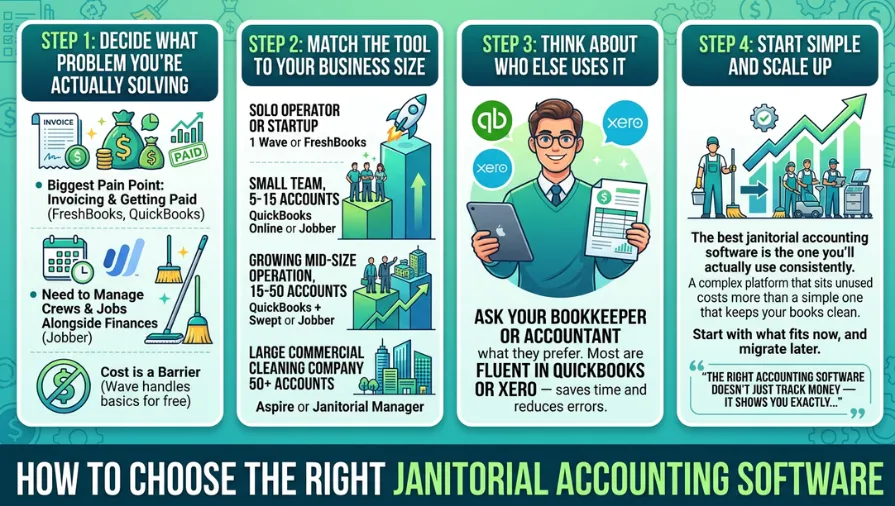
With ten solid options on this list, the choice comes down to a few practical questions about your business:
Step 1 — Decide What Problem You’re Actually Solving
If your biggest pain point is invoicing and getting paid on time, start with FreshBooks or QuickBooks. If you need to manage crews and jobs alongside finances, Jobber covers both. If cost is a barrier, Wave handles the basics for free.
Step 2 — Match the Tool to Your Business Size
- Solo operator or startup — Wave or FreshBooks
- Small team, 5-15 accounts — QuickBooks Online or Jobber
- Growing mid-size operation, 15-50 accounts — QuickBooks + Swept or Jobber
- Large commercial cleaning company, 50+ accounts — Aspire or Janitorial Manager
Step 3 — Think About Who Else Uses It
If you have a bookkeeper or accountant, ask what they prefer. Most accounting professionals are fluent in QuickBooks or Xero — using a tool they already know saves you time and reduces errors.
Step 4 — Start Simple and Scale Up
The best janitorial accounting software is the one you’ll actually use consistently.
A complex platform that sits unused costs more than a simple one that keeps your books clean. Start with what fits now, and migrate to something more powerful when your operation demands it.
“The right accounting software doesn’t just track money — it shows you exactly where you’re making it and where it’s leaking out.”
Conclusion
Managing the financial side of a janitorial business gets more complex as you grow — and the tools you choose either support that growth or slow it down. The platforms on this list cover every stage, from a solo operator sending their first invoice to a commercial cleaning company managing dozens of accounts and a full crew.
QuickBooks Online remains the strongest all-around choice for most cleaning businesses. Jobber is the best option if you want field operations and billing in one place. And Wave is the right starting point when cost is the primary concern.
Pick the tool that fits where your business is right now — and that gives you room to grow into over the next few years.