Pricing is where more cleaning businesses quietly fail than at any other point in their growth. Not because the work is bad or the clients are hard to find — but because the bids are wrong.
Either priced too low to win the contract fast, or priced without understanding true labor costs well enough to stay profitable once the contract starts.
The cleaning companies that grow consistently and stay healthy financially are the ones that understand exactly what every hour of cleaning actually costs their business — and price from that number upward, not from what a competitor quoted.
This guide covers every janitorial pricing model available in 2026 — how each one works, when to use it, what the market rates look like, and how to calculate your true cost before you ever put a number on paper.
Short answer: Most commercial cleaning contracts are best priced using a flat monthly rate built from a square-footage calculation plus a per-task time estimate. Target a gross margin of 40-55% on every contract. Never price to beat the competition — price to cover your costs and make the job worth doing.
The 4 Janitorial Pricing Models — How Each One Works
1. Square Footage Pricing
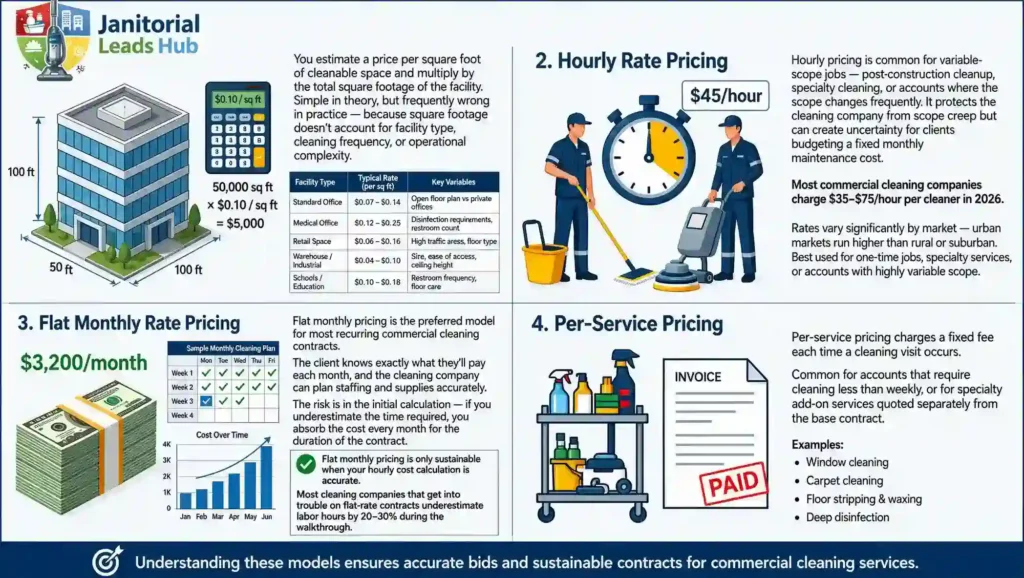
Square footage pricing is the most common starting point for commercial cleaning bids. You estimate a price per square foot of cleanable space and multiply by the total square footage of the facility.
Simple in theory, but frequently wrong in practice — because square footage doesn’t account for facility type, cleaning frequency, or operational complexity.
| Facility Type | Typical Rate Per Sq Ft | Key Variables |
|---|---|---|
| Standard office | $0.07–$0.14/sq ft | Open floor plan vs private offices |
| Medical office | $0.12–$0.25/sq ft | Disinfection requirements, restroom count |
| Retail space | $0.08–$0.16/sq ft | High-traffic areas, floor type |
| Warehouse / industrial | $0.04–$0.09/sq ft | Floor care complexity, facility size |
| Schools / education | $0.10–$0.18/sq ft | Restroom frequency, floor care |
2. Hourly Rate Pricing
Hourly pricing is common for variable-scope jobs — post-construction cleanup, specialty cleaning, or accounts where the scope changes frequently. It protects the cleaning company from scope creep but can create uncertainty for clients budgeting a fixed monthly maintenance cost.
- Most commercial cleaning companies charge $35-$75/hour per cleaner in 2026
- Rates vary significantly by market — urban markets run higher than rural or suburban
- Best used for one-time jobs, specialty services, or accounts with highly variable scope
3. Flat Monthly Rate Pricing
Flat monthly pricing is the preferred model for most recurring commercial cleaning contracts. The client knows exactly what they’ll pay each month, and the cleaning company can plan staffing and supplies accurately.
The risk is in the initial calculation — if you underestimate the time required, you absorb the cost every month for the duration of the contract.
Flat monthly pricing is only sustainable when your hourly cost calculation is accurate. Most cleaning companies that get into trouble on flat-rate contracts underestimated labor hours by 20-30% during the walkthrough.
4. Per-Service Pricing
Per-service pricing charges a fixed fee each time a cleaning visit occurs. Common for accounts that require cleaning less than weekly, or for specialty add-on services quoted separately from the base contract.
How to Calculate Your True Hourly Cost
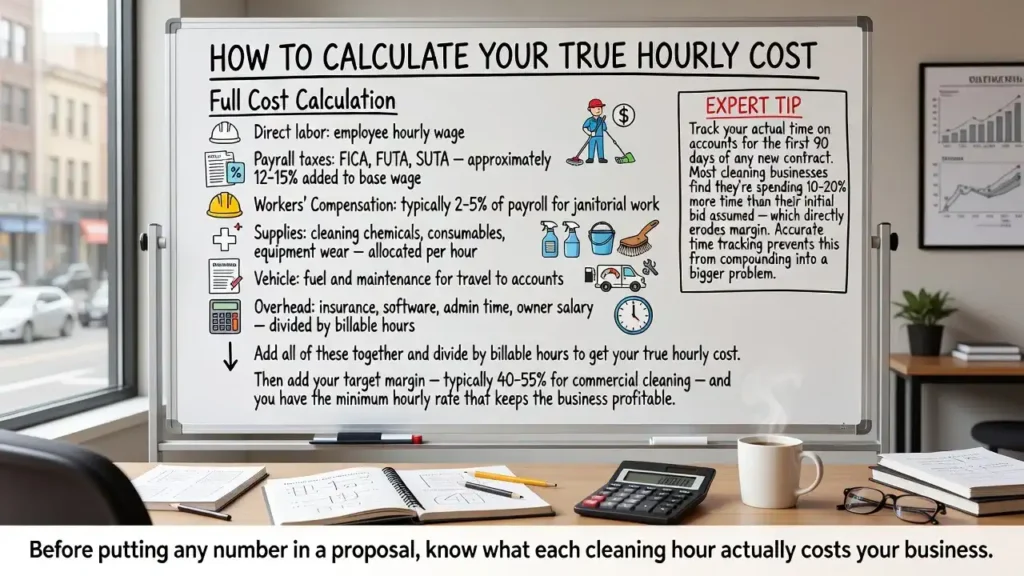
Before putting any number in a proposal, you need to know what each cleaning hour actually costs your business. Most owners underestimate this by a significant margin because they calculate direct labor but forget the indirect costs that attach to every hour of work.
The Full Cost Calculation
- Direct labor: employee hourly wage
- Payroll taxes: FICA, FUTA, SUTA — approximately 12-15% added to base wage
- Workers’ Compensation: typically 2-5% of payroll for janitorial work
- Supplies: cleaning chemicals, consumables, equipment wear — allocated per hour
- Vehicle: fuel and maintenance for travel to accounts
- Overhead: insurance, software, admin time, owner salary — divided by billable hours
Add all of these together and divide by billable hours to get your true hourly cost. Then add your target margin — typically 40-55% for commercial cleaning — and you have the minimum hourly rate that keeps the business profitable.
Expert tip: Track your actual time on accounts for the first 90 days of any new contract. Most cleaning businesses find they’re spending 10-20% more time than their initial bid assumed — which directly erodes margin. Accurate time tracking prevents this from compounding into a bigger problem.
Pricing by Frequency — How Cleaning Schedule Affects Your Rate
Daily vs Weekly vs Monthly Accounts
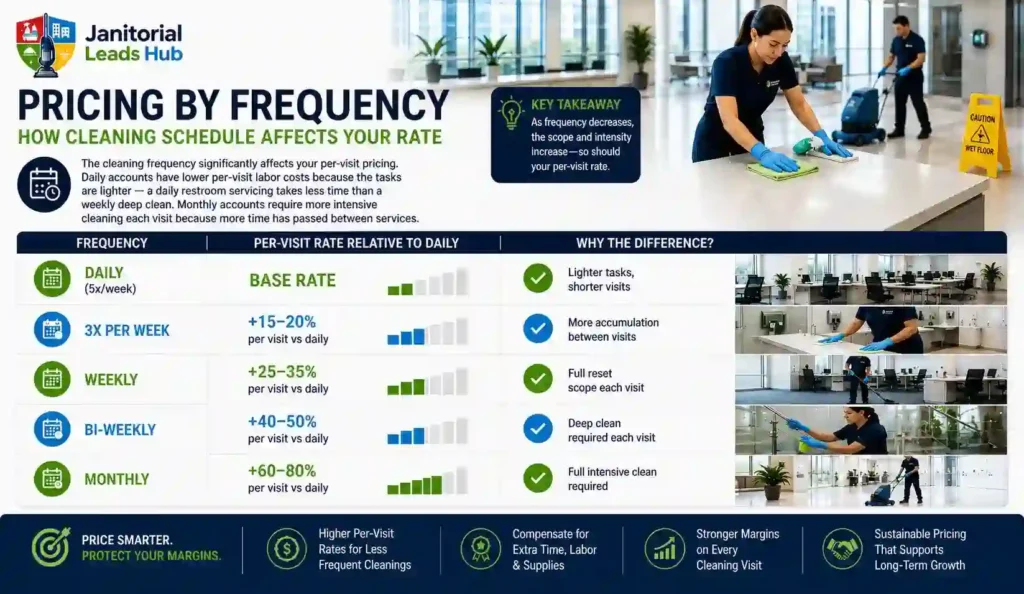
The cleaning frequency significantly affects your per-visit pricing. Daily accounts have lower per-visit labor costs because the tasks are lighter — a daily restroom servicing takes less time than a weekly deep clean.
Monthly accounts require more intensive cleaning each visit because more time has passed between services.
| Frequency | Per-Visit Rate Relative to Daily | Why the Difference |
|---|---|---|
| Daily (5x/week) | Base rate | Lighter tasks, shorter visits |
| 3x per week | +15-20% per visit vs daily | More accumulation between visits |
| Weekly | +25-35% per visit vs daily | Full reset scope each visit |
| Bi-weekly | +40-50% per visit vs daily | Deep clean required each visit |
| Monthly | +60-80% per visit vs daily | Full intensive clean required |
The 3-Tier Pricing Strategy — Presenting Options That Convert

Never present a single price. Presenting three service tiers — standard, comprehensive, and premium — consistently outperforms single-price proposals on both win rate and average contract value.
Here’s why it works:
- Budget-conscious clients have an entry point they can say yes to
- The middle tier looks like obvious value compared to the two extremes
- Premium tiers open upsell conversations that flat-rate proposals never create
Name your tiers around outcomes, not tasks. ‘Essential Clean,’ ‘Professional Clean,’ and ‘Premium Clean’ perform better than ‘Bronze,’ ‘Silver,’ and ‘Gold’ because they communicate value rather than commodity.
Common Pricing Mistakes That Quietly Drain Profit
Mistake 1 — Pricing to Beat the Competition
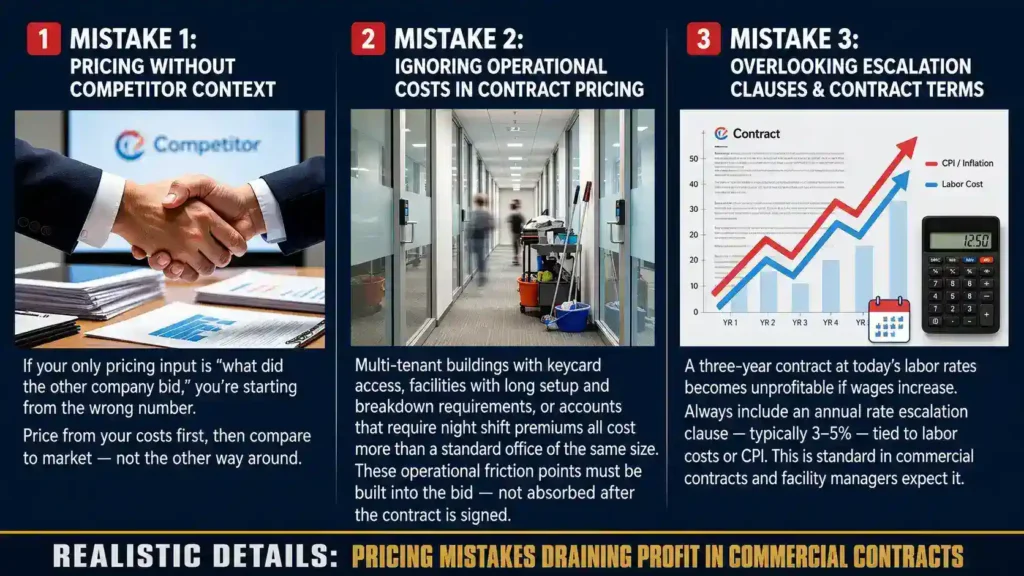
If your only pricing input is ‘what did the other company bid,’ you’re starting from the wrong number. Price from your costs first, then compare to market — not the other way around.
Mistake 2 — Not Accounting for Operational Friction
Multi-tenant buildings with keycard access, facilities with long setup and breakdown requirements, or accounts that require night shift premiums all cost more than a standard office of the same size. These operational friction points must be built into the bid — not absorbed after the contract is signed.
Mistake 3 — Ignoring Contract Escalation Clauses
A three-year contract at today’s labor rates becomes unprofitable if wages increase. Always include an annual rate escalation clause — typically 3-5% — tied to labor costs or CPI. This is standard in commercial contracts and facility managers expect it.
Conclusion
Pricing janitorial services correctly starts with an accurate understanding of what every hour of cleaning truly costs your business — not just the cleaner’s wage. Build your bid from that number upward, use a three-tier presentation, include an escalation clause for multi-year contracts, and track actual time against estimates in the first 90 days of every new account.
The contracts that drain a cleaning business aren’t the ones that were hard to win. They’re the ones that were easy to win because the price was too low. Price for profit from the start, and the accounts you land will still be worth holding 18 months from now.
Winning more walkthroughs to practice your new pricing strategy on? Janitorial Leads Hub delivers verified, exclusive commercial cleaning leads with appointments already set