If you’ve been chasing commercial cleaning contracts around major downtown business districts and growing commercial hubs, you already know that multi-tenant office buildings are the holy grail. Securing just one of these buildings can completely transform your cash flow.
However, multi-tenant layouts are a completely different beast compared to a standard single-occupant warehouse or a small retail shop. If you quote them using a basic square-foot rate, you will either price yourself out of the running or—even worse—underbid, win the contract, and lose your shirt on labor costs.
Here is exactly how to navigate the bidding process, secure high-value office cleaning leads, and structure your quote to land lucrative corporate office cleaning contracts.
The Answer Capsule
To successfully bid on multi-tenant office buildings, you must calculate your quote using a split-zone pricing structure rather than a flat square-foot rate. Separate the communal areas (lobbies, shared elevators, main restrooms) from individual tenant suites, and factor in a 15–20% labor buffer to account for high-traffic wear, security access delays, and tenancy turnover.
1. The Multi-Tenant Trap: Why Standard Bidding Fails
When a property manager puts a multi-tenant corporate building out to tender, they aren’t just looking for someone to empty trash cans. They are looking for an outfit that understands the operational friction of a shared commercial space.
In a single-occupancy building, your cleaners walk in, disarm one alarm, clean the building from front to back, and lock up. In a multi-tenant layout, your team has to deal with:
- Segmented Security: Keying into different floors, managing separate master keys, and handling individual suite alarm codes.
- Variable Clean Times: A financial advisory firm on Level 3 might need pristine, daily high-end detailing, while a tech startup on Level 4 might only want a basic surface wipe down three times a week.
- The Shared Zone Factor: Lobbies, elevator cars, and central stairwells endure massive foot traffic, especially during winter snow slushes or rainy afternoons when everyone stays indoors.
If you don’t account for the minutes lost walking between floors and managing keys, your profit margin will dry up faster than midsummer asphalt.
2. Step-by-Step Bidding Framework for Commercial Buildings
To turn your commercial office leads into signed contracts, use this field-tested walkthrough during your site inspection.
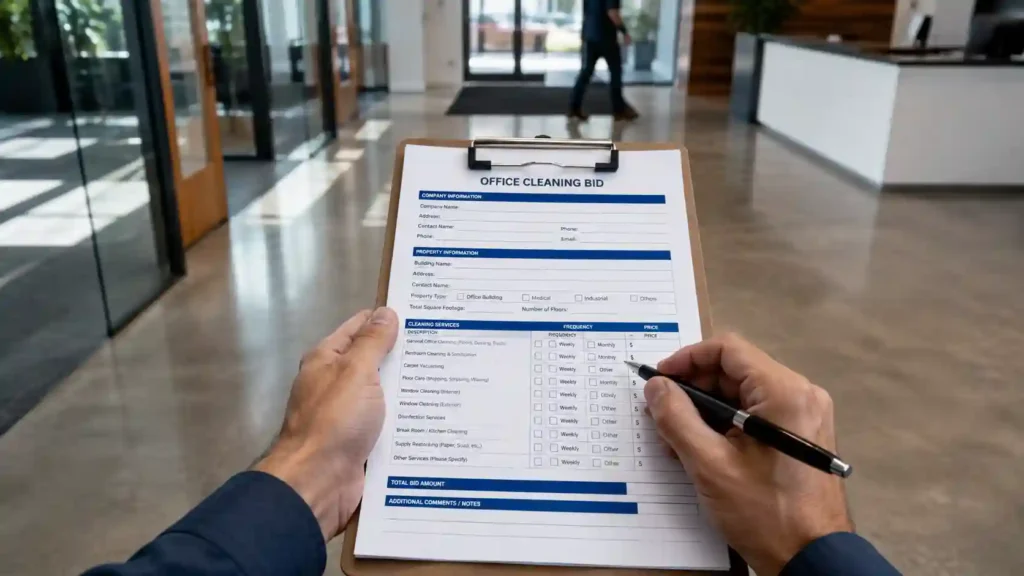
Step 1: The Site Walkthrough & Asset Count
Never submit a blind quote. Walk the site with the property manager or building representative. Note down the exact number of:
- Shared toilet cubicles, urinals, and basins per floor.
- Elevator cars and public glass surfaces.
- Fitness or bike storage facilities (common in modern corporate centers, requiring heavy sanitization).
Step 2: The Split-Zone Calculation
Divide your bid into two distinct categories:
- The Base Building (Property Management Budget): This covers the main foyer, elevators, shared corridors, central restrooms, and external dumpster areas. This is usually billed monthly to the building management.
- The Tenant Suites (Individual Corporate Budgets): These are individual contracts for each business inside the building. If you win the base building contract, you have a massive advantage in picking up these separate corporate office cleaning contracts by offering an “in-house” discount to the tenants.
Step 3: Factoring the Operational Friction Index
Add an extra 10 to 15 minutes per cleaner, per shift, purely for operational lag. Commercial property managers are notoriously strict on security access. If your crew has to wait for a service elevator or badge through multiple checkpoints on every floor, that time must be built into your hourly labor rate.
3. Creating Your Proposal
When presenting your quote, don’t just hand over a sheet with a flat price on it. Use a professional office cleaning bidding template that breaks down your scope of work. Property managers love transparency. Your proposal should clearly separate:
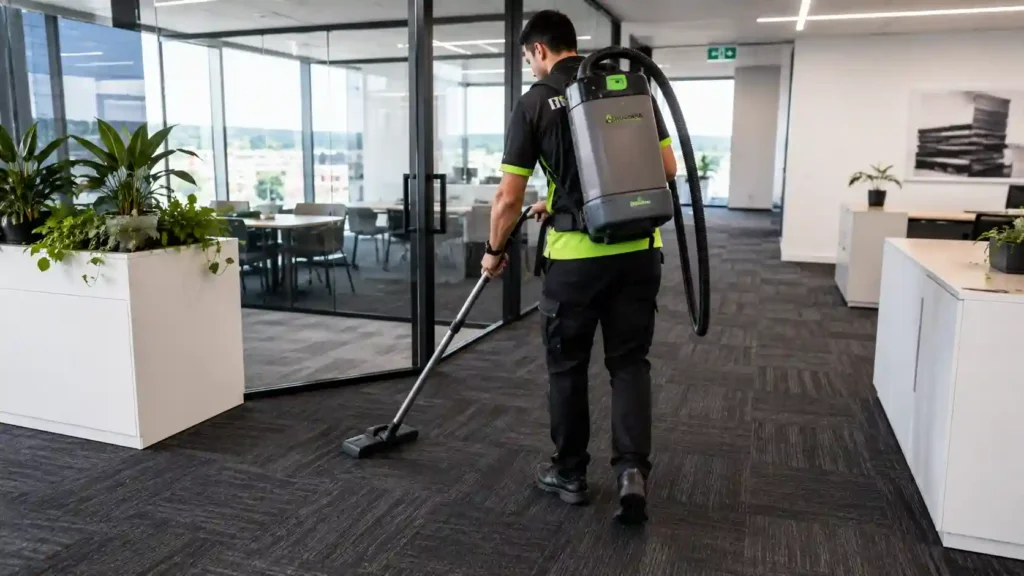
- Daily Scope: Trash rotation, high-touch point sanitization, elevator track vacuuming, and restroom restocking.
- Weekly Scope: Detail dusting, baseboards, and deep carpet vacuuming.
- Periodic Scope: Hard floor burnishing, high-window cleaning, and carpet steam cleaning (typically quoted as optional add-ons to boost your job value).
Show them you have full Workers’ Comp, are fully bonded, and hold a comprehensive General Liability Insurance policy. In the commercial sector, this compliance is non-negotiable.
Frequently Asked Questions
How do you price the shared communal areas in a multi-tenant office building?
Direct Answer: Communal areas should be quoted as a fixed monthly base-building rate billed directly to the property manager or building management company.
You should calculate this by estimating the exact labor hours needed for high-traffic zones like foyers, shared elevators, and common restrooms, then adding a 15% buffer for seasonal weather changes (like extra salt, mud, and water tracked in during the winter months).
What should be included in an office cleaning bidding template for large corporate contracts?
Your bidding template must explicitly break down daily, weekly, and monthly tasks, alongside clear, separated pricing structures for both the base building and individual tenant suites. To look like a true professional to property managers, it should also showcase your compliance documentation upfront—specifically your General Liability Insurance certificate, proof of bonding, and a site-specific safety plan.
How do individual tenant changes affect a long-term corporate office cleaning contract?
Tenant turnover directly impacts your cleaning schedules and security access requirements. Your core agreement with the property manager should remain completely stable for the communal areas, but your individual tenant suite contracts must include a flexible clause. This allows you to adjust or pause services whenever a business moves out or a floor undergoes a fresh commercial build-out.