The janitorial industry has spent decades running on the same playbook — a set route, a checklist, and trust that the crew did what they said. That playbook is changing fast. Buildings now expect proof of work, faster turnaround on problems, and cleaning teams that can show their results instead of just claiming them.
Industry estimates put the global cleaning services market at roughly $442 billion in 2025, with projections climbing toward $770 billion by 2033 — growth that’s increasingly tied to how cleaning companies operate, not just how many buildings they service.
Staffing shortages are pushing this shift along. The U.S. Bureau of Labor Statistics expects about 351,300 janitorial job openings annually through 2034, much of it from people leaving the field rather than new positions being created.
Equipment, software, and data tools are stepping in to help cleaning teams do more with fewer hands — improving consistency, safety, labor planning, and how they report back to clients.
Here’s a look at the 11 trends and technologies actually shaping where janitorial services are headed — and what each one practically means for a commercial cleaning company trying to stay competitive.
1. Sensor-Driven Cleaning Equipment Is Replacing Guesswork
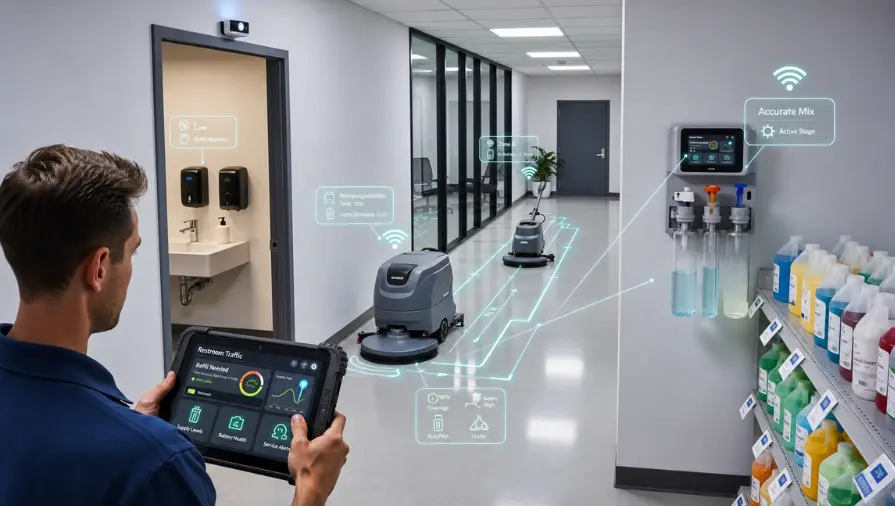
Cleaning equipment built with sensors, automation, and connected data is quickly becoming standard rather than optional. These tools tell a crew exactly where attention is needed, which supplies are running low, and when a machine needs servicing — removing a lot of the guesswork that used to come with fixed cleaning routes.
Restroom traffic sensors, touch-free dispensers, battery-operated vacuums, auto-scrubbers, and chemical dilution systems are now common in facilities that used to rely entirely on manual spot-checks. Industry groups like ISSA point to IoT sensors and cleaning analytics as some of the clearest signs of where the industry is heading — away from routine cleaning and toward cleaning based on actual demand.
| Equipment | What It Actually Does |
|---|---|
| Restroom sensors | Flags traffic, supply levels, and refill timing |
| Connected floor machines | Tracks runtime, coverage area, battery health |
| Dilution control systems | Cuts down on wasted or mismeasured chemicals |
| Touch-free dispensers | Reduces contact points, supports hygiene goals |
None of this replaces a trained cleaner’s judgment. What it does is give that cleaner better timing and fewer repeated mistakes — the technology supports the work, it doesn’t take it over.
2. Robots Are Handling the Repetitive Floor Work
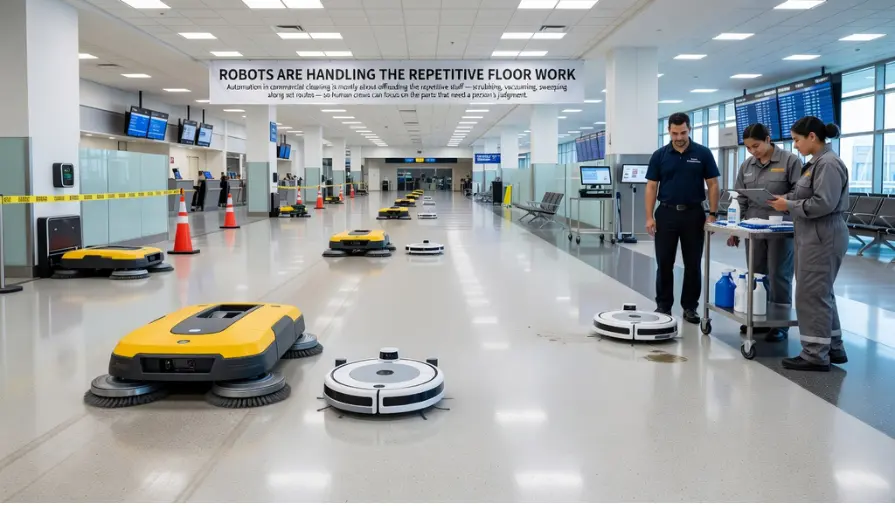
Automation in commercial cleaning is mostly about offloading the repetitive stuff — scrubbing, vacuuming, sweeping along set routes — so human crews can focus on the parts that need a person’s judgment. Robotic scrubbers and autonomous vacuums tend to perform best in large, open, predictable layouts: think airports, warehouses, big retail floors, or hospital corridors.
What robots still can’t do well is judge things a person notices instantly — a lingering odor, a stained corner, a spill that needs immediate attention, or a client complaint that requires a real response. That’s why the strongest setups treat automation as a layer added on top of a trained crew, not a replacement for one.
Getting good results from robotics in cleaning depends on the groundwork: mapped routes, properly trained operators, realistic charging schedules, clear safety protocols, and a manual backup plan for when something doesn’t go as expected.
3. Cleaning Decisions Are Becoming Data-Backed
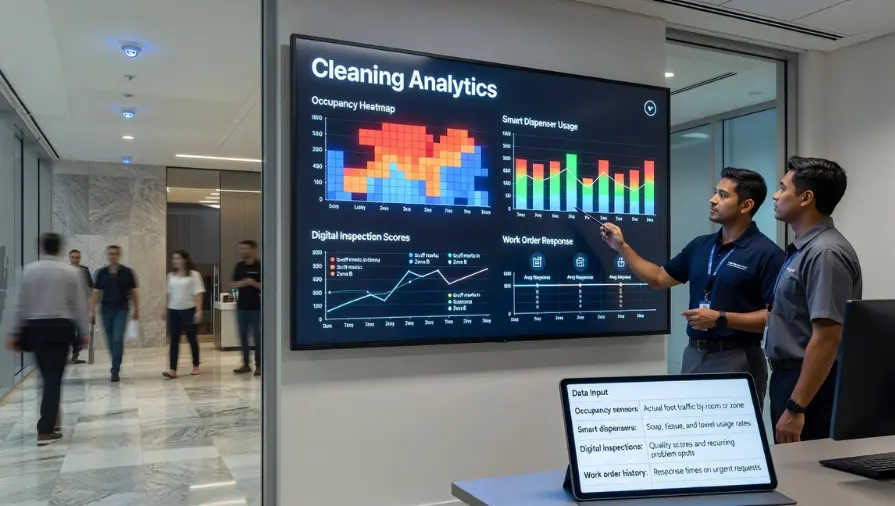
Data-driven cleaning is the practice of using real information from a building — not a fixed weekly schedule — to decide where and how often cleaning happens. A high-traffic lobby clearly needs more frequent attention than a hallway that barely sees foot traffic, and occupancy sensors, inspection history, and supply alerts make that obvious instead of left to guesswork.
This shift directly improves labor planning. Crews spend more time where it’s actually needed and less time over-servicing spaces that don’t require it. ISSA has flagged cleaning analytics dashboards as a meaningful piece of cleaning technology specifically because they hand managers real-time performance data instead of assumptions.
| Data Input | What Managers Learn From It |
|---|---|
| Occupancy sensors | Actual foot traffic by room or zone |
| Smart dispensers | Soap, tissue, and towel usage rates |
| Digital inspections | Quality scores and recurring problem spots |
| Work order history | Response times on urgent requests |
4. Scheduling and Work Orders Are Going Fully Digital
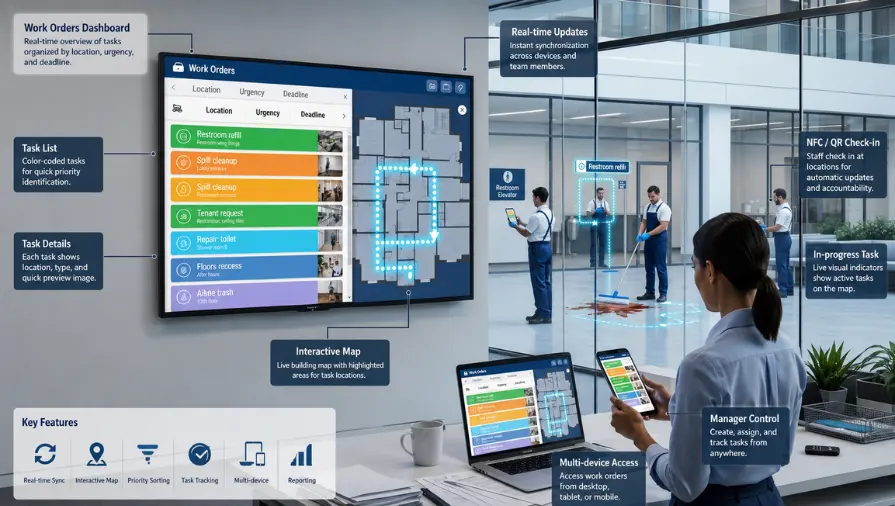
Smart scheduling and digital work order systems are quietly one of the most useful shifts on this entire list. They replace the usual mess of paper notes, group texts, and verbal shift instructions with a single organized workflow that everyone can actually see.
Cleaning needs shift constantly throughout a day — a restroom runs out of supplies, a spill needs immediate cleanup, a tenant calls in an extra request after hours. Digital work orders let a supervisor route the right task to the right person with location, urgency, deadline, and photo confirmation all attached.
Routing tools built into these platforms also save real time in larger buildings, cutting down the minutes crews lose walking between zones that aren’t next to each other.
5. Digital Inspections Are Replacing the Paper Checklist
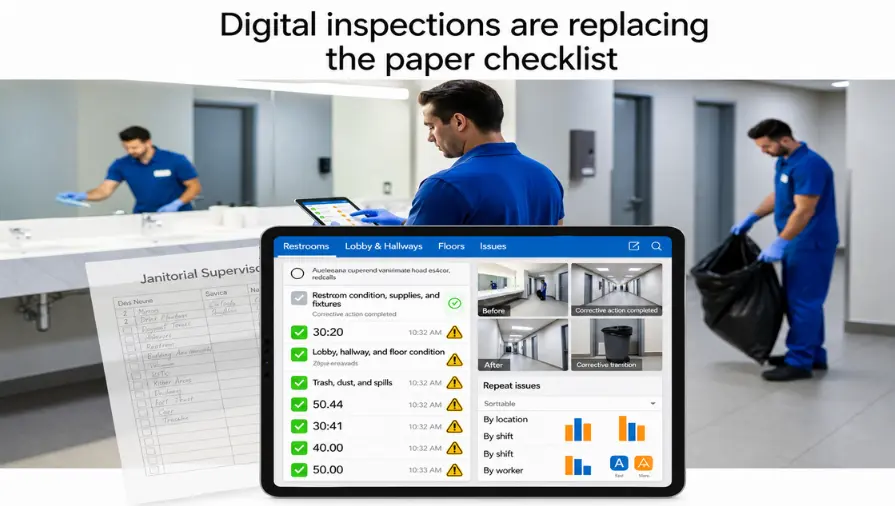
Digital inspection tools let janitorial teams check cleaning quality, document problems, and prove the work happened — with photos, scores, and timestamps that hold up better than a paper checklist ever could. Supervisors, cleaners, and clients can all pull up the same record.
Quality control matters because the small stuff is usually what triggers complaints. A restroom can look fine at a glance while an empty soap dispenser or a streaked mirror quietly shapes a client’s entire opinion of the service.
- Restroom condition, supplies, and fixture status
- Lobby, hallway, and floor condition by zone
- Missed trash, dust buildup, or unaddressed spills
- Photo evidence tied to corrective action notes
- Repeat issues sorted by location, shift, or worker
That last point matters more than it sounds. A pattern of repeated failures in one spot usually points to a scheduling gap or training issue — not one careless cleaner having a bad day.
6. Disinfection Has Become More Science, Less Guesswork
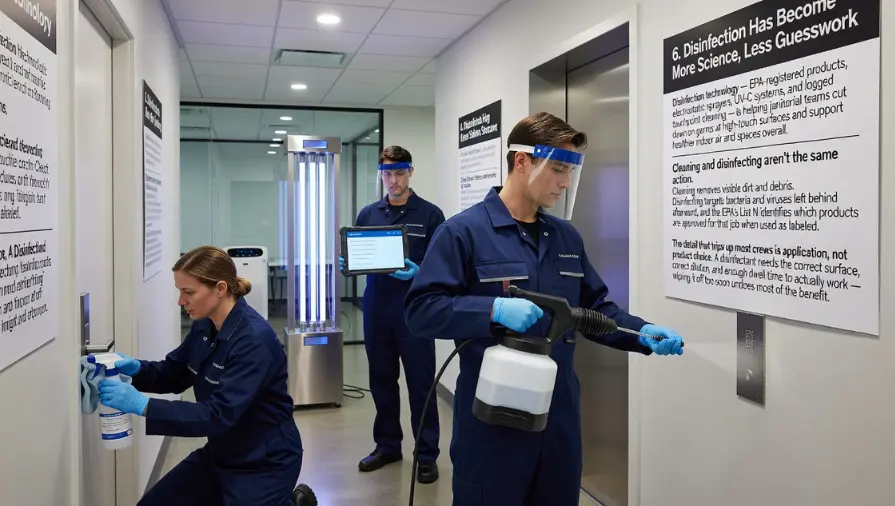
Disinfection technology — EPA-registered products, electrostatic sprayers, UV-C systems, and logged touchpoint cleaning — is helping janitorial teams cut down on germs at high-touch surfaces and support healthier indoor air and spaces overall.
Cleaning and disinfecting aren’t the same action. Cleaning removes visible dirt and debris. Disinfecting targets bacteria and viruses left behind afterward, and the EPA’s List N identifies which products are approved for that job when used as labeled.
The detail that trips up most crews is application, not product choice. A disinfectant needs the correct surface, correct dilution, and enough dwell time to actually work — wiping it off too soon undoes most of the benefit.
7. Sustainability Is Showing Up in Cleaning Innovation
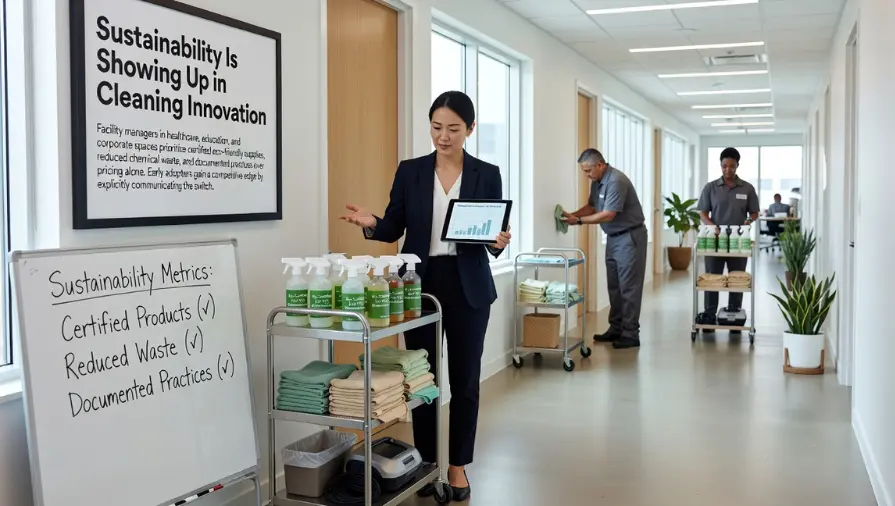
Green cleaning has moved well past being a marketing checkbox. Facility managers — particularly in healthcare, education, and corporate spaces with public sustainability goals — are increasingly asking about certified products, reduced chemical waste, and documented sustainable practices before they even discuss pricing.
This shift rewards cleaning companies willing to make the switch early. Certified eco-friendly supplies typically don’t cost dramatically more than standard products, but very few janitorial businesses mention the switch explicitly in their pitch — which makes saying it out loud a real point of difference.
8. Client Reporting Has Become Part of the Service Itself
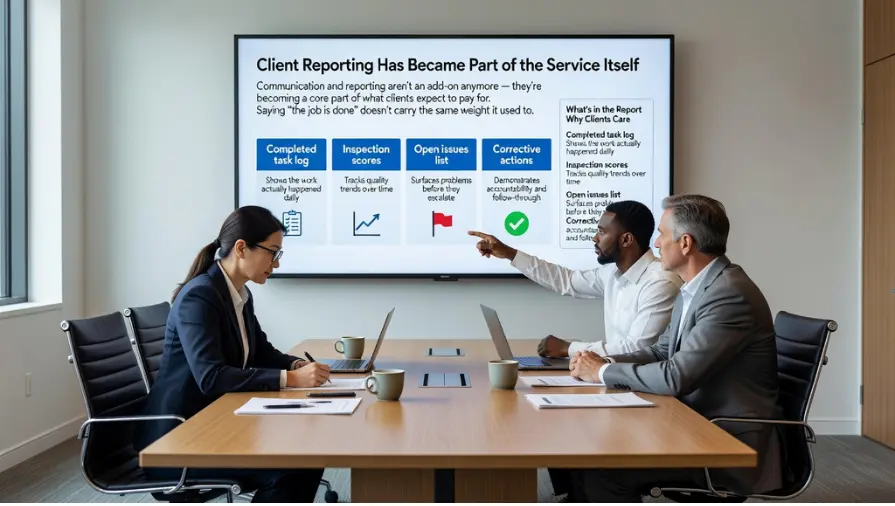
Communication and reporting aren’t an add-on anymore — they’re becoming a core part of what clients expect to pay for. Saying “the job is done” doesn’t carry the same weight it used to.
Facility managers want to see what got cleaned, when it happened, and what issues are still open.
Sharing inspection scores, completed task logs, open issues, and corrective actions matters most in offices, schools, healthcare facilities, and multi-site accounts where a missed task can quickly turn into a safety or satisfaction problem.
| What’s in the Report | Why Clients Care |
|---|---|
| Completed task log | Shows the work actually happened daily |
| Inspection scores | Tracks quality trends over time |
| Open issues list | Surfaces problems before they escalate |
| Corrective actions | Demonstrates accountability and follow-through |
9. Training and Safety Tools Are Moving to Mobile
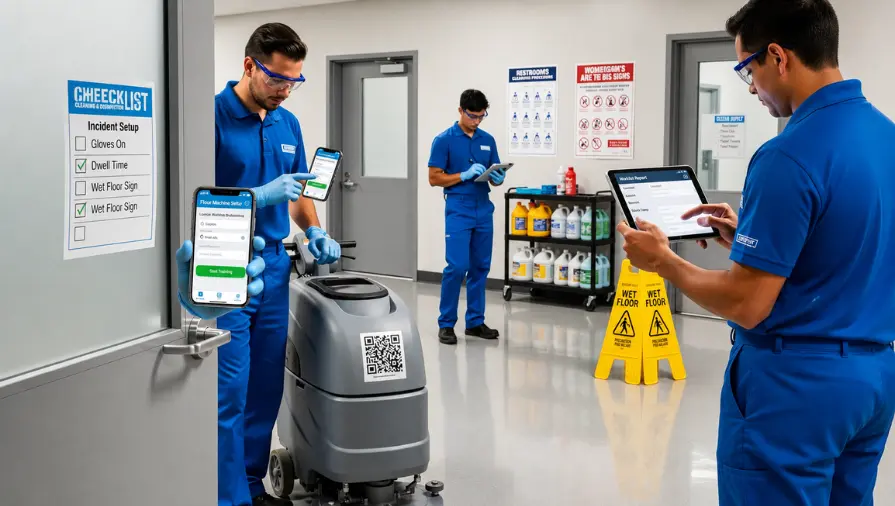
Workforce training and safety technology — mobile training modules, QR-code linked SOPs, digital safety checklists, and incident reporting apps — are helping janitorial teams stay consistent and safe across multiple sites without relying on memory from a single orientation day.
The work itself carries real risk. Cleaners regularly handle chemicals, work around wet floors, operate heavy machines, and sometimes work night shifts alone.
OSHA requires employers to train staff on these hazards — chemical safety, PPE use, equipment handling, emergency response — and digital tools are making that training easier to deliver in the moment it’s actually needed.
- A QR code near a floor machine pulls up the correct setup instantly
- Restroom checklists confirm dwell time, glove use, and signage requirements
- Mobile incident reports get issues to a supervisor faster than a phone call chain
10. Data Privacy Has Entered the Cleaning Industry
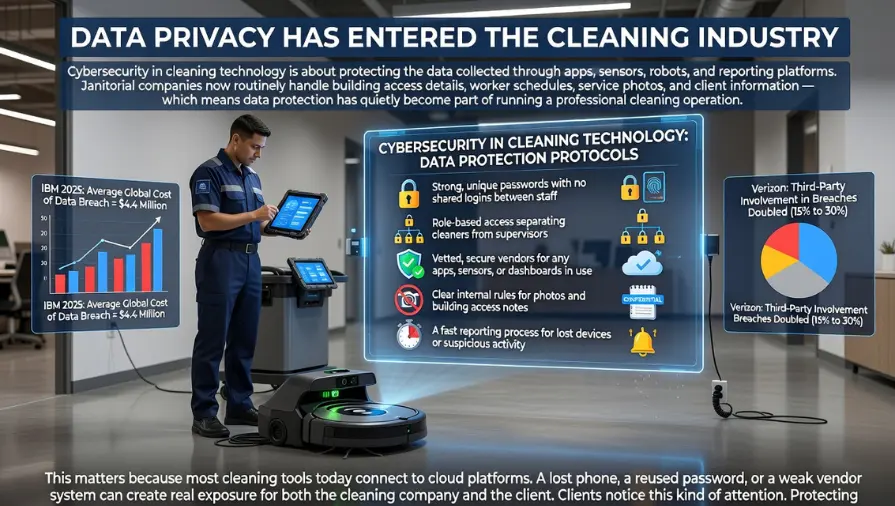
Cybersecurity in cleaning technology is about protecting the data collected through apps, sensors, robots, and reporting platforms. Janitorial companies now routinely handle building access details, worker schedules, service photos, and client information — which means data protection has quietly become part of running a professional cleaning operation.
This matters because most cleaning tools today connect to cloud platforms. A lost phone, a reused password, or a weak vendor system can create real exposure for both the cleaning company and the client.
IBM’s 2025 data put the average global cost of a data breach at $4.4 million, and Verizon found that third-party involvement in breaches roughly doubled — from 15% to 30% — in the same period.
- Strong, unique passwords with no shared logins between staff
- Role-based access separating cleaners from supervisors
- Vetted, secure vendors for any apps, sensors, or dashboards in use
- Clear internal rules for photos and building access notes
- A fast reporting process for lost devices or suspicious activity
Clients notice this kind of attention. Protecting service records and building information with the same care given to cleaning quality builds a different level of trust.
11. Cost and ROI Decisions Are Getting More Scrutiny
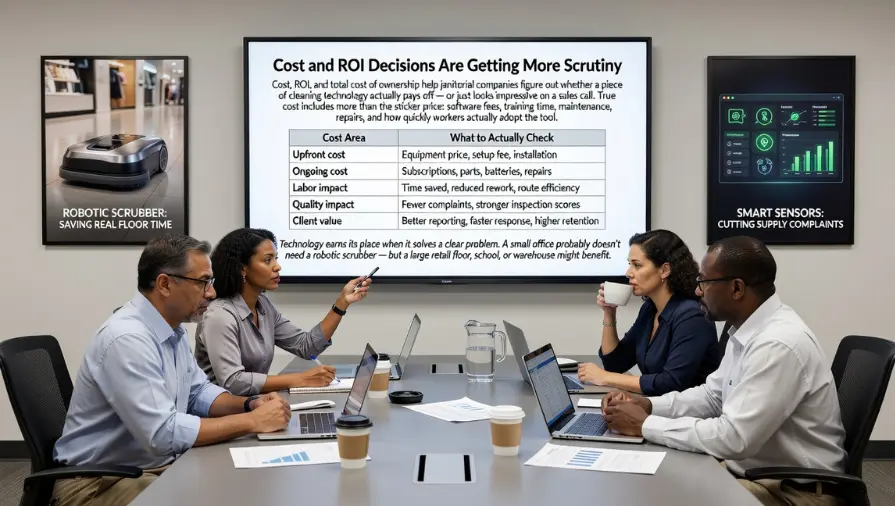
Cost, ROI, and total cost of ownership help janitorial companies figure out whether a piece of cleaning technology actually pays off — or just looks impressive on a sales call. True cost includes more than the sticker price: software fees, training time, maintenance, repairs, and how quickly workers actually adopt the tool.
A cheaper tool that breaks down often or slows a crew down can end up costing more over a year than a pricier option with better support and fewer interruptions. The real return on cleaning technology tends to come from practical gains — a robotic scrubber saving real floor-cleaning time, smart sensors cutting supply complaints, or scheduling software reducing the number of frantic supervisor calls.
| Cost Area | What to Actually Check |
|---|---|
| Upfront cost | Equipment price, setup fee, installation |
| Ongoing cost | Subscriptions, parts, batteries, repairs |
| Labor impact | Time saved, reduced rework, route efficiency |
| Quality impact | Fewer complaints, stronger inspection scores |
| Client value | Better reporting, faster response, higher retention |
Technology earns its place when it solves a clear problem. A small office probably doesn’t need a robotic scrubber — but a large retail floor, school, or warehouse might benefit significantly. Site size, layout, traffic, and cleaning frequency should all factor into whether the investment actually makes sense.
How to Roll Out New Cleaning Technology Without Disrupting Daily Work
Cleaning technology works best when it’s introduced in stages, not all at once. A smooth rollout starts by understanding current performance, testing the tool in one area, and expanding only once it proves real results — protecting day-to-day service quality while management figures out whether the tool genuinely helps.
New technology tends to fail when the process around it is vague. A robot, sensor, inspection app, or scheduling platform needs trained staff, clear ownership, and a defined goal — without that structure, it just becomes another task layered on top of the work instead of something that actually fixes a problem.
Step 1: Establish a Baseline Before Buying Anything
Measure current performance before introducing new technology — complaint frequency, inspection scores, labor hours, supply usage, equipment downtime, and response time all work as useful starting points. If restroom complaints spike after lunch, smart restroom sensors might help. If floor cleaning takes too long in a warehouse, a robotic scrubber might be worth testing.
Step 2: Pilot the Tool in One Zone First
Test new technology in a controlled, busy area before deploying it site-wide. A pilot running about 30 days gives a realistic picture, since cleaning demand naturally shifts with traffic, events, weather, and work schedules.
| Technology Being Tested | Metric to Watch |
|---|---|
| Smart restroom sensors | Drop in supply-related complaints |
| Robotic scrubber | Reduction in floor cleaning time |
| Digital inspections | Improvement in inspection scores |
| Work order app | Faster response to issues |
Step 3: Train the Team and Lock the Process
Training is what turns new technology into an actual daily habit rather than something workers avoid. Staff need to know how to use the tool, report problems, follow safety steps, and complete tasks consistently across every shift.
Supervisors need training too — dashboards and reports only create value if someone is actually reviewing and acting on them.
Step 4: Scale Gradually and Review Monthly
Expansion should only happen once the pilot has proven its value. Scaling tends to go more smoothly when similar sites are chosen first, with the process adjusted slightly for each new building.
Monthly reviews of complaints, labor time, inspection scores, supply waste, and response speed keep the rollout grounded in actual results rather than assumptions.
Frequently Asked Questions Janitorial Trend and Technology
1. What is the future of janitorial services?
The future of janitorial services is increasingly technology-supported rather than purely manual. Smart equipment, robotics, digital inspections, green cleaning practices, and data dashboards are helping cleaning teams improve consistency, safety, labor planning, and client communication — without replacing the trained workers who still handle judgment-based work.
2. How is technology changing janitorial services?
Technology is making cleaning operations more data-driven, trackable, and efficient overall. Sensors, robots, mobile apps, and inspection tools are letting teams clean based on actual building usage instead of fixed routes that treat every space the same way, regardless of demand.
3. Will robots eventually replace janitorial workers?
Not in any complete sense. Robots and automation handle repetitive tasks well — floor scrubbing, vacuuming, route-based cleaning — but they can’t judge odor, restroom condition, spills, clutter, or client complaints the way a trained person can. The realistic outcome is robots supporting crews on repetitive work while people continue handling detail and judgment-based cleaning.
4. What cleaning technologies are most commonly used in commercial janitorial services today?
Commercial janitorial operations are increasingly using smart sensors, robotic scrubbers, autonomous vacuums, digital inspection apps, work order software, chemical dilution systems, UV-C disinfection tools, air quality sensors, and client-facing reporting dashboards — though adoption varies heavily based on facility size and type.
5. How do smart sensors actually help a janitorial team day to day?
Smart sensors help janitorial teams track restroom traffic, supply levels, odor concerns, and overall occupancy patterns in real time. This lets crews respond faster, reduce wasted cleaning passes, prevent complaints before they happen, and focus attention on high-use areas at the right time instead of guessing.
Conclusion
The future of janitorial services isn’t really about swapping people out for machines — it’s about giving cleaning teams sharper tools, better information, better training, and a clearer way to prove the quality of their work. Smart equipment, robotics, digital inspections, green cleaning, disinfection technology, client reporting, and workforce safety tools are already reshaping how commercial cleaning operates day to day.
The janitorial companies that come out ahead will be the ones who adopt these tools thoughtfully, measure the actual results, and keep their workers at the center of the process instead of treating technology as a replacement for good people.
Cleaning technology earns its place when it solves a real problem. A company that starts with a clear pain point, tests one zone, trains its team properly, and reviews monthly results will improve service without throwing daily operations into chaos.