Every commercial cleaning business owner reaches a point where word-of-mouth and referrals aren’t enough to sustain the growth they’re after. At that point, investing in a professional lead generation service becomes a logical next step — and almost immediately, a question comes up that doesn’t have a single obvious answer.
Pay per lead or subscription? Both models promise a pipeline of new prospects.
Both have their advocates. And depending on how your business is structured, which stage of growth you’re in, and what your cash flow looks like, the right answer can be genuinely different from one company to the next.
This guide breaks down exactly how both models work, where each one delivers value, and which one tends to produce better results for janitorial and commercial cleaning businesses — based on how the industry actually operates, not just how these services market themselves.
How Each Model Works
What Is Pay Per Lead?
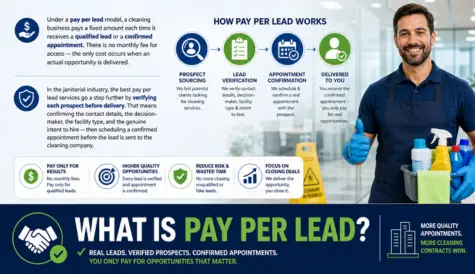
Under a pay per lead model, a cleaning business pays a fixed amount each time it receives a qualified lead or a confirmed appointment. There is no monthly fee for access — the only cost occurs when an actual opportunity is delivered.
In the janitorial industry, the best pay per lead services go a step further by verifying each prospect before delivery. That means confirming the contact details, the decision-maker, the facility type, and the genuine intent to hire — then scheduling a confirmed appointment before the lead is sent to the cleaning company.
What Is a Subscription Model?
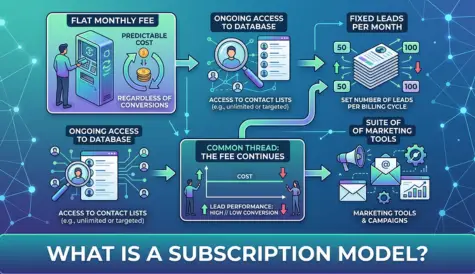
A subscription-based lead service charges a flat monthly fee in exchange for ongoing access to a database of contacts, a set number of leads per month, or a suite of marketing tools and campaigns. The cost stays the same regardless of how many leads convert.
Some subscription services offer unlimited access to contact lists. Others promise a fixed number of leads per billing cycle. The common thread is that the fee continues whether the leads perform well or not.
Side-by-Side Comparison of Pay Per Lead vs Subscription Cleaning
| Factor | Pay Per Lead | Subscription | Winner |
| Upfront cost | None | Monthly fee required | Pay Per Lead ✅ |
| Cost during slow months | Zero — no leads, no cost | Flat fee continues | Pay Per Lead ✅ |
| Lead exclusivity | Exclusive (quality providers) | Often shared | Pay Per Lead ✅ |
| Lead quality control | Verified before delivery | Varies widely | Pay Per Lead ✅ |
| Volume flexibility | Scale up or down freely | Capped by plan tier | Pay Per Lead ✅ |
| Cost predictability | Variable per lead | Fixed monthly cost | Subscription ✅ |
| Access to contact database | No direct database access | Often included | Subscription ✅ |
| Best for established volume | High-converting niches | High-volume outreach | Depends |
The Real Case for Pay Per Lead
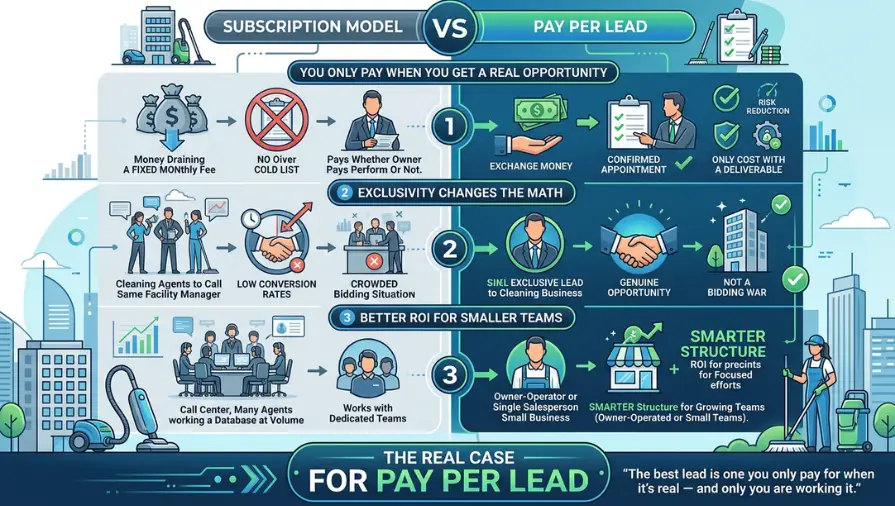
For the majority of commercial cleaning businesses — particularly those in the growth phase between a handful of accounts and a full-scale operation — pay per lead consistently outperforms subscription models. Here’s why.
1. You Only Pay When You Get a Real Opportunity
This is the single most significant advantage. A subscription charges you whether the leads perform or not.
If your contact list goes cold, if the quality dips one month, or if your team simply doesn’t have capacity to follow up on every name in the database, the fee still hits your account.
Pay per lead eliminates that risk entirely. There is no cost without a deliverable — and with a high-quality provider, that deliverable is a confirmed appointment with a real decision-maker, not just a name and a phone number.
2. Exclusivity Changes the Math
One of the most common frustrations with subscription-based lead databases is that the same contacts are being worked by multiple cleaning companies simultaneously. When five cleaners are all reaching out to the same facility manager, the conversion rate drops and the close rate suffers.
Exclusive pay per lead arrangements eliminate that problem. When a lead comes to you, it goes to you only — meaning the appointment you walk into is a genuine opportunity, not a competitive bidding situation triggered by a shared database.
3. Better ROI for Smaller Teams
A subscription service often makes more financial sense when a business has a dedicated sales team that can work a large database at volume. For most janitorial businesses — where the owner or one salesperson handles client acquisition alongside everything else — paying only for what actually comes through the door is simply the smarter structure.
“The best lead is one you only pay for when it’s real — and only you are working it.”
When a Subscription Model Makes Sense
Subscription-based services aren’t without merit. There are specific situations where the fixed monthly model does offer genuine advantages.
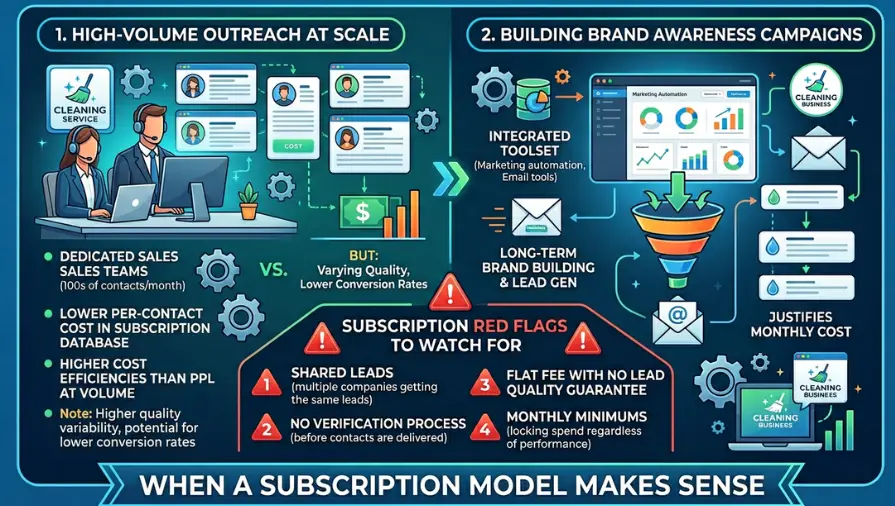
1. High-Volume Outreach at Scale
If a cleaning business has a dedicated outbound sales team that can work hundreds of contacts per month, a subscription database can deliver cost efficiencies that pay per lead cannot match at volume. The per-contact cost in a subscription database is typically lower — the trade-off is that quality varies and conversion rates tend to be lower as a result.
2. Building Brand Awareness Campaigns
Some subscription platforms include marketing automation, email campaign tools, and drip sequences. For businesses investing in longer-term brand awareness alongside direct lead generation, this kind of integrated toolset can justify the monthly cost.
The Subscription Red Flags to Watch For
- Shared leads sold to multiple companies simultaneously
- No verification process before contacts are delivered
- Flat fee with no lead quality guarantee
- Monthly minimums that lock in spend regardless of performance
What the Numbers Say
The cost of commercial cleaning leads varies significantly by source and model:
- Shared leads from subscription databases — typically on the lower end per contact
- Exclusive verified leads with appointment setting — higher cost per lead but significantly higher conversion rates
- Google Local Services Ads — pay per call/lead model with strong local intent
- Organic SEO leads — near-zero marginal cost after initial investment, highest long-term ROI
The key metric isn’t cost per lead — it’s cost per signed contract. A lower-cost lead that converts at a low rate is almost always more expensive in total than a higher-cost lead that converts at a high rate.
A cleaning company that closes 40% of appointment-set, exclusive leads is generating far more revenue per dollar spent than one closing 10% of a shared database — even if the database subscription cost is a fraction of the per-lead price.
How to Choose the Right Model for Your Business
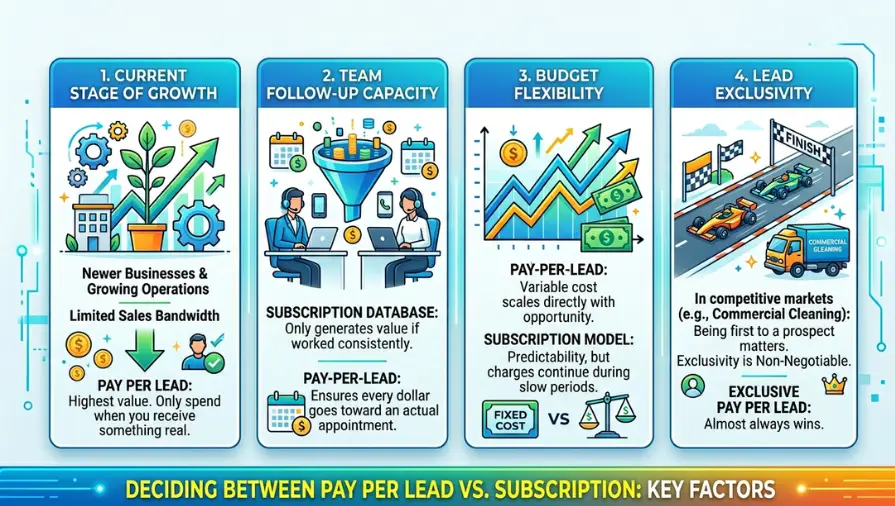
The decision between pay per lead and subscription comes down to four practical factors:
1. Your Current Stage of Growth
Newer businesses and growing operations with limited sales bandwidth get the most value from pay per lead. Only spend when you receive something real.
2. Your Team’s Follow-Up Capacity
A subscription database only generates value if someone is working it consistently. If your team can’t commit to high-volume outreach, a pay per lead model ensures every dollar spent goes toward an actual appointment.
3. Your Budget Flexibility
Pay per lead is inherently variable — which can feel uncertain, but also means cost scales directly with opportunity. Subscription models offer predictability but continue charging during slow periods.
4. Lead Exclusivity Requirements
If you’re in a competitive market where being first to a prospect matters — and in commercial cleaning, it almost always does — exclusivity is non-negotiable. Pay per lead with an exclusive model almost always wins here.
Conclusion
For most commercial cleaning and janitorial businesses actively working to grow their client base, pay per lead is the better model.
It aligns cost directly with value delivered, ensures exclusivity, eliminates the risk of paying during slow months, and — whensourced from a quality provider — delivers verified, appointment-ready prospects instead of raw contact lists.
Subscription models have their place — particularly for high-volume operations with dedicated sales teams — but for the majority of cleaning businesses in growth mode, paying only when a real opportunity arrives is simply the smarter financial decision.
To learn more about who we are and how we deliver leads, visit our about page.
“Don’t pay for access to a database. Pay for a real appointment with a real decision-maker who is expecting your call.”