Going from 3 clients to 30 is one of the toughest jumps a janitorial business owner will ever make — and it’s rarely about working harder. Most cleaning business owners hit a ceiling not because the demand isn’t there, but because the way they’re running things at 3 clients simply can’t carry 30.
The short answer: scaling a janitorial business comes down to seven things working together — a mindset shift, real systems, your first hires, smart territory expansion, a lead generation strategy that doesn’t depend on you personally, the right CRM tools, and a shift toward recurring revenue. Get those right, and 30 clients stops feeling impossible.
Let’s break down each piece in plain terms — no fluff, just what actually moves a janitorial business growth strategy forward.
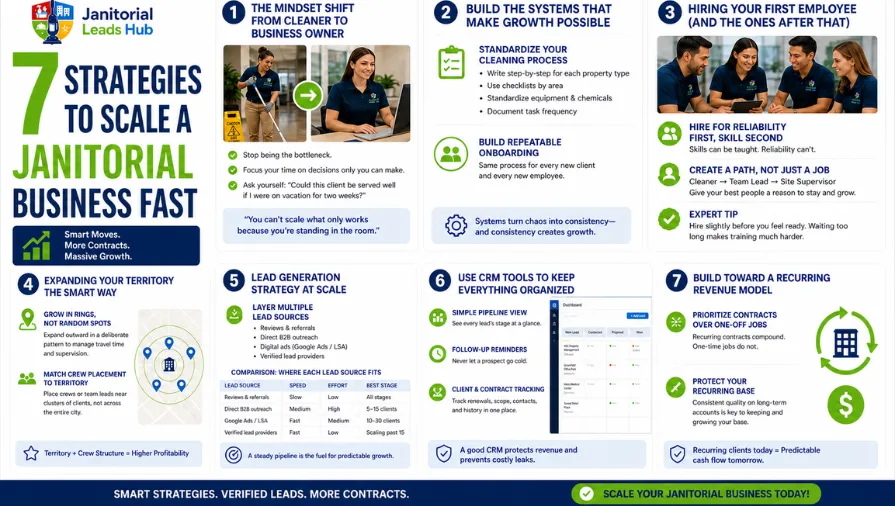
1. The Mindset Shift From Cleaner to Business Owner
Every cleaning business owner starts as the cleaner. You’re the one in the building, mop in hand, making sure the job gets done right. That’s how you earned your first 3 clients — and it’s also the exact thing that will cap your growth if it doesn’t change.
Stop Being the Bottleneck
If every job has to go through you — every checklist, every client call, every quality check — your business can only grow as fast as your personal calendar allows. Scaling a commercial cleaning company means accepting that your time is better spent on decisions only you can make.
A Simple Way to Think About It
Ask yourself: ‘Could this client be served well if I were on vacation for two weeks?’ If the answer is no, that’s the gap your systems and team need to close.
“You can’t scale what only works because you’re standing in the room.”
2. Build the Systems That Make Growth Possible
Systems are what let your business run the same way whether you’re there or not. Without them, every new client adds stress instead of revenue — with them, every new client just plugs into a process that already works.
Standardize Your Cleaning Process
Write down exactly how each type of property should be cleaned — offices, medical spaces, retail units — step by step. This becomes your training manual, your quality benchmark, and your safety net all at once.
- Create checklists by area: entryways, restrooms, common areas, offices
- Standardize the equipment and chemicals used across every site
- Document how often each task should be done — daily, weekly, monthly
Build Repeatable Onboarding
Every new client and every new employee should follow the same onboarding process. This is one of the most overlooked janitorial business systems — but it’s what keeps quality consistent as you grow faster than you can personally oversee.
3. Hiring Your First Employee (And the Ones After That)
Hiring your first cleaning employee is a milestone — and also one of the most nerve-wracking steps for any owner used to doing everything themselves. But this is exactly where scaling begins to feel real.
Hire for Reliability First, Skill Second
Cleaning skills can be taught through your standardized checklists. Reliability — showing up on time, following instructions, communicating problems — is much harder to teach. Prioritize it in every hire.
Create a Path, Not Just a Job
The owners who scale smoothly build a simple career path: cleaner, then team lead, then site supervisor. This gives your best people a reason to stay — and gives you people you can delegate real responsibility to as you grow.
Expert Tip
Hire slightly before you feel ready. Waiting until you’re completely overwhelmed means training a new employee while you’re already stretched thin — which almost never goes well.
4. Expanding Your Territory the Smart Way
More clients often means a wider service area — but expanding too fast, too far, can quietly destroy your margins through drive time, fuel costs, and supervision gaps.
Grow in Rings, Not Random Spots
As you expand into new areas, targeting the right facility types matters. We provide verified leads across 50+ industries across the USA — so you can grow into new sectors without starting from scratch.
Match Crew Placement to Territory
As you expand, place small crews or team leads close to clusters of clients rather than sending one crew across the whole city. This is where territory expansion and your crew structure need to grow together — not separately.
5. Lead Generation Strategy at Scale
At 3 clients, referrals and word-of-mouth might be enough. At 30, you need a lead generation for cleaning companies strategy that brings in new opportunities every single week — predictably, not by chance.
Layer Multiple Lead Sources
- Reviews and referrals — ask every happy client for a Google review and a referral
- Direct B2B outreach — consistent contact with property managers and local businesses
- Digital ads — Google Ads or Local Service Ads targeting active searchers
- Verified lead providers — a steady supply of pre-qualified, appointment-ready prospects
Comparison: Where Each Lead Source Fits
| Lead Source | Speed | Effort | Best Stage |
| Reviews & referrals | Slow | Low | All stages |
| Direct B2B outreach | Medium | High | 5-15 clients |
| Google Ads / LSA | Fast | Medium | 10-30 clients |
| Verified lead providers | Fast | Low | Scaling past 15 |
As your crew and systems grow, your time for outreach shrinks. This is exactly where a verified janitorial lead provider helps most — delivering appointment-ready prospects so your pipeline doesn’t dry up while you’re focused on operations.
6. Use CRM Tools to Keep Everything Organized
Once leads, clients, and employees start multiplying, sticky notes and memory stop working. A CRM for janitorial business operations keeps every prospect, proposal, and client follow-up in one place — so nothing falls through the cracks.
What to Look For
- Simple pipeline view — see every lead’s stage at a glance
- Follow-up reminders — so prospects never go cold from forgetfulness
- Client and contract tracking — renewal dates, scope notes, contact history
Why This Matters for Growth
A good CRM doesn’t just organize information — it protects revenue. Missed follow-ups and forgotten renewals are quiet leaks that become expensive once you’re managing 20+ accounts.
7. Build Toward a Recurring Revenue Model
The real goal behind scaling isn’t just more clients — it’s predictable, recurring commercial cleaning contracts that give your business a stable foundation month after month.
Prioritize Contracts Over One-Off Jobs
One-time jobs are useful for cash flow, but they don’t compound. Recurring contracts do — every signed client adds to a base that keeps generating revenue without new sales effort each month.
Protect Your Recurring Base
As you scale, your existing recurring clients are your most valuable asset. Quality slips on long-term accounts are one of the fastest ways to undo months of growth — which is exactly why the systems and hiring pieces above matter so much.
Conclusion
Scaling a janitorial business from 3 clients to 30 isn’t one big leap — it’s seven smaller shifts happening together. The mindset to step back from daily cleaning, systems that keep quality consistent, your first reliable hires, smart territory growth, a lead generation strategy that runs without you, CRM tools to stay organized, and a recurring revenue base that compounds over time.
Get those moving in the same direction, and 30 clients becomes a natural milestone — not a wall you keep running into.